Overview
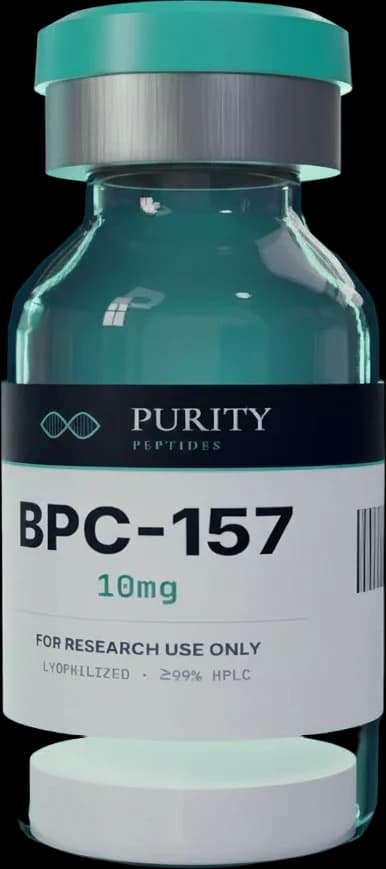
BPC-157 is a synthetic 15-amino-acid peptide whose sequence corresponds to a fragment of a larger protein originally described in human gastric juice. The name stands for "body protection compound", reflecting the cytoprotective activity reported for it in early gastrointestinal experiments. Most of the published literature originates from a research group in Zagreb, Croatia, and spans several decades of animal work.
in vitro studies and animal models.">Preclinical studies have examined the peptide in rodent models of tendon transection, ligament and muscle injury, bone defects, and lesions of the stomach and intestine induced by alcohol or NSAIDs. Reported outcomes include faster structural recovery and changes in blood-vessel formation. Controlled human data, however, remain very limited, and no regulator has approved BPC-157 for any use. It is included on the WADA Prohibited List as a non-approved substance and is offered here exclusively for in-vitro and animal research.
Mechanism studied
- BPC-157
- Fibroblasts & endothelium
- VEGFR2 / NO signalling
- Tissue remodelling
The mechanism of BPC-157 is not fully defined. Cell and rodent studies point to several pathways: upregulation of VEGFR2 expression and downstream signalling linked to angiogenesis, interaction with the nitric oxide system, and activation of FAK–paxillin signalling that promoted tendon fibroblast outgrowth and migration in vitro. Other work reported increased growth hormone receptor expression in tendon fibroblasts. The peptide is described as unusually stable in gastric juice, which is why both oral and parenteral routes have been explored in animal experiments.
Research highlights
- 01Evidence base is overwhelmingly preclinical, largely from a single research group
- 02Studied in rodent tendon, ligament, muscle, bone and gastrointestinal injury models
- 03In-vitro work links the peptide to VEGFR2, nitric oxide and FAK–paxillin signalling
- 04An early clinical programme for inflammatory bowel disease was not carried to approval
- 05Listed by WADA as a non-approved substance (S0)
Research areas
- Tendon & ligament models
- Gastrointestinal mucosa research
- Angiogenesis signalling
- Muscle injury models
Evidence & regulatory status
Overall status: Not approved — research
Key references
- [1]Sikiric et al., 2018 — Curr Pharm Des (review)
- [2]Gwyer et al., 2019 — Cell Tissue Res (review)
- [3]PubMed — reviews on BPC-157 and tissue repair
- [4]WADA — Prohibited List of Substances and Methods
Latest published research
316 papers on PubMed →Efficient Expression of Small Molecule Bioactive Peptides in Bacillus licheniformis
Zhang H et al. · Applied biochemistry and biotechnology · 2026 Nov · PMID 42667535
Investigational Peptides in Orthopaedic Practice: Evidence, Safety, and Patient Counseling for BPC-157, Thymosin Beta-4, and TB-500
Tham A et al. · The Journal of the American Academy of Orthopaedic Surgeons · 2026 Oct 27 · PMID 42937313
Helically Chiral Tetradentate Pt(II) Emitters via Efficient Diastereoselective Synthesis for High-Performance Deep-Blue CP-PhOLEDs
Xu K et al. · Angewandte Chemie (International ed. in English) · 2026 Oct 19 · PMID 42649603
Human evidence for BPC-157 in orthopaedic and regenerative medicine: a systematic review of efficacy and safety
Poolton JT et al. · Acta orthopaedica Belgica · 2026 Oct 8 · PMID 42885452
Possibilities for Cytoprotective Liver Therapy, Stable Gastric Pentadecapeptide BPC 157, and Standard Agents-A Narrative Review
Sever M et al. · Pharmaceuticals (Basel, Switzerland) · 2026 Oct 1 · PMID 42943255
Synergistic Effects of Shewanella algae A3 and Serratia marcescens Van80 UB3 on Immune Response, Gene Expression and Resistance to Vibrio parahaemolyticus Vp5 in Pacific White Shrimp
Sutanti S et al. · Journal of fish diseases · 2026 Oct · PMID 42093608
Case Report: Regenerative peptides for Inferior alveolar nerve injury: a narrative review with hypothesis-generating three clinical cases
Froum S et al. · Frontiers in oral health · 2026 · PMID 42876687
BPC 157 in Rodent Ischemia-Reperfusion Injury: A Critical Review of Preclinical Evidence
Demirtaş H et al. · International journal of molecular sciences · 2026 Sep 19 · PMID 42794771
Live feed from PubMed (NCBI) for “BPC-157”, updated 2026-10-30. Listing a paper is not an endorsement of its findings.
Registered studies
4 on ClinicalTrials.gov →- Not yet recruitingPhase 1
Impact of BPC-157 on Recovery Following Rotator Cuff Repair Surgery
NCT07803250 · University of Arkansas · 2027-01-01
- Completed
A Clinical Trial to Evaluate the Effects of Peptide Gummies on Markers of Inflammation, Physical Performance, and Recovery
NCT07752381 · Parlay Wellness · 2025-09-01
- RecruitingPhase 2
BPC 157 for Acute Hamstring Muscle Strain Repair
NCT07437547 · Hudson Biotech · 2026-02-02
- UnknownPhase 1
PCO-02 - Safety and Pharmacokinetics Trial
NCT02637284 · PharmaCotherapia d.o.o. · 2015-10
From the public ClinicalTrials.gov registry for “BPC-157”, updated 2026-10-30. Shown for research context only; Purity Peptides products are not for human use.
FAQ
Published human data are sparse and consist mostly of small or uncontrolled reports. The bulk of the literature comes from rodent injury models and cell culture. BPC-157 is not approved by any major regulator and is sold here only as a research compound.
Lyophilized BPC-157 is normally kept sealed at −20 °C, protected from light and moisture. Once reconstituted for laboratory work, aliquots are held at 2–8 °C for short-term use or frozen, avoiding repeated freeze–thaw. Follow the lot-specific guidance on the certificate of analysis.
Every lot of BPC-157 ships with a certificate of analysis reporting HPLC purity, mass-spectrometry identity against the expected molecular weight, appearance and lot number. Match the COA lot to the vial label and keep it with your experimental records.
Last updated October 2026 · Reviewed by the Purity Peptides research team · Information is a summary of published literature and is not a recommendation for any use.