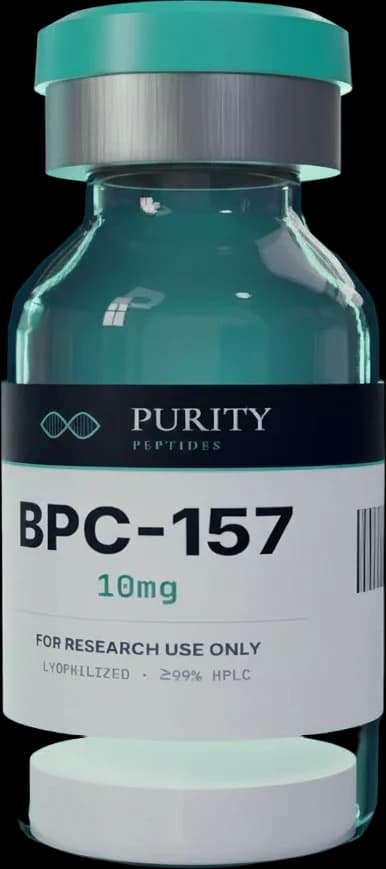
Research reviews
BPC-157 Research Review: Origin, Mechanism, Evidence
A research review of BPC-157: its gastric origin, sequence and stability, proposed mechanisms, rodent and in vitro findings, evidence gaps and WADA status.
October 30, 2026 · 6 min read · Purity Peptides research team
BPC-157 is one of the most widely discussed research peptides, and one of the least clinically characterised. A large preclinical literature describes activity in gastrointestinal, musculoskeletal and vascular models, yet almost no controlled human data have been published. This review sets out where the compound came from, what its structure tells us, which mechanisms have been proposed, and how much weight the existing studies can bear.
Origin and discovery
BPC stands for "Body Protection Compound". The name comes from the group of Predrag Sikirić at the University of Zagreb, which in the early 1990s described a protective protein fraction isolated from human gastric juice. BPC-157 is a synthetic 15-residue peptide corresponding to a partial sequence of that larger protein. It does not appear to be a known circulating hormone or a fragment of a well-characterised human protein in public sequence databases, which is one reason its physiological role remains unclear.
Over three decades the Zagreb group has published the large majority of BPC-157 papers, covering gastric lesions, intestinal anastomoses, tendon and ligament injury, muscle damage, bone defects and various toxicity models. Independent laboratories, notably in Taiwan, have contributed in vitro and tendon work, but the literature remains heavily concentrated in one centre. Earlier development under the code PL 14736 included early clinical evaluation for inflammatory bowel disease, but full results were not published in a peer-reviewed journal.
Structure and chemistry
The sequence is Gly-Glu-Pro-Pro-Pro-Gly-Lys-Pro-Ala-Asp-Asp-Ala-Gly-Leu-Val (GEPPPGKPADDAGLV). The molecular formula is C62H98N16O22 and the average molecular weight is approximately 1,419.5 Da.
Several features stand out:
- Proline content. Four prolines, three of them consecutive, give the N-terminal half a rigid, polyproline-like character. Proline-rich stretches are generally less susceptible to many proteases.
- Acidic residues. One glutamate and two aspartates make the peptide net acidic at neutral pH, which affects solubility and HPLC retention.
- Reported stability. The originating group reports that BPC-157 remains intact in human gastric juice for extended periods, which is unusual for a short linear peptide and has shaped much of the experimental design in animal work.
Commercial material is usually supplied as an acetate or trifluoroacetate salt, and an arginate salt is also marketed with claims of improved stability. Counter-ion identity changes the mass of peptide per vial, so certificates of analysis should state net peptide content as well as HPLC purity.
Mechanism studied
No single receptor has been identified for BPC-157. Instead, the literature describes several downstream effects, each supported by a limited number of studies:
- Angiogenic signalling. Hsieh et al. (2017) reported increased VEGFR2 expression and activation of the VEGFR2–Akt–eNOS pathway in endothelial cells and in a rat hind-limb ischaemia model.
- Nitric oxide system. The Zagreb group has repeatedly described interactions with NO synthesis, with BPC-157 counteracting effects of both NOS inhibitors and NO precursors in rodent models.
- Fibroblast migration. Chang et al. (2011) found increased outgrowth, survival and migration of rat tendon fibroblasts, associated with FAK–paxillin activation.
- Growth hormone receptor expression. A follow-up study by the same Taiwanese group (Chang et al., 2014) reported increased GH receptor expression in tendon fibroblasts.
These findings are compatible with a pro-repair, pro-angiogenic profile, but they come from different systems and have not been integrated into a single mechanistic model. Whether they reflect direct target engagement or secondary effects remains open.
Research landscape by model system
In vitro
Cell work is comparatively sparse. The best-known studies used rat tendon fibroblasts (migration, spreading, survival under oxidative stress) and human umbilical vein endothelial cells (tube formation, VEGFR2 signalling). Few studies report full concentration–response relationships, and fewer still include an inactive scrambled-sequence control.
Animal models
Rodent studies form the core of the literature:
- Gastrointestinal: gastric and duodenal lesions induced by ethanol, NSAIDs and stress; colitis models; fistula and anastomosis healing.
- Musculoskeletal: Staresinic et al. (2003) reported improved functional, biomechanical and histological outcomes after rat Achilles tendon transection. Related work examined ligament, quadriceps muscle crush and segmental bone defects.
- Vascular and other systems: limb ischaemia, vessel occlusion, and a range of toxicity and behavioural models.
Most animal studies are small, single-site and not pre-registered. Blinding and randomisation are inconsistently reported, and outcome measures vary between papers, which makes pooling difficult.
Human studies
There are no published randomised controlled trials of BPC-157 in a peer-reviewed journal. A few small case series and pilot reports have appeared in lower-impact journals, without control groups. These cannot establish efficacy or safety, and no regulator has evaluated a marketing application.
Evidence quality and open questions
Overall evidence quality is low. The principal concerns are:
- Concentration in one group. Independent replication of key in vivo findings is limited.
- Mechanistic breadth. Effects reported across many unrelated tissues, without a defined target, are hard to interpret and raise the possibility of publication bias.
- Pharmacokinetics. Peer-reviewed data on absorption, distribution, metabolism and elimination are scarce, and analytical methods for detecting the intact peptide in biological matrices are still being developed.
- Safety. Long-term toxicology to regulatory standards has not been published. Theoretical concerns about pro-angiogenic activity in the presence of neoplastic tissue have been raised in reviews but not tested systematically.
- Material quality. Grey-market products vary in identity and purity, so studies using commercially sourced material should verify sequence and mass independently.
Useful next steps for the field would include independent replication of the tendon and gastric findings, receptor-binding studies, and properly blinded animal experiments with scrambled-peptide controls.
Regulatory and anti-doping status
BPC-157 is not an approved medicine in the United States, the European Union or any other major jurisdiction. The US FDA has listed it among bulk drug substances that may present significant safety risks when used in compounding. The World Anti-Doping Agency has named BPC-157 under section S0 (non-approved substances) of the Prohibited List since 2022, so it is prohibited at all times in sport. It is supplied by research vendors strictly as a reference material for laboratory investigation.
Summary table
| Attribute | BPC-157 |
|---|---|
| Type | Synthetic 15-residue peptide |
| Sequence | GEPPPGKPADDAGLV |
| Approx. molecular weight | 1,419.5 Da |
| Origin | Partial sequence of a protein reported in human gastric juice (Zagreb group) |
| Proposed mechanisms | VEGFR2 signalling, NO system modulation, FAK–paxillin activation, GH receptor expression |
| Main model systems | Rodent gastrointestinal, tendon, ligament, muscle, bone and vascular models |
| Human data | No published controlled trials |
| Evidence level | Low |
| FDA / EMA | Not approved |
| WADA | Prohibited, S0 (named) |
References
- Sikiric P, Seiwerth S, Rucman R, et al. Stable gastric pentadecapeptide BPC 157: novel therapy in gastrointestinal tract. Curr Pharm Des. 2011;17(16):1612–1632.
- Seiwerth S, Rucman R, Turkovic B, et al. BPC 157 and standard angiogenic growth factors. Gastrointestinal tract healing, lessons from tendon, ligament, muscle and bone healing. Curr Pharm Des. 2018;24(18):1972–1989.
- Staresinic M, Sebecic B, Patrlj L, et al. Gastric pentadecapeptide BPC 157 accelerates healing of transected rat Achilles tendon and in vitro stimulates tendocytes growth. J Orthop Res. 2003;21(6):976–983.
- Chang CH, Tsai WC, Lin MS, Hsu YH, Pang JHS. The promoting effect of pentadecapeptide BPC 157 on tendon healing involves tendon outgrowth, cell survival, and cell migration. J Appl Physiol. 2011;110(3):774–780.
- Chang CH, Tsai WC, Hsu YH, Pang JHS. Pentadecapeptide BPC 157 enhances the growth hormone receptor expression in tendon fibroblasts. Molecules. 2014;19(11):19066–19077.
- Hsieh MJ, Liu HT, Wang CN, et al. Therapeutic potential of pro-angiogenic BPC157 is associated with VEGFR2 activation and up-regulation. J Mol Med. 2017;95(3):323–333.
- Gwyer D, Wragg NM, Wilson SL. Gastric pentadecapeptide body protection compound BPC 157 and its role in accelerating musculoskeletal soft tissue healing. Cell Tissue Res. 2019;377(2):153–159.
- World Anti-Doping Agency. Prohibited List (current edition). wada-ama.org.
FOR RESEARCH USE ONLY.Not for human or veterinary use. Not intended to diagnose, treat, cure, or prevent any disease.