Compound comparisons
BPC-157 vs TB-500: What the Research Shows
BPC-157 vs TB-500 compared: origin, structure, model systems studied, evidence level and WADA status, plus notes on the Wolverine blend.
October 29, 2026 · 5 min read · Purity Peptides research team

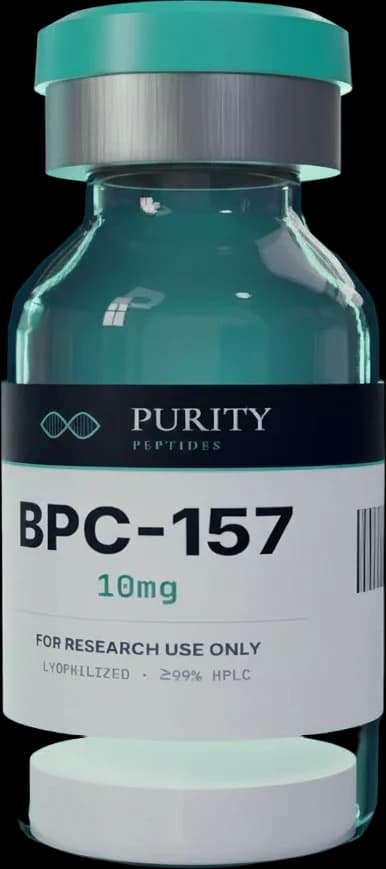
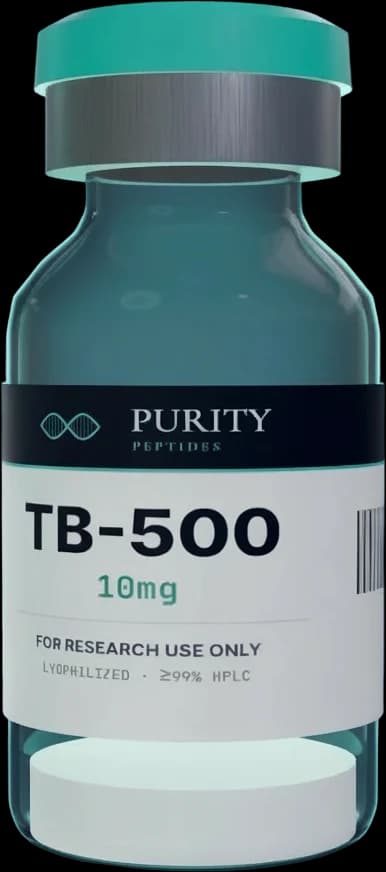
BPC-157 and TB-500 are the two peptides most often discussed together in tissue-repair research. They are grouped in catalogues, sold as a combined blend, and frequently confused. They are unrelated molecules with different origins, sizes and evidence bases. This article summarises what the published literature has examined, and where it stops.
At a glance
| BPC-157 | TB-500 | |
|---|---|---|
| Origin | Partial sequence of a protein reported in human gastric juice | Derived from thymosin β4, an intracellular actin-binding protein |
| Length | 15 amino acids | Usually 7 residues (Ac-LKKTETQ); some suppliers use the name for full-length 43-residue Tβ4 |
| Approx. molecular weight | 1,419.5 Da | ~889 Da (fragment) or ~4,963 Da (full-length Tβ4) |
| Main model systems | Rodent gastrointestinal, tendon, ligament, muscle and bone injury models | Rodent dermal wound and cardiac injury models (mostly full-length Tβ4) |
| Human data | Very limited, not published in full | Full-length Tβ4 evaluated in early and mid-stage trials; little on the fragment itself |
| Evidence level | Low | Low to moderate (Tβ4); very low (TB-500 fragment) |
| Approval status | Not approved by FDA or EMA | Not approved by FDA or EMA |
| WADA | Prohibited, S0 (named) | Prohibited, S2 (named) |
BPC-157
Origin
BPC-157 ("Body Protection Compound-157") is a synthetic pentadecapeptide. It corresponds to a partial sequence of a larger protein that the group of Predrag Sikirić at the University of Zagreb reported in human gastric juice in the early 1990s. The large majority of the published literature still originates from that group, which matters when weighing the evidence.
Structure
The sequence is Gly-Glu-Pro-Pro-Pro-Gly-Lys-Pro-Ala-Asp-Asp-Ala-Gly-Leu-Val (GEPPPGKPADDAGLV), molecular formula C62H98N16O22. The originating group reports stability in human gastric juice, which is unusual for a short linear peptide. Commercial material is typically supplied as an acetate or TFA salt; an arginate salt form is also marketed.
Model systems studied
- Gastrointestinal: rodent models of gastric and intestinal lesions, including NSAID- and alcohol-induced injury.
- Musculoskeletal: rat Achilles tendon transection, ligament, muscle crush and bone defect models.
- In vitro: Chang et al. (2011) reported increased outgrowth, survival and migration of rat tendon fibroblasts exposed to BPC-157.
- Vascular signalling: proposed interactions with the nitric oxide system and VEGFR2-related angiogenic pathways.
Evidence level
Low. The data are almost entirely preclinical, concentrated in one research group, and independent replication is limited. No phase 2 or phase 3 trial results have been published in a peer-reviewed journal.
Regulatory status
BPC-157 is not an approved medicine in the US or EU. WADA has listed it by name under S0 (non-approved substances) since 2022. The US FDA has also placed it among bulk drug substances that may present significant safety risks in compounding.
TB-500
Origin
Thymosin β4 (Tβ4) is a 43-residue, N-terminally acetylated protein and one of the most abundant actin-sequestering molecules inside mammalian cells. It was first characterised from thymus tissue by Allan Goldstein's laboratory.
"TB-500" is a commercial name, not an International Nonproprietary Name. It usually refers to a synthetic peptide built around Tβ4's central actin-binding motif, LKKTETQ (residues 17–23), commonly N-acetylated. Some suppliers apply the same name to full-length Tβ4. The two are very different molecules, so the COA matters: the stated sequence and the observed mass (~889 Da versus ~4,963 Da) show which one is in the vial.
Model systems studied
- Dermal wounds: Malinda et al. (1999) reported faster re-epithelialisation and wound contraction with Tβ4 in a rat full-thickness wound model.
- Cardiac injury: Bock-Marquette et al. (2004) found that Tβ4 activated integrin-linked kinase, promoted cardiomyocyte migration and survival, and improved function after coronary ligation in mice. Smart et al. (2007) reported mobilisation of epicardial progenitor cells and neovascularisation.
- Ocular and dermal clinical work: formulations of full-length Tβ4 have been evaluated in human trials for corneal and dermal indications. None has reached approval.
Evidence level
For full-length Tβ4: moderate preclinical evidence and early-to-mid clinical data in narrow indications. For the TB-500 fragment: very low. Results obtained with full-length Tβ4 should not be assumed to transfer to a 7-residue fragment.
Regulatory status
Not approved by FDA or EMA. WADA's S2 class names "thymosin-β4 and its derivatives, e.g. TB-500" explicitly.
The Wolverine blend
"Wolverine" is a trade name for a single vial containing BPC-157 and TB-500, usually in a fixed ratio by mass.
- No peer-reviewed study has evaluated the combination. The rationale is extrapolated from two separate literatures.
- Both components need verification. A blend COA should show two HPLC peaks, two observed masses, and the content of each component.
- Fixed ratios limit design. Studies that must attribute an effect to one molecule are better served by single-compound vials.
Practical takeaways for study design
- Match the molecule to the literature: BPC-157 work centres on gastrointestinal and musculoskeletal models, Tβ4 work on dermal and cardiac models.
- Confirm which TB-500 you have before comparing results with published Tβ4 studies.
- Use vehicle controls matched for counter-ion and diluent.
References
- Sikiric P, Seiwerth S, Rucman R, et al. Stable gastric pentadecapeptide BPC 157: novel therapy in gastrointestinal tract. Curr Pharm Des. 2011;17(16):1612–1632.
- Chang CH, Tsai WC, Lin MS, Hsu YH, Pang JHS. The promoting effect of pentadecapeptide BPC 157 on tendon healing involves tendon outgrowth, cell survival, and cell migration. J Appl Physiol. 2011;110(3):774–780.
- Seiwerth S, Rucman R, Turkovic B, et al. BPC 157 and standard angiogenic growth factors. Gastrointestinal tract healing, lessons from tendon, ligament, muscle and bone healing. Curr Pharm Des. 2018;24(18):1972–1989.
- Goldstein AL, Hannappel E, Kleinman HK. Thymosin β4: actin-sequestering protein moonlights to repair injured tissues. Trends Mol Med. 2005;11(9):421–429.
- Malinda KM, Sidhu GS, Mani H, et al. Thymosin β4 accelerates wound healing. J Invest Dermatol. 1999;113(3):364–368.
- Bock-Marquette I, Saxena A, White MD, DiMaio JM, Srivastava D. Thymosin β4 activates integrin-linked kinase and promotes cardiac cell migration, survival and cardiac repair. Nature. 2004;432:466–472.
- Smart N, Risebro CA, Melville AAD, et al. Thymosin β4 induces adult epicardial progenitor mobilization and neovascularization. Nature. 2007;445:177–182.
- World Anti-Doping Agency. The World Anti-Doping Code International Standard: Prohibited List (current edition). wada-ama.org.
FOR RESEARCH USE ONLY.Not for human or veterinary use. Not intended to diagnose, treat, cure, or prevent any disease.