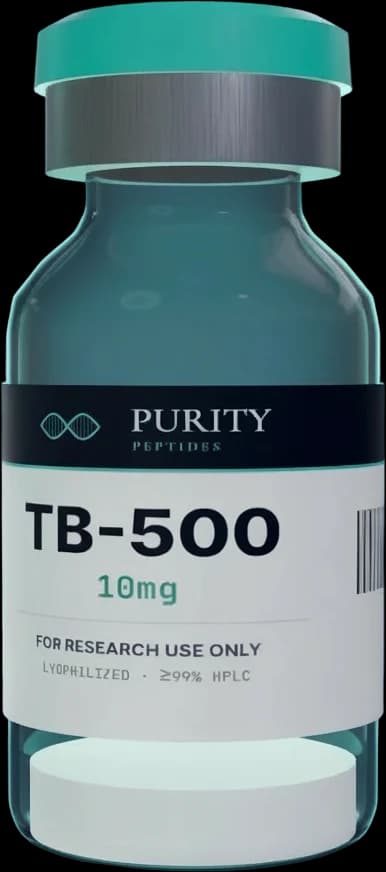
Overview
TB-500 is a synthetic peptide related to thymosin beta-4 (Tβ4), a 43-amino-acid protein found at high concentrations in platelets, white blood cells and most tissues. The name TB-500 is used for preparations based on the actin-binding region of Tβ4, most often the acetylated fragment corresponding to residues 17–23; composition can vary between suppliers, so analytical confirmation is essential.
Interest in the peptide stems from research on full-length Tβ4, which has been studied in dermal and corneal wound models, mouse models of cardiac injury and, as a clinical eye-drop candidate, in dry-eye trials. TB-500 itself has a much thinner evidence base, with little formal human research. It has drawn attention in equine and human anti-doping testing and is prohibited in sport. We supply TB-500 strictly for laboratory and animal research on actin dynamics, cell migration and tissue repair.
Mechanism studied
- TB-500
- G-actin binding
- Cell migration
- Tissue remodelling
Thymosin β4 is the principal G-actin-sequestering protein in mammalian cells. By binding monomeric actin through its central LKKTETQ motif, it regulates the pool available for filament assembly, influencing cell shape and motility. In experimental models, Tβ4 and related fragments promoted migration of keratinocytes, endothelial cells and cardiac progenitors, supported new vessel formation, and reduced inflammatory signalling. Mouse cardiac studies linked Tβ4 to activation of integrin-linked kinase and Akt survival signalling. Which of these activities the short fragment retains remains under study.
Research highlights
- 01Based on the actin-binding LKKTETQ region of thymosin beta-4
- 02Full-length Tβ4 studied in dermal, corneal and cardiac repair models
- 03Formal human research on the TB-500 fragment itself is minimal
- 04Detected in equine and human anti-doping programmes
- 05Prohibited in sport under WADA class S2
Research areas
- Actin dynamics & cell migration
- Wound & corneal repair models
- Cardiac injury models
- Angiogenesis research
Evidence & regulatory status
Overall status: Not approved — research
Key references
- [1]Goldstein et al., 2012 — Expert Opin Biol Ther
- [2]PubMed — reviews on thymosin beta-4 and repair
- [3]WADA — Prohibited List of Substances and Methods
Latest published research
30 papers on PubMed →Investigational Peptides in Orthopaedic Practice: Evidence, Safety, and Patient Counseling for BPC-157, Thymosin Beta-4, and TB-500
Tham A et al. · The Journal of the American Academy of Orthopaedic Surgeons · 2026 Oct 27 · PMID 42937313
Case Report: Regenerative peptides for Inferior alveolar nerve injury: a narrative review with hypothesis-generating three clinical cases
Froum S et al. · Frontiers in oral health · 2026 · PMID 42876687
Peptides in Regenerative Medicine: A Comprehensive Review of Clinical Applications in Tissue Repair and Chronic Pain Management
Luansritisakul C et al. · Current pain and headache reports · 2026 Aug 24 · PMID 42635865
Peptide Supplements and Their Therapeutic Applications in Sports Medicine
Tewari K et al. · The American journal of sports medicine · 2026 Aug 11 · PMID 42578445
Safety and Efficacy of Approved and Unapproved Peptide Therapies for Musculoskeletal Injuries and Athletic Performance
Mendias CL et al. · Sports medicine (Auckland, N.Z.) · 2026 Aug · PMID 41966639
Effects of BPC-157 and TB-500 on Achilles tendon healing in rats: A histopathological and biomechanical study
Biçer O et al. · Joint diseases and related surgery · 2026 Jul 23 · PMID 42542926
Dangers of Injectable Peptides and Other Unregulated "Biohacking" Drugs
Moiz A et al. · Missouri medicine · 2026 Jul-Aug · PMID 42757290
Synthetic Peptides in Pharmacy Compounding: Analysis of PCAC Recommendations and Industry Safety Standards
Willis J et al. · International journal of pharmaceutical compounding · 2026 Jul-Aug · PMID 42752426
Live feed from PubMed (NCBI) for “TB-500”, updated 2026-10-30. Listing a paper is not an endorsement of its findings.
Registered studies
1 on ClinicalTrials.gov →From the public ClinicalTrials.gov registry for “TB-500”, updated 2026-10-30. Shown for research context only; Purity Peptides products are not for human use.
FAQ
Not exactly. Thymosin beta-4 is a 43-residue protein, while TB-500 generally refers to a shorter synthetic peptide based on its actin-binding region. Because naming varies across the market, researchers should confirm sequence and mass on the certificate of analysis before use.
Lyophilized TB-500 is normally kept sealed at −20 °C, protected from light and moisture. Once reconstituted for laboratory work, aliquots are held at 2–8 °C for short-term use or frozen, avoiding repeated freeze–thaw. Follow the lot-specific guidance on the certificate of analysis.
Every lot of TB-500 ships with a certificate of analysis reporting HPLC purity, mass-spectrometry identity against the expected molecular weight, appearance and lot number. Match the COA lot to the vial label and keep it with your experimental records. The sequence identity is stated explicitly on each COA.
Last updated October 2026 · Reviewed by the Purity Peptides research team · Information is a summary of published literature and is not a recommendation for any use.