Overview
GHK-Cu is the copper(II) complex of the tripeptide glycyl-L-histidyl-L-lysine. GHK was first identified in human plasma in the 1970s, where it was found to have a strong affinity for copper ions; circulating levels have been reported to fall substantially with age. The peptide is also released from extracellular-matrix proteins such as collagen during tissue breakdown.
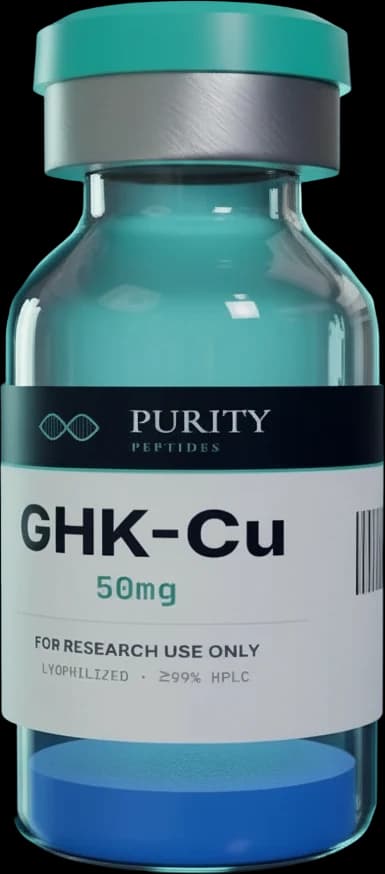
Research has focused on skin and wound biology. Cell studies report that GHK-Cu stimulates fibroblast production of collagen, elastin, decorin and glycosaminoglycans, and animal wound models have examined its effects on contraction and blood-vessel formation. Topical formulations have been evaluated in small cosmetic studies of photoaged skin. GHK-Cu is widely used as a cosmetic ingredient but is not approved as a drug. Our product is the lyophilized research-grade complex intended for laboratory study of matrix remodelling and copper biology.
Mechanism studied
- GHK-Cu
- Dermis
- Collagen & ECM
- Matrix remodelling
GHK forms a tight complex with Cu2+ and is thought to act partly as a copper carrier, delivering the ion to enzymes such as lysyl oxidase that cross-link collagen and elastin. In fibroblast cultures, GHK-Cu has been associated with increased synthesis of matrix proteins and with balanced regulation of metalloproteinases and their inhibitors. Gene-expression analyses using public datasets suggest the peptide can shift the activity of many genes involved in tissue repair, antioxidant defence and inflammation, though the upstream receptor mechanisms are not well defined.
Research highlights
- 01Naturally occurring plasma tripeptide with high affinity for copper(II)
- 02Fibroblast studies report increased collagen, elastin and glycosaminoglycan synthesis
- 03Studied in animal wound models and small cosmetic skin studies
- 04Gene-expression analyses suggest broad effects on repair-related pathways
- 05Common cosmetic ingredient, but not an approved drug
Research areas
- Dermal fibroblast & collagen models
- Wound-healing research
- Copper transport biology
- Gene-expression profiling
Evidence & regulatory status
Overall status: Cosmetic ingredient — not approved as a drug
Key references
- [1]Pickart & Margolina, 2018 — Int J Mol Sci 19(7):1987
- [2]PubMed — reviews on GHK-Cu and the skin
Latest published research
139 papers on PubMed →Characterization of copper tripeptide-loaded lipid carriers and their stability in complex cosmetic matrices
Ogórek K et al. · Journal of chromatography. A · 2026 Nov 22 · PMID 42887096
Hierarchical regulation and mechanism of "open-hollow-fibrous network" structures: Osteogenic-angiogenic coupling responses of poly(γ-benzyl-L-glutamate) microspheres
Su J et al. · Biomaterials advances · 2026 Nov · PMID 42320090
Peptides in Aesthetic Dermatology: Classification, Fibroblast-Centered Mechanisms, Delivery Technologies, and Clinical Evidence
Yi KH et al. · Life (Basel, Switzerland) · 2026 Oct 2 · PMID 42942246
A tea exosome-integrated self‑oxygenating cascade chitosan/oxidized alginate hydrogel for remodeling the hyperglycemic and hypoxic microenvironment in diabetic wound healing
Xie LH et al. · Carbohydrate polymers · 2026 Oct 1 · PMID 42586657
Water-Soluble, Enzyme-Degradable, and Hydrolyzable STAR Particles for Enhanced Drug Delivery to Skin
Sadeqi A et al. · Advanced healthcare materials · 2026 Sep · PMID 42712263
Microenvironment-responsive injectable dynamic hydrogel for sequential antioxidant and tissue regeneration therapy of radiation-induced skin injury
Yu X et al. · Bioactive materials · 2026 Sep · PMID 42058630
GHK-Cu as a Bioactive Metallopeptide and Drug-Delivery Cargo: Coordination Chemistry, Formulation Science, Therapeutic Evidence, and a Translational Roadmap
Mateescu DM et al. · Pharmaceutics · 2026 Aug 27 · PMID 42797253
Peptides in Regenerative Medicine: A Comprehensive Review of Clinical Applications in Tissue Repair and Chronic Pain Management
Luansritisakul C et al. · Current pain and headache reports · 2026 Aug 24 · PMID 42635865
Live feed from PubMed (NCBI) for “GHK-Cu”, updated 2026-10-30. Listing a paper is not an endorsement of its findings.
Registered studies
25 on ClinicalTrials.gov →- Enrolling by invitationEarly Phase 1
Systemic and Topical Geroprotective Rejuvenation Assessed by START/REST Aging Clocks
NCT07888595 · Frontiers in Bioscience Research Institute and Aging · 2026-10-21
- Completed
AI-Personalized Skincare Regimen for Facial Photoaging in Women
NCT07879833 · MDalgorithms Inc. · 2025-09-30
- Active not recruitingPhase 1
NEPC Study: An Exploratory Safety and Efficacy Study With PSMA, SSTR2 and GRPR Targeted Radioligand Therapy in Metastatic Neuroendocrine Prostate Cancer.
NCT06379217 · Novartis Pharmaceuticals · 2024-07-29
- RecruitingPhase 1
A Study of Theranostic Pair PD-32766D/T in Participants With Carbonic Anhydrase IX Positive Clear Cell Renal Cell Carcinoma
NCT07688187 · PeptiDream Inc. · 2026-07-07
- Not yet recruiting
Two-Part Study of the Effects of the X39 Patch on Circulating GHK and GHK-Cu Levels in Healthy Adults
NCT07706361 · LifeWave, Inc. · 2027-01
- RecruitingPhase 4
An Investigational Scan (64Cu-DOTA-Trastuzumab PET/MRI) in Imaging Patients With HER2+ Breast Cancer With Brain Metastasis
NCT05376878 · City of Hope Medical Center · 2022-12-21
- RecruitingPhase 4
Surgical Debulking Prior to Peptide Receptor Radionuclide Therapy in Well Differentiated Gastroenteropancreatic Neuroendocrine Tumors
NCT06016855 · Vanderbilt-Ingram Cancer Center · 2024-05-31
- RecruitingPhase 2
Topical GHK-Cu Gel for Acute Skin Wound Healing
NCT07437586 · Hudson Biotech · 2026-02-02
From the public ClinicalTrials.gov registry for “GHK-Cu”, updated 2026-10-30. Shown for research context only; Purity Peptides products are not for human use.
FAQ
The characteristic blue colour comes from the copper(II) ion coordinated by the peptide. Colour intensity is a quick visual check of the complex, but identity and purity should always be confirmed against the HPLC and mass-spectrometry data on the certificate of analysis.
Lyophilized GHK-Cu is normally kept sealed at −20 °C, protected from light and moisture. Once reconstituted for laboratory work, aliquots are held at 2–8 °C for short-term use or frozen, avoiding repeated freeze–thaw. Follow the lot-specific guidance on the certificate of analysis.
Every lot of GHK-Cu ships with a certificate of analysis reporting HPLC purity, mass-spectrometry identity against the expected molecular weight, appearance and lot number. Match the COA lot to the vial label and keep it with your experimental records.
Last updated October 2026 · Reviewed by the Purity Peptides research team · Information is a summary of published literature and is not a recommendation for any use.