Overview
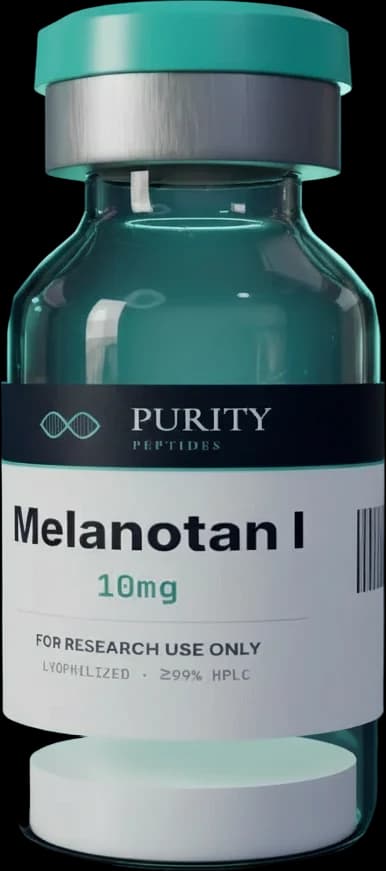
Melanotan I, known by its INN afamelanotide, is a linear 13-amino-acid analogue of alpha-melanocyte-stimulating hormone (α-MSH). It was developed at the University of Arizona in the 1980s, where two substitutions — norleucine at position 4 and D-phenylalanine at position 7 — made the peptide far more stable and potent than the natural hormone.
Afamelanotide was later developed as a controlled-release implant and evaluated in phase 3 trials in people with erythropoietic protoporphyria, a rare disorder causing severe light-induced pain. It is approved in the EU (2014) and the US (2019) for this indication as a prescription medicine administered by healthcare professionals. Outside that context, the peptide is widely used in research on melanocortin receptors and skin pigmentation. Our product is the research-grade reference compound, intended for laboratory study rather than clinical use.
Mechanism studied
- Melanotan I
- MC1R
- Eumelanin synthesis
- Photoprotection
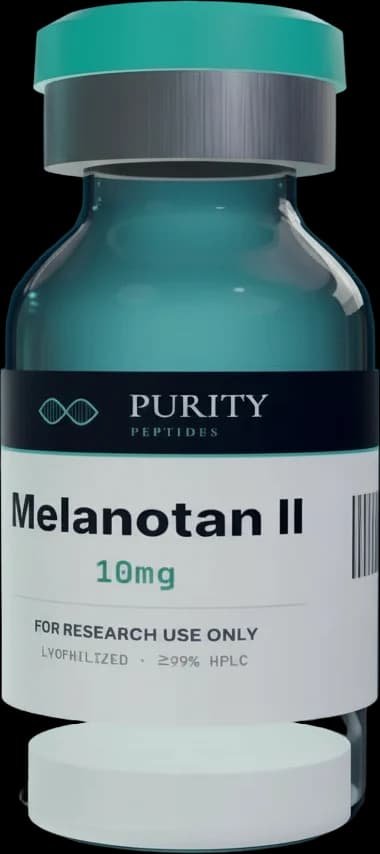
Afamelanotide is an agonist of the melanocortin-1 receptor (MC1R) on melanocytes. MC1R activation increases intracellular cAMP and upregulates MITF, the master transcription factor for melanogenesis, shifting pigment production toward photoprotective eumelanin. Research also describes antioxidant and DNA-repair effects downstream of MC1R signalling. Compared with melanotan II, afamelanotide is linear and relatively selective for MC1R, which accounts for its narrower pharmacological profile in published studies, with fewer central effects on appetite or sexual function.
Research highlights
- 01Stabilised α-MSH analogue with Nle4 and D-Phe7 substitutions
- 02Approved by EMA (2014) and FDA (2019) for erythropoietic protoporphyria
- 03Phase 3 data published in the New England Journal of Medicine (2015)
- 04Relatively selective MC1R agonist compared with melanotan II
- 05Widely used as a reference ligand in melanocortin research
Research areas
- MC1R signalling research
- Melanogenesis models
- Photoprotection studies
- Melanocortin pharmacology
Evidence & regulatory status
Overall status: Approved (Rx) — erythropoietic protoporphyria (as afamelanotide implant)
Key references
- [1]Langendonk et al., 2015 — N Engl J Med 373:48–59
- [2]Scenesse® prescribing information — FDA / EMA
Latest published research
123 papers on PubMed →Acute impact of afamelanotide on UVR erythemal and melanogenic responses in healthy humans in vivo: an exploratory study
Griffin LL et al. · Photochemical & photobiological sciences : Official journal of the European Photochemistry Association and the European Society for Photobiology · 2026 Nov · PMID 42678656
Adjunctive use of Polypodium leucotomos extract in patients with erythropoietic protoporphyria: An exploratory study
Shetty N et al. · Photochemistry and photobiology · 2026 Sep-Oct · PMID 41766687
Heterochiral co-assembly of β-strands and hairpins affords stereocomplexed peptide hydrogels for drug delivery
Anderson CF et al. · Journal of controlled release : official journal of the Controlled Release Society · 2026 Jul 10 · PMID 41999898
A Review of Randomized Controlled Trials for Vitiligo Therapies Published Between 2013 and 2023
Maverakis Ramirez N et al. · Cureus · 2026 Jul · PMID 42569625
Investigation of the stability profile of therapeutic α-MSH analogue: Insights from liquid chromatography-high resolution mass spectrometry analysis of afamelanotide
Chawathe A et al. · Journal of pharmaceutical and biomedical analysis · 2026 May 15 · PMID 41547183
Afamelanotide improves quality of life and light tolerance in Austrian erythropoietic protoporphyria patients
Seidl-Philipp M et al. · Journal der Deutschen Dermatologischen Gesellschaft = Journal of the German Society of Dermatology : JDDG · 2026 Mar 6 · PMID 41793078
New and currently investigated pharmacotherapies for the erythropoietic protoporphyrias: spotlight on dersimelagon and bitopertin
Barman-Aksözen J et al. · Expert opinion on pharmacotherapy · 2026 Mar · PMID 41885813
Congenital Erythropoietic Porphyria with Persistent Severe Biochemical Abnormalities and a Non-Mutilating Clinical Course: A Case Report
Peshin S et al. · Reports (MDPI) · 2026 Feb 16 · PMID 41718315
Live feed from PubMed (NCBI) for “Melanotan I (Afamelanotide)”, updated 2026-10-30. Listing a paper is not an endorsement of its findings.
Registered studies
23 on ClinicalTrials.gov →- CompletedPhase 1Phase 2
Pharmacokinetics of Afamelanotide in Erythropoietic Protoporphyria Patients
NCT06388642 · Clinuvel Europe Limited · 2024-03-07
- Active not recruitingPhase 3
A Study to Compare the Efficacy and Safety of SCENESSE and Narrow-Band Ultraviolet (NB-UVB) Light Versus NB-UVB Light Alone in Patients With Vitiligo
NCT06109649 · Clinuvel, Inc. · 2023-10-11
- CompletedPhase 2
Study to Evaluate the Safety and Efficacy of Afamelanotide in Patients With Variegate Porphyria (VP)
NCT05854784 · Clinuvel Pharmaceuticals Limited · 2023-03-28
- CompletedPhase 2
Afamelanotide and Narrow-Band Ultraviolet B (NB-UVB) Phototherapy in the Treatment of Nonsegmental Vitiligo (NSV)
NCT04525157 · Clinuvel Pharmaceuticals Limited · 2014-06-06
- UnknownPhase 2
A Study to Evaluate the Safety and Efficacy of Afamelanotide in Patients With Xeroderma Pigmentosum C and V
NCT05370235 · Clinuvel Europe Limited · 2022-03-28
- UnknownPhase 2
A Study to Evaluate the Safety and Efficacy of Afamelanotide in Patients With Xeroderma Pigmentosum (XP)
NCT05159752 · Clinuvel Europe Limited · 2021-10-19
- CompletedPhase 2
A Proof of Concept Study to Evaluate the Safety of Afamelanotide in Patients With Acute Arterial Ischaemic Stroke (AIS)
NCT04962503 · Clinuvel Pharmaceuticals Limited · 2021-06-03
- CompletedPhase 1
DNA Repair Capacity of Afamelanotide on Ultraviolet Radiation-induced DNA Damage in Healthy Volunteers
NCT05368857 · Clinuvel (UK) Ltd. · 2022-01-19
From the public ClinicalTrials.gov registry for “Melanotan I (Afamelanotide)”, updated 2026-10-30. Shown for research context only; Purity Peptides products are not for human use.
FAQ
Melanotan I (afamelanotide) is a linear peptide that mainly activates MC1R and is an approved medicine for a rare photodermatosis. Melanotan II is a cyclic analogue that activates several melanocortin receptors, including MC3R and MC4R, and has no regulatory approval. Their pharmacological profiles differ substantially in published research.
Lyophilized Melanotan I is normally kept sealed at −20 °C, protected from light and moisture. Once reconstituted for laboratory work, aliquots are held at 2–8 °C for short-term use or frozen, avoiding repeated freeze–thaw. Follow the lot-specific guidance on the certificate of analysis.
Every lot of Melanotan I ships with a certificate of analysis reporting HPLC purity, mass-spectrometry identity against the expected molecular weight, appearance and lot number. Match the COA lot to the vial label and keep it with your experimental records.
Last updated October 2026 · Reviewed by the Purity Peptides research team · Information is a summary of published literature and is not a recommendation for any use.