

Research reviews
Melanocortin Peptides: Melanotan, PT-141, Setmelanotide
Melanotan I and II, PT-141 (bremelanotide) and setmelanotide reviewed: α-MSH origins, structure, MC1R–MC5R pharmacology, trials and regulatory status.
October 30, 2026 · 6 min read · Purity Peptides research team

The melanocortin system is one of the clearest examples of how a single family of peptides can influence very different physiology, from skin pigmentation to appetite and sexual motivation. Synthetic analogues of α-melanocyte-stimulating hormone (α-MSH) have produced three approved prescription medicines and one widely misused, unapproved compound. This review covers the origin of these peptides, how their structures determine receptor selectivity, the clinical research behind them and their regulatory position.
Origin and discovery
α-MSH is a 13-residue peptide cleaved from pro-opiomelanocortin (POMC), the same precursor that yields ACTH and β-endorphin. It acts on a family of five melanocortin receptors, MC1R to MC5R, all G protein-coupled receptors that signal mainly through Gαs and cAMP.
In the late 1970s and 1980s, a group at the University of Arizona, including Victor Hruby, Mac Hadley and colleagues, set out to create more stable α-MSH analogues. Replacing methionine at position 4 with norleucine and L-phenylalanine at position 7 with D-phenylalanine produced [Nle4, D-Phe7]-α-MSH, a far more potent and longer-acting melanotropin (Sawyer et al., 1980). This peptide later became known as Melanotan I and received the INN afamelanotide.
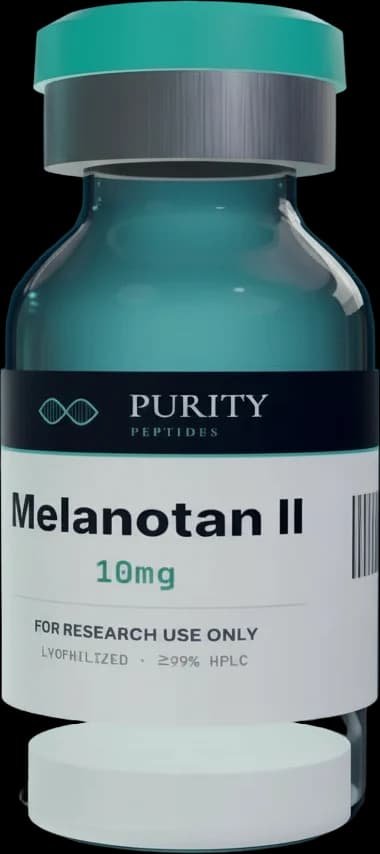
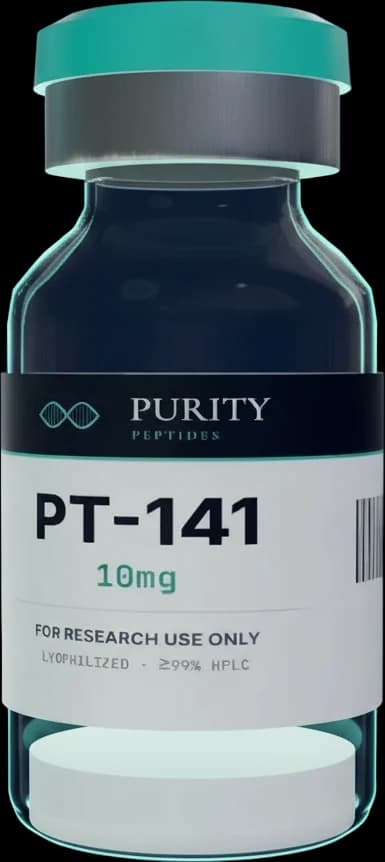
The same group then produced a constrained cyclic analogue, Melanotan II. Early human studies of Melanotan II examining pigmentation unexpectedly recorded effects on sexual arousal (Dorr et al., 1996; Wessells et al., 1998), which led Palatin Technologies to develop bremelanotide, also known as PT-141.
Separately, genetic research established MC4R as a central regulator of energy balance. Mice lacking MC4R develop severe obesity (Huszar et al., 1997), and MC4R variants are among the most common monogenic causes of human obesity. This work underpinned the development of setmelanotide by Rhythm Pharmaceuticals.
Structure and chemistry
- Afamelanotide (Melanotan I) is a linear 13-residue peptide, Ac-Ser-Tyr-Ser-Nle-Glu-His-D-Phe-Arg-Trp-Gly-Lys-Pro-Val-NH2. It retains the α-MSH length and is relatively selective for MC1R.
- Melanotan II is a cyclic heptapeptide, Ac-Nle-cyclo[Asp-His-D-Phe-Arg-Trp-Lys]-NH2. A lactam bridge between aspartate and lysine side chains constrains the core His-D-Phe-Arg-Trp pharmacophore, increasing potency and stability but reducing selectivity.
- Bremelanotide (PT-141) has the same cyclic sequence as Melanotan II but ends in a free carboxylic acid rather than an amide. This seemingly small change shifts its profile toward central melanocortin receptors.
- Setmelanotide is a cyclic octapeptide closed by a disulfide bridge, engineered for potency and selectivity at MC4R relative to other subtypes.
The shared His-Phe-Arg-Trp motif is the minimal sequence recognised by melanocortin receptors. Ring size, stereochemistry and terminal groups determine which receptors a given analogue activates.
Receptor pharmacology and mechanism studied
The five melanocortin receptors have distinct distributions:
- MC1R on melanocytes drives eumelanin synthesis through cAMP and the transcription factor MITF. It is the main target of afamelanotide.
- MC2R in the adrenal cortex is the ACTH receptor and does not respond meaningfully to α-MSH analogues.
- MC3R and MC4R in the hypothalamus and other brain regions regulate food intake, energy expenditure and aspects of sexual function (Cone, 2005).
- MC5R is found in exocrine glands and contributes to sebaceous secretion.
Melanotan II activates MC1R, MC3R, MC4R and MC5R with high affinity, which explains why pigmentation, appetite and sexual-function effects appear together. Bremelanotide's activity is concentrated at MC4R and MC3R; animal work suggests MC4R activation in the medial preoptic area increases dopamine release, a pathway associated with sexual motivation. Setmelanotide restores signalling downstream of defects in the leptin–melanocortin pathway, such as loss of POMC, PCSK1 or the leptin receptor, by directly activating MC4R.
Research and clinical-trial landscape
Afamelanotide was evaluated in phase 3 trials in people with erythropoietic protoporphyria (EPP), a rare genetic disorder causing severe light-induced pain. The trials evaluated time spent in direct sunlight without pain as a primary endpoint (Langendonk et al., 2015).
Bremelanotide was evaluated in the phase 3 RECONNECT trials in premenopausal women with acquired, generalised hypoactive sexual desire disorder (HSDD), which evaluated desire and distress scores as co-primary endpoints (Kingsberg et al., 2019).
Setmelanotide was first studied in individuals with POMC deficiency (Kühnen et al., 2016), followed by phase 3 trials in POMC and leptin receptor deficiency obesity (Clément et al., 2020) and in Bardet–Biedl syndrome (Haqq et al., 2022), which evaluated body-weight and hunger endpoints.
Melanotan II has never completed a formal clinical development programme. Its human data consist of small early studies, and the wider literature is dominated by case reports associated with unregulated products, including reports of changes in melanocytic naevi, which dermatology researchers have flagged as a concern.
Evidence quality and open questions
- Approved analogues are supported by randomised trials in narrowly defined populations. Extrapolation beyond those populations is not supported by the data.
- Melanotan II lacks controlled trial data, and its non-selective receptor profile makes its effects difficult to interpret.
- MC1R and melanoma risk. Whether sustained MC1R stimulation affects naevus biology or melanoma risk is an unresolved and important research question.
- Central melanocortin signalling is linked to changes in blood pressure and heart rate in some studies, a consideration for any MC4R-directed research.
- Selectivity tools. More selective agonists and antagonists for each subtype remain valuable for dissecting which receptor drives which effect.
Regulatory and anti-doping status
Afamelanotide is an approved prescription medicine (Scenesse) for EPP in the EU and the United States. Bremelanotide is an approved prescription medicine in the United States (Vyleesi) for premenopausal women with acquired, generalised HSDD. Setmelanotide is an approved prescription medicine (Imcivree) in the United States and EU for obesity due to specific rare genetic conditions. Melanotan II is not approved anywhere, and regulators in several countries have issued public warnings about unlicensed products marketed for tanning.
None of these peptides is explicitly named on the WADA Prohibited List at the time of writing, but non-approved substances such as Melanotan II may fall under S0. Researchers should consult the current list.
Summary table
| Afamelanotide (MT-I) | Melanotan II | Bremelanotide (PT-141) | Setmelanotide | |
|---|---|---|---|---|
| Structure | Linear 13-mer | Cyclic 7-mer (lactam), amide | Cyclic 7-mer (lactam), acid | Cyclic 8-mer (disulfide) |
| Main receptors | MC1R | MC1R, MC3R, MC4R, MC5R | MC4R, MC3R | MC4R |
| Research focus | Pigmentation, photoprotection | Non-selective tool compound | Sexual motivation | Genetic obesity |
| Status | Approved Rx (EPP) | Not approved; warnings issued | Approved Rx (US, HSDD) | Approved Rx (rare genetic obesity) |
References
- Sawyer TK, Sanfilippo PJ, Hruby VJ, et al. 4-Norleucine, 7-D-phenylalanine-α-melanocyte-stimulating hormone: a highly potent α-melanotropin with ultralong biological activity. Proc Natl Acad Sci USA. 1980;77(10):5754–5758.
- Dorr RT, Lines R, Levine N, et al. Evaluation of Melanotan-II, a superpotent cyclic melanotropic peptide in a pilot phase-I clinical study. Life Sci. 1996;58(20):1777–1784.
- Wessells H, Fuciarelli K, Hansen J, et al. Synthetic melanotropic peptide initiates erections in men with psychogenic erectile dysfunction: double-blind, placebo controlled crossover study. J Urol. 1998;160(2):389–393.
- Huszar D, Lynch CA, Fairchild-Huntress V, et al. Targeted disruption of the melanocortin-4 receptor results in obesity in mice. Cell. 1997;88(1):131–141.
- Cone RD. Anatomy and regulation of the central melanocortin system. Nat Neurosci. 2005;8(5):571–578.
- Langendonk JG, Balwani M, Anderson KE, et al. Afamelanotide for erythropoietic protoporphyria. N Engl J Med. 2015;373:48–59.
- Kingsberg SA, Clayton AH, Portman D, et al. Bremelanotide for the treatment of hypoactive sexual desire disorder: two randomized phase 3 trials. Obstet Gynecol. 2019;134(5):899–908.
- Kühnen P, Clément K, Wiegand S, et al. Proopiomelanocortin deficiency treated with a melanocortin-4 receptor agonist. N Engl J Med. 2016;375:240–246.
- Clément K, van den Akker E, Argente J, et al. Efficacy and safety of setmelanotide, an MC4R agonist, in individuals with severe obesity due to LEPR or POMC deficiency: single-arm, open-label, multicentre, phase 3 trials. Lancet Diabetes Endocrinol. 2020;8(12):960–970.
- Haqq AM, Chung WK, Dollfus H, et al. Efficacy and safety of setmelanotide, a melanocortin-4 receptor agonist, in patients with Bardet–Biedl syndrome and Alström syndrome: a multicentre, randomised, double-blind, placebo-controlled, phase 3 trial with an open-label period. Lancet Diabetes Endocrinol. 2022;10(12):859–868.
FOR RESEARCH USE ONLY.Not for human or veterinary use. Not intended to diagnose, treat, cure, or prevent any disease.