Overview
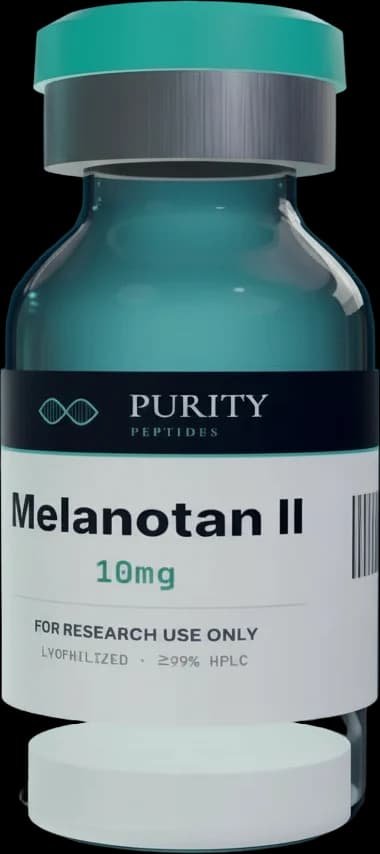
Melanotan II is a cyclic heptapeptide analogue of α-MSH, developed at the University of Arizona alongside melanotan I. A lactam bridge constrains its structure, making it highly potent and resistant to degradation, but also less selective: it activates most melanocortin receptor subtypes rather than MC1R alone.
Small early human studies examined skin pigmentation and, unexpectedly, documented effects on sexual arousal, which led to the development of bremelanotide (PT-141). Melanotan II itself was never approved. Health authorities in several countries have issued warnings about unlicensed products sold online, and dermatology literature includes reports of changes in pigmented lesions. In the laboratory, the peptide remains a widely cited non-selective melanocortin agonist used to probe pigmentation, appetite and central melanocortin signalling. It is supplied here strictly as a research reference compound.
Mechanism studied
- Melanotan II
- MC1R–MC5R
- Melanogenesis
- Central MC4R signalling
Melanotan II binds MC1R, MC3R, MC4R and MC5R with high affinity. Activation of MC1R on melanocytes raises cAMP and drives eumelanin synthesis, explaining pigmentation effects. Activation of MC3R and MC4R in the hypothalamus and spinal cord influences appetite, energy expenditure and sexual-function pathways; MC4R agonism is linked to reduced food intake in rodent studies. This broad receptor engagement underlies both its utility as a research tool and the diverse effects reported in early human studies.
Research highlights
- 01Cyclic lactam α-MSH analogue with high potency and broad receptor activity
- 02Agonist at MC1R, MC3R, MC4R and MC5R
- 03Early human pigmentation studies led to the development of bremelanotide
- 04Not approved anywhere; regulators have issued consumer warnings
- 05Widely used as a reference ligand in melanocortin and appetite research
Research areas
- Melanocortin receptor pharmacology
- Pigmentation models
- Appetite & MC4R research
- Sexual-function signalling studies
Evidence & regulatory status
Overall status: Not approved — regulatory warnings issued
Key references
- [1]PubMed — reviews on melanotan II and dermatological risks
- [2]Health alerts — FDA / European agencies
Latest published research
4,562 papers on PubMed →"Mary thinks that John thinks that…" Developmental change and individual stability in attributing second-order mental states in 5 to 7-year-olds
Białecka M et al. · Journal of experimental child psychology · 2027 Jan · PMID 42574792
Melatonin testicular synthesis and its role in reproductive physiology in seasonal and non-seasonal breeders
Cesauri M et al. · Research in veterinary science · 2026 Nov · PMID 42762694
Targeting mitochondrial metabolism in renal cell carcinoma with melatonin: Preclinical evidence and clinical perspectives
Noroozi-Karimabad M et al. · Tissue & cell · 2026 Nov · PMID 42229285
Neuronal receptor remodeling in the aging periosteum: From single-cell atlases to regenerative targets
Liu Z et al. · Neural regeneration research · 2026 Oct 29 · PMID 42955884
Maternal piromelatine treatment is associated with attenuated behavioral alterations and sex-specific changes in hippocampal pCREB/BDNF signaling in adult offspring following prenatal constant-light exposure
Stoyanova T et al. · Behavioural brain research · 2026 Oct 17 · PMID 42892467
HIV-1 Infection Alters Post-Transcriptional Processing of HTLV-1 RNA in MT-2 Cells
Liu H et al. · Microorganisms · 2026 Oct 15 · PMID 42943598
Anti-HIV-1 activity and mechanism of action of homoplantaginin: A multitarget flavonoid compound
Liu X et al. · Bioorganic chemistry · 2026 Oct 14 · PMID 42892153
Corrigendum to "RANKL promotes MT2 degradation and ROS production in osteoclast precursors through Beclin1-dependent autophagy" [Differentiation 143, (2025), 100863]
Ke D et al. · Differentiation; research in biological diversity · 2026 Oct 14 · PMID 42874372
Live feed from PubMed (NCBI) for “Melanotan II”, updated 2026-10-30. Listing a paper is not an endorsement of its findings.
Registered studies
26 on ClinicalTrials.gov →- RecruitingPhase 2
Inotuzumab Ozogamicin and Blinatumomab With or Without Ponatinib in Treating Patients With Newly Diagnosed, Recurrent, or Refractory CD22-Positive B-Lineage Acute Lymphoblastic Leukemia
NCT03739814 · National Cancer Institute (NCI) · 2019-05-08
- RecruitingPhase 2
A Study Testing the Combination of Dasatinib or Imatinib to Chemotherapy Treatment With Blinatumomab for Children, Adolescents, and Young Adults With Philadelphia Chromosome Positive (Ph+) or ABL-Class Philadelphia Chromosome-Like (Ph-Like) B-cell Acute Lymphoblastic Leukemia (B-ALL)
NCT06124157 · National Cancer Institute (NCI) · 2025-05-30
- RecruitingPhase 2
Testing the Addition of the Anti-cancer Drug Venetoclax and/or the Anti-cancer Immunotherapy Blinatumomab to the Usual Chemotherapy Treatment for Infants With Newly Diagnosed KMT2A-rearranged or KMT2A-non-rearranged Leukemia
NCT06317662 · National Cancer Institute (NCI) · 2025-06-05
- Active not recruitingPhase 3
Blinatumomab in Treating Younger Patients With Relapsed B-cell Acute Lymphoblastic Leukemia
NCT02101853 · National Cancer Institute (NCI) · 2014-12-17
- Not yet recruitingPhase 2
Testing Blinatumomab With or Without Revumenib in Patients With B-cell Acute Lymphoblastic Leukemia With a Genetic Change Requiring More Treatment
NCT07636564 · SWOG Cancer Research Network · 2026-10-14
- Active not recruitingPhase 3
Combination Chemotherapy With or Without Blinatumomab in Treating Patients With Newly Diagnosed BCR-ABL-Negative B Lineage Acute Lymphoblastic Leukemia
NCT02003222 · National Cancer Institute (NCI) · 2014-05-19
- RecruitingPhase 2
A Study to Compare Blinatumomab Alone to Blinatumomab With Nivolumab in Patients Diagnosed With First Relapse B-Cell Acute Lymphoblastic Leukemia (B-ALL)
NCT04546399 · National Cancer Institute (NCI) · 2020-12-17
- RecruitingPhase 3
Inotuzumab Ozogamicin and Post-Induction Chemotherapy in Treating Patients With High-Risk B-ALL, Mixed Phenotype Acute Leukemia, and B-LLy
NCT03959085 · Children's Oncology Group · 2019-10-31
From the public ClinicalTrials.gov registry for “Melanotan II”, updated 2026-10-30. Shown for research context only; Purity Peptides products are not for human use.
FAQ
Its cyclic structure binds several melanocortin receptors with high affinity, including MC1R in skin and MC3R and MC4R in the brain. This broad activity makes it a useful pan-agonist reference in receptor studies, but it complicates interpretation when a single receptor pathway is under investigation.
Lyophilized Melanotan II is normally kept sealed at −20 °C, protected from light and moisture. Once reconstituted for laboratory work, aliquots are held at 2–8 °C for short-term use or frozen, avoiding repeated freeze–thaw. Follow the lot-specific guidance on the certificate of analysis.
Every lot of Melanotan II ships with a certificate of analysis reporting HPLC purity, mass-spectrometry identity against the expected molecular weight, appearance and lot number. Match the COA lot to the vial label and keep it with your experimental records.
Last updated October 2026 · Reviewed by the Purity Peptides research team · Information is a summary of published literature and is not a recommendation for any use.