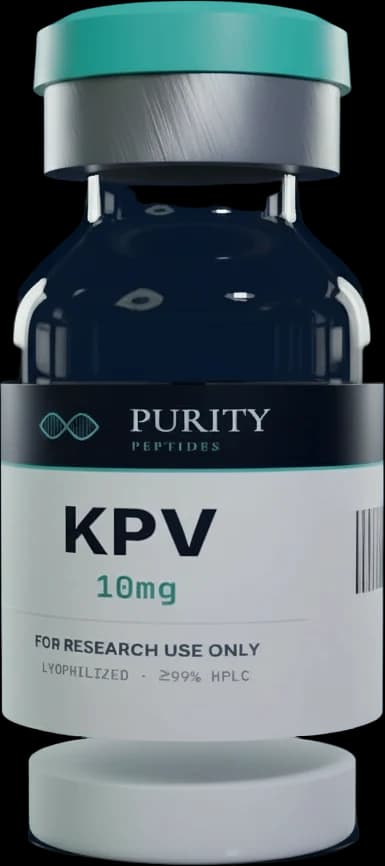
Overview
KPV is the C-terminal tripeptide (lysine-proline-valine) of alpha-melanocyte-stimulating hormone. Researchers studying the anti-inflammatory properties of α-MSH found that much of this activity could be reproduced by its last three residues, which lack the pigment-stimulating effects of the full hormone.
The best-known work on KPV comes from models of inflammatory bowel disease. A 2008 study reported that KPV is transported into intestinal epithelial and immune cells by the peptide transporter PepT1 and that oral delivery reduced inflammation in mouse colitis models. Later studies packaged KPV into nanoparticles to target the colon. Research has also examined its effects in skin inflammation and wound models. There are no clinical trials of KPV, and it is not an approved medicine. It is supplied here as a research peptide for inflammation and transporter studies.
Mechanism studied
- KPV
- PepT1 uptake
- NF-κB inhibition
- Inflammatory cytokines ↓
KPV enters cells through the proton-coupled oligopeptide transporter PepT1, which is upregulated in the inflamed colon. Once inside, it has been reported to inhibit activation of NF-κB and MAPK pathways, reducing the production of pro-inflammatory cytokines such as IL-6, IL-8 and TNF-α. Unlike full-length α-MSH, its effects do not appear to depend primarily on melanocortin receptor activation, although some studies propose a contribution from MC1R. Its small size supports oral and topical delivery in experimental models.
Research highlights
- 01C-terminal Lys-Pro-Val tripeptide of α-melanocyte-stimulating hormone
- 02Retains anti-inflammatory activity without pigmentary effects
- 03Taken up by the PepT1 transporter in intestinal epithelium
- 04Reduced inflammation in mouse colitis models (Gastroenterology, 2008)
- 05No human clinical trials published
Research areas
- Colitis models
- NF-κB signalling studies
- PepT1 transport research
- Skin inflammation models
Evidence & regulatory status
Overall status: Not approved — research
Key references
- [1]Dalmasso et al., 2008 — Gastroenterology 134(1):166–178
- [2]Brzoska et al., 2008 — Endocr Rev 29(5):581–602
Latest published research
149 papers on PubMed →Lysine-Proline-Valine attenuates oxidized low-density lipoprotein-induced foam cell formation and inflammatory responses in RAW264.7 macrophages
Bai JS et al. · Tissue & cell · 2026 Oct 7 · PMID 42854645
KPV attenuates adipogenesis and lipid metabolism through modulation of ROS-mediated AKT/mTORC1/PPARγ signaling
An SH et al. · Tissue & cell · 2026 Aug 9 · PMID 42585803
Synthetic Peptides in Pharmacy Compounding: Analysis of PCAC Recommendations and Industry Safety Standards
Willis J et al. · International journal of pharmaceutical compounding · 2026 Jul-Aug · PMID 42752426
A new era of doping? Use of peptide and peptide-analog drugs in recreational and professional sport and bodybuilding: a critical review
Coutinho LFD et al. · The Journal of sports medicine and physical fitness · 2026 Jul · PMID 41880199
Lysine-proline-valine peptide attenuates hepatic lipid accumulation through ROS-dependent regulation of the PPARγ pathway in HepG2 cells
Lee JY et al. · Cytotechnology · 2026 Jun · PMID 42064835
NLRP3 autophagic degradation disruption in melanocytes contributes to vitiligo development
Zeng K et al. · Cell death and differentiation · 2026 Feb · PMID 40935835
Inflammation-triggered self-immolative conjugates enable oral peptide delivery by overcoming gastrointestinal barriers
Cheng J et al. · Science advances · 2026 Jan 16 · PMID 41533788
Host defense peptides as a new drug lead to a strategy for inflammatory bowel disease
Rodrigues JM et al. · Drug discovery today · 2025 Dec · PMID 41241376
Live feed from PubMed (NCBI) for “KPV”, updated 2026-10-30. Listing a paper is not an endorsement of its findings.
Registered studies
4 on ClinicalTrials.gov →- Active not recruiting
Prandial Metabolic Phenotype in Adults
NCT05400733 · Texas A&M University · 2022-06-24
- Unknown
Plasma Free Amino Acids in Patients With Hepatic Encephalopathy
NCT03306498 · Assiut University · 2017-12-15
- Completed
The Effect of Acute Tryptophan Depletion (ATD) on Esophageal Sensitivity in Healthy Volunteers
NCT03017768 · Universitaire Ziekenhuizen KU Leuven · 2016-06
- Completed
The Role of Serotonin in Hot Flashes After Breast Cancer
NCT00228943 · Indiana University · 2005-07
From the public ClinicalTrials.gov registry for “KPV”, updated 2026-10-30. Shown for research context only; Purity Peptides products are not for human use.
FAQ
KPV is derived from α-MSH but does not reproduce its pigment-stimulating activity. Its anti-inflammatory effects in research models appear to arise mainly from intracellular inhibition of NF-κB signalling after PepT1-mediated uptake, rather than from classic melanocortin receptor activation.
Lyophilized KPV is normally kept sealed at −20 °C, protected from light and moisture. Once reconstituted for laboratory work, aliquots are held at 2–8 °C for short-term use or frozen, avoiding repeated freeze–thaw. Follow the lot-specific guidance on the certificate of analysis.
Every lot of KPV ships with a certificate of analysis reporting HPLC purity, mass-spectrometry identity against the expected molecular weight, appearance and lot number. Match the COA lot to the vial label and keep it with your experimental records.
Last updated October 2026 · Reviewed by the Purity Peptides research team · Information is a summary of published literature and is not a recommendation for any use.