Overview
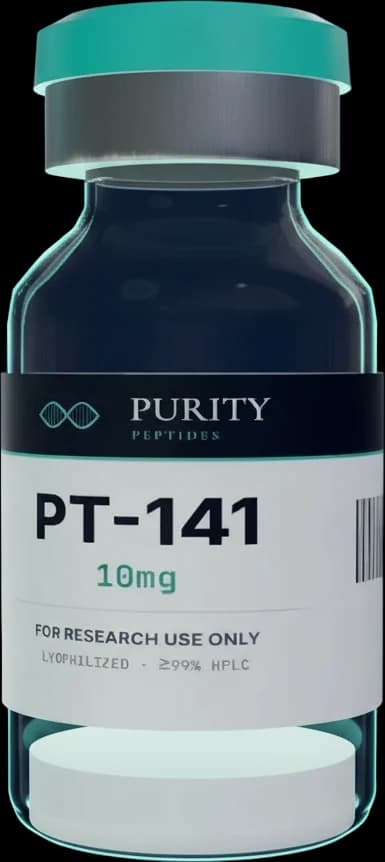
PT-141, known by its INN bremelanotide, is a cyclic heptapeptide melanocortin agonist derived from melanotan II. It differs from its parent by a C-terminal carboxylic acid in place of an amide, a change that reduces activity at MC1R and shifts its profile toward the central melanocortin receptors involved in sexual motivation.
Developed by Palatin Technologies, bremelanotide was evaluated in the phase 3 RECONNECT trials in premenopausal women with acquired, generalised hypoactive sexual desire disorder. The FDA approved it in 2019 as the prescription medicine Vyleesi; a European application was withdrawn. Reported adverse events in trials included nausea, flushing and transient increases in blood pressure. In the laboratory, PT-141 is used to study how central melanocortin pathways influence motivation and behaviour. Our product is the research-grade reference peptide and is not intended for human use.
Mechanism studied
- PT-141
- MC3R / MC4R
- Hypothalamic dopamine
- Desire-related signalling
Bremelanotide activates melanocortin receptors, principally MC4R and MC3R, in the hypothalamus and limbic system. Animal studies suggest MC4R activation in the medial preoptic area increases dopamine release, a pathway associated with sexual motivation and reward. Unlike phosphodiesterase-5 inhibitors, its action is central rather than vascular. Residual activity at MC1R accounts for focal skin darkening seen in some trial participants, while effects on autonomic signalling are thought to underlie transient blood-pressure changes.
Research highlights
- 01Cyclic heptapeptide derived from melanotan II with a C-terminal acid
- 02Phase 3 RECONNECT trials published in Obstetrics & Gynecology (2019)
- 03FDA-approved in 2019 as Vyleesi for premenopausal HSDD
- 04Acts centrally via MC4R rather than through vascular mechanisms
- 05European marketing application was withdrawn
Research areas
- Central MC4R signalling
- Sexual-motivation neurobiology
- Melanocortin pharmacology
- Cardiovascular response studies
Evidence & regulatory status
Overall status: Approved (Rx, US) — premenopausal HSDD
Key references
- [1]Kingsberg et al., 2019 — Obstet Gynecol
- [2]Vyleesi® prescribing information — FDA
Latest published research
113 papers on PubMed →Peptides in urology and sexual medicine: clinical effectiveness, dosing, indications, and safety: a narrative review
Vasylieva V et al. · Sexual medicine reviews · 2026 Sep 30 · PMID 42862021
Comprehensive characterization of bremelanotide acetate and its degradants by LC-HRMS/MS and predicting epimerization through computational modelling
Yuvaraaj VK et al. · Analytical methods : advancing methods and applications · 2026 Aug 20 · PMID 42485063
Goldilocks-Inspired Design of Mid-Size Macrocycles for Selective Targeting of Human Melanocortin Receptors
Merlino F et al. · Journal of medicinal chemistry · 2026 Aug 13 · PMID 42340853
Strategies for Treating Sexual Health Concerns After Breast and Gynecologic Cancer
Mihulka O et al. · Journal of minimally invasive gynecology · 2026 Jul · PMID 41419078
Clinical trial evidence on emerging pharmacological therapies for hypoactive sexual desire disorder in women: a systematic review and analysis of completed studies registered on ClinicalTrials.gov
Ashour AM et al. · Frontiers in medicine · 2026 · PMID 42254382
FDA-Approved Drugs Containing D-Amino Acids: A Historical and Developmental Perspective
Tran L et al. · Drug development research · 2026 May · PMID 42041173
Should Bremelanotide Be Considered for the Treatment of Sexual Arousal and Desire Disorders in Men?
Pfaus JG et al. · Journal of clinical psychopharmacology · 2026 May-Jun 01 · PMID 41960633
Therapeutic Peptides in Aesthetic, Metabolic and Endocrine Conditions: Effects, Safety, Clinical Applications, and Future Perspectives
Renke G et al. · International journal of molecular sciences · 2026 Apr 27 · PMID 42123471
Live feed from PubMed (NCBI) for “PT-141 (Bremelanotide)”, updated 2026-10-30. Listing a paper is not an endorsement of its findings.
Registered studies
10 on ClinicalTrials.gov →- CompletedPhase 4
Single Dose of Vyleesi in Lactating Female Subjects to Measure the Concentration of Bremelanotide in Breast Milk
NCT06867835 · Cosette Pharmaceuticals, Inc. · 2025-07-11
- Active not recruitingPhase 2
A Phase 2 Study Evaluating the Co-Administration of Bremelanotide With Tirzepatide for the Treatment of Obesity
NCT06565611 · Palatin Technologies, Inc · 2024-08-05
- CompletedPhase 3
A Phase 3, Bridging, Multicenter, Randomized, Double-blind, Placebo-controlled, Parallel-group Trial to Evaluate the Efficacy and Safety of Subcutaneously Administered Bremelanotide in Premenopausal Women With Hypoactive Sexual Desire Disorder (With or Without Decreased Arousal)
NCT04943068 · Kwang Dong Pharmaceutical co., ltd. · 2021-05-10
- CompletedPhase 2
A Phase IIb, Multicenter, Open-Label, Prospective Study of Bremelanotide in Diabetic Kidney Disease
NCT05709444 · Palatin Technologies, Inc · 2022-12-26
- CompletedPhase 4
Role of the Melanocortin-4 Receptor in Hypoactive Sexual Desire Disorder
NCT04179734 · Imperial College Healthcare NHS Trust · 2019-10-07
- CompletedPhase 1
Study to Evaluate Rate of Nausea in Healthy Premenopausal Female Subjects Treated With Single Dose of Bremelanotide Alone or With Zofran
NCT03973047 · AMAG Pharmaceuticals, Inc. · 2019-06-17
- CompletedPhase 3
1. Study to Evaluate the Efficacy/Safety of Bremelanotide in Premenopausal Women With Hypoactive Sexual Desire Disorder
NCT02333071 · Palatin Technologies, Inc · 2014-12
- CompletedPhase 3
2. Study to Evaluate the Efficacy/Safety of Bremelanotide in Premenopausal Women With Hypoactive Sexual Desire Disorder
NCT02338960 · Palatin Technologies, Inc · 2015-01
From the public ClinicalTrials.gov registry for “PT-141 (Bremelanotide)”, updated 2026-10-30. Shown for research context only; Purity Peptides products are not for human use.
FAQ
Vyleesi is the FDA-approved prescription product containing bremelanotide, the same molecule known as PT-141. Our product is a research-grade reference peptide supplied for laboratory investigation only; it is not a medicine, has not been formulated for clinical use and must not be administered to people.
Lyophilized PT-141 is normally kept sealed at −20 °C, protected from light and moisture. Once reconstituted for laboratory work, aliquots are held at 2–8 °C for short-term use or frozen, avoiding repeated freeze–thaw. Follow the lot-specific guidance on the certificate of analysis.
Every lot of PT-141 ships with a certificate of analysis reporting HPLC purity, mass-spectrometry identity against the expected molecular weight, appearance and lot number. Match the COA lot to the vial label and keep it with your experimental records.
Last updated October 2026 · Reviewed by the Purity Peptides research team · Information is a summary of published literature and is not a recommendation for any use.