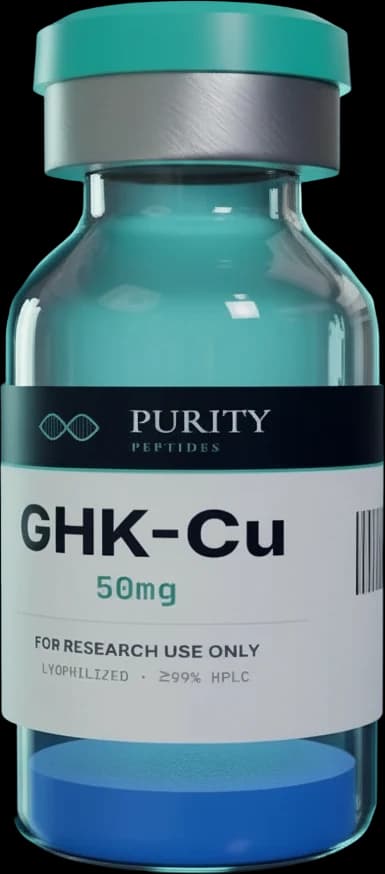
Research reviews
GHK-Cu Copper Peptide: A Research Review
GHK-Cu reviewed: discovery in human plasma, copper coordination chemistry, matrix and gene-expression studies, animal wound models and evidence gaps.
October 30, 2026 · 6 min read · Purity Peptides research team
GHK-Cu is the copper(II) complex of the tripeptide glycyl-L-histidyl-L-lysine. It is one of the few research peptides with a well-defined endogenous origin, a characterised metal-binding chemistry and a five-decade publication record. It is also widely used as a cosmetic ingredient, which has generated more commercial claims than controlled data. This review separates what has been measured from what has been inferred.
Origin and discovery
Loren Pickart identified GHK in 1973 while studying differences in how plasma from younger and older donors affected protein synthesis in cultured liver tissue. Working with Melvin Thaler, he isolated a small factor from the albumin fraction of human plasma and later identified it as the tripeptide Gly-His-Lys, which binds copper with high affinity.
The same sequence occurs within larger extracellular proteins, including the α2 chain of type I collagen and the matricellular protein SPARC. Lane et al. (1994) showed that proteolysis of SPARC released copper-binding GHK-containing peptides with angiogenic activity. This supports a model in which GHK is generated locally at sites of tissue damage as matrix proteins are broken down, acting as a signal of injury.
Plasma GHK concentrations have been reported to decline with age, an observation that has driven much of the later interest in the molecule, although the physiological significance of that decline has not been established.
Structure and chemistry
GHK has the formula C14H24N6O4 and an average molecular weight of about 340.4 Da. The copper complex is roughly 404 Da depending on the counter-ions present.
Copper(II) is coordinated by:
- the free α-amino nitrogen of glycine,
- the deprotonated amide nitrogen of the Gly–His peptide bond, and
- the imidazole nitrogen of histidine.
A fourth position is typically occupied by a carboxylate oxygen from a neighbouring GHK molecule or by water, and the lysine side chain remains free and positively charged. The lysine is thought to help the complex interact with cell-surface or matrix components. Because the binding affinity is high enough to compete with albumin for copper but low enough to release the ion to cellular uptake systems, GHK has been described as a copper transport and delivery molecule.
GHK-Cu is blue in solution. Its colour and absorbance are sensitive to pH and to the ratio of copper to peptide, so research material is often characterised by both HPLC purity of the peptide and copper content.
Mechanism studied
Proposed mechanisms fall into three groups:
- Copper delivery. Copper is a cofactor for lysyl oxidase, which cross-links collagen and elastin, and for superoxide dismutase. GHK may supply copper to these enzymes in tissues.
- Matrix remodelling. Maquart et al. (1988) reported that GHK-Cu stimulated collagen synthesis in fibroblast cultures. Later studies described effects on glycosaminoglycan synthesis and on the balance between matrix metalloproteinases and their tissue inhibitors.
- Gene expression. Using the Broad Institute's Connectivity Map, Pickart and colleagues reported that GHK was associated with altered expression of a large number of human genes, including genes linked to repair, antioxidant defence and inflammation. Campbell et al. (2012) identified GHK as a compound predicted to reverse a gene-expression signature of emphysematous lung destruction, and confirmed restoration of TGF-β-related signalling and contractile organisation in cultured lung fibroblasts from patients with COPD.
No specific cell-surface receptor for GHK or GHK-Cu has been identified. Whether gene-expression effects are mediated by copper, by the peptide itself, or by both is unresolved.
Research landscape by model system
In vitro
Fibroblast cultures dominate the literature, with endpoints including collagen and elastin synthesis, decorin expression, proliferation and migration. Keratinocyte, endothelial and stem-cell cultures have also been used. Results vary with copper-to-peptide ratio, concentration and culture conditions, and very high concentrations can reduce cell viability, so concentration–response data matter.
Animal models
- Wound repair. Rat, rabbit and other animal wound models have examined wound contraction, granulation tissue and angiogenesis, generally reporting faster closure with GHK-Cu-containing materials.
- Biomaterials. GHK-Cu has been incorporated into collagen dressings, hydrogels and nanofibre scaffolds to test whether controlled release supports tissue formation.
- Other systems. Rodent studies have examined lung injury, nerve regeneration and hair follicle biology, but each area rests on a small number of papers.
Human studies
Most human data come from cosmetic studies of skin appearance, often small, short and industry-funded, with variable blinding. These studies were not designed to test medical endpoints and their findings should not be read as clinical evidence. No drug-development programme for GHK-Cu has reached regulatory approval.
Evidence quality and open questions
Evidence quality is low to moderate. The chemistry and endogenous presence of GHK are well established, and in vitro matrix effects have been reproduced by independent groups. The broader regenerative and gene-expression claims rest heavily on computational analyses and on reviews from a limited number of authors.
Open questions include:
- Receptor and uptake. How GHK-Cu enters cells and what, if anything, it binds is unknown.
- Copper versus peptide. Many studies lack copper-only and peptide-only controls.
- Connectivity Map findings. Transcriptional associations from cell-line databases require validation at the protein and tissue level.
- Stability. GHK is susceptible to enzymatic cleavage, and the copper complex can be disrupted by chelators or pH changes in formulation.
Regulatory and anti-doping status
GHK-Cu is not approved as a drug by the FDA or EMA. Under the INCI name "copper tripeptide-1" it is listed as a cosmetic ingredient, which is a separate regulatory category from medicines and does not involve review of efficacy claims. GHK-Cu is not named on the WADA Prohibited List at the time of writing, though researchers working with athletes should check the current list. Research-grade material is supplied for laboratory use only.
Summary table
| Attribute | GHK-Cu |
|---|---|
| Type | Endogenous tripeptide–copper(II) complex |
| Sequence | Gly-His-Lys (GHK) |
| Approx. molecular weight | ~340 Da (peptide); ~404 Da (copper complex) |
| Origin | Isolated from human plasma (Pickart, 1973); also released from SPARC and collagen |
| Proposed mechanisms | Copper delivery, matrix synthesis and remodelling, broad gene-expression effects |
| Main model systems | Fibroblast cultures, animal wound models, biomaterial scaffolds |
| Human data | Small cosmetic studies only |
| Evidence level | Low to moderate |
| FDA / EMA | Cosmetic ingredient; not approved as a medicine |
| WADA | Not named (check current list) |
References
- Pickart L, Thaler MM. Tripeptide in human serum which prolongs survival of normal liver cells and stimulates growth in neoplastic liver. Nat New Biol. 1973;243(124):85–87.
- Maquart FX, Pickart L, Laurent M, Gillery P, Monboisse JC, Borel JP. Stimulation of collagen synthesis in fibroblast cultures by the tripeptide-copper complex glycyl-L-histidyl-L-lysine-Cu2+. FEBS Lett. 1988;238(2):343–346.
- Lane TF, Iruela-Arispe ML, Johnson RS, Sage EH. SPARC is a source of copper-binding peptides that stimulate angiogenesis. J Cell Biol. 1994;125(4):929–943.
- Campbell JD, McDonough JE, Zeskind JE, et al. A gene expression signature of emphysema-related lung destruction and its reversal by the tripeptide GHK. Genome Med. 2012;4(8):67.
- Pickart L, Vasquez-Soltero JM, Margolina A. GHK peptide as a natural modulator of multiple cellular pathways in skin regeneration. Biomed Res Int. 2015;2015:648108.
- Pickart L, Margolina A. Regenerative and protective actions of the GHK-Cu peptide in the light of the new gene data. Int J Mol Sci. 2018;19(7):1987.
FOR RESEARCH USE ONLY.Not for human or veterinary use. Not intended to diagnose, treat, cure, or prevent any disease.