Science explained
TFA vs Acetate: Peptide Salt Forms and Net Content
Why peptides carry TFA, acetate or chloride counter-ions, how salt form changes powder mass, and how net peptide content differs from HPLC purity.
October 30, 2026 · 6 min read · Purity Peptides research team

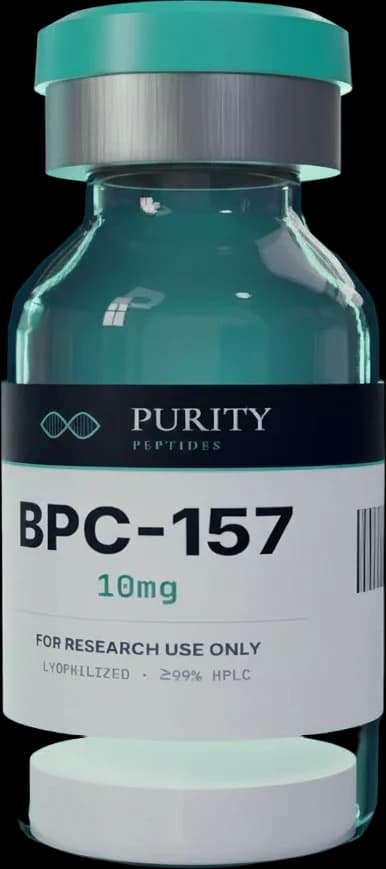
A vial labelled "10 mg" of a 99% pure peptide does not contain 10 mg of that peptide. Part of the powder is counter-ion and part is water. This surprises many researchers, but it follows directly from how peptides are made and purified. This article explains salt forms, why they matter, and how to use net peptide content correctly.
Peptides are salts
Most peptides contain ionisable groups. The free N-terminus and the side chains of lysine, arginine and histidine are basic and carry a positive charge under acidic conditions. Aspartic acid, glutamic acid and the free C-terminus are acidic and can carry a negative charge.
When a peptide is isolated as a dry solid, every positive charge must be balanced by a negative ion. That negative ion is the counter-ion. The peptide is therefore not a neutral molecule in the vial but a salt: peptide plus counter-ions, plus some tightly bound water.
Where TFA comes from
Trifluoroacetic acid (TFA, CF₃COOH) is everywhere in peptide manufacturing:
- Cleavage. In Fmoc solid-phase synthesis, concentrated TFA releases the peptide from the resin and removes side-chain protecting groups.
- Purification. Preparative reverse-phase HPLC uses water and acetonitrile containing about 0.1% TFA, which sharpens peaks by ion pairing.
- Isolation. The purified fractions are lyophilised. Excess free TFA evaporates, but TFA bound to basic groups stays as trifluoroacetate.
The default product of standard synthesis and purification is therefore a TFA salt. A peptide with four basic sites will typically carry about four trifluoroacetate ions per molecule.
Common salt forms
| Salt form | Counter-ion mass | How produced | Typical notes |
|---|---|---|---|
| Trifluoroacetate (TFA) | 113 Da (as CF₃COO⁻; 114 as acid) | Default from synthesis and HPLC | Cheapest; can interfere in some biological assays |
| Acetate | 59 Da (60 as acid) | Ion exchange or HPLC with acetic acid buffers | Common in pharmaceutical peptides; generally well tolerated in cell work |
| Hydrochloride (chloride) | 35.5 Da (36.5 as HCl) | Repeated lyophilisation from dilute HCl, or ion exchange | Lightest counter-ion; may be harsh for acid-sensitive sequences |
Many approved peptide drugs are supplied as acetate salts; larazotide acetate, an intestinal permeability modulator studied in clinical trials, is one example that carries the salt in its name.
Why the counter-ion can matter
Biological effects
TFA is not inert in every system. Cornish and colleagues reported in 1999 that trifluoroacetate inhibited the proliferation of osteoblasts and chondrocytes in culture at concentrations that can arise from peptide preparations. Other groups have described counter-ion effects on antimicrobial activity and cytotoxicity measurements. TFA can also alter the apparent secondary structure of peptides in infrared spectroscopy, since it absorbs strongly near the amide I band.
None of this means TFA salts are unusable. For many biochemical and analytical applications they are perfectly adequate. But for sensitive cell-based assays, an acetate or hydrochloride form removes one variable.
Mass and molar calculations
Counter-ions add mass. Consider a peptide of molecular weight 1,500 Da with five basic sites:
- As the free base: 1,500 Da
- As the TFA salt: 1,500 + 5 × 114 ≈ 2,070 Da
- As the acetate salt: 1,500 + 5 × 60 ≈ 1,800 Da
In this example, TFA would make up more than a quarter of the powder mass. Short, highly basic peptides, such as arginine-rich sequences, are affected most. Peptides with few basic groups, such as BPC-157 (which has a single lysine plus its N-terminus), carry proportionally less counter-ion.
Purity vs net peptide content
These two measurements answer different questions and should never be substituted for each other.
- HPLC purity asks: of the peptide-related material that absorbs at 214 nm, what fraction is the correct sequence? Counter-ions, water and inorganic salts are invisible to this measurement.
- Net peptide content (NPC) asks: of the total powder mass weighed out, what fraction is peptide of any kind?
Net peptide content for research peptides commonly falls between about 70% and 90%, depending on sequence, salt form and residual moisture.
How net peptide content is measured
- Amino acid analysis (AAA). The peptide is hydrolysed in strong acid into its constituent amino acids, which are quantified against standards. The total amount of peptide is calculated from the known sequence. This is the reference method, described in Ph. Eur. 2.2.56 and USP ⟨1052⟩.
- Elemental (CHN) analysis. Nitrogen content is measured by combustion and compared with the theoretical nitrogen content of the peptide. It is simple but less specific, since any nitrogen-containing impurity contributes.
- Quantitative NMR or UV absorbance. Used in some laboratories, particularly for peptides with aromatic residues.
Counter-ion content itself can be measured directly by ion chromatography, by ¹⁹F NMR for TFA, or by HPLC for acetate (USP ⟨503⟩ describes acetic acid in peptides).
Putting the numbers together
To estimate how much target peptide is present in a vial:
target peptide mass = labelled powder mass × net peptide content × HPLC purity
For a vial labelled 5 mg with 85% net peptide content and 98.5% HPLC purity:
5 × 0.85 × 0.985 ≈ 4.19 mg of target peptide.
If you are preparing solutions at a defined molar concentration, use this corrected figure and the molecular weight of the free peptide (not the salt) in your calculation. Ignoring the correction would overstate the concentration by roughly 15–20% in this example. Some suppliers instead fill vials to a specified net peptide mass; check the certificate and label to see which convention applies.
Converting between salt forms
TFA can be exchanged for acetate or chloride after purification. Common approaches are:
- Ion-exchange chromatography, binding the peptide and eluting with an acetate buffer
- Repeated lyophilisation from dilute hydrochloric acid, which displaces trifluoroacetate with chloride
- Preparative HPLC with acetic acid in the mobile phase instead of TFA
Each step adds cost and some yield loss, which is why acetate and hydrochloride salts are usually priced higher than TFA salts. A complete certificate states the salt form, and ideally reports the residual TFA content.
Checklist
- Identify the stated counter-ion on the label or certificate.
- Note net peptide content separately from HPLC purity.
- Correct for content when molar concentration matters.
- Use the free-peptide molecular weight in molarity calculations.
- For cell-based work, consider whether an acetate or hydrochloride form is preferable.
For more on reading these values, see how to read a certificate of analysis.
References
- Cornish J, Callon KE, Lin CQ, et al. Trifluoroacetate, a contaminant in purified proteins, inhibits proliferation of osteoblasts and chondrocytes. Am J Physiol. 1999;277(5):E779–E783.
- Andrushchenko VV, Vogel HJ, Prenner EJ. Optimization of the hydrochloric acid concentration used for trifluoroacetate removal from synthetic peptides. J Pept Sci. 2007;13(1):37–43.
- European Pharmacopoeia. 2.2.56 Amino Acid Analysis.
- United States Pharmacopeia. General Chapter ⟨1052⟩ Biotechnology-Derived Articles—Amino Acid Analysis. USP–NF.
- United States Pharmacopeia. General Chapter ⟨503⟩ Acetic Acid in Peptides. USP–NF.
- US Food and Drug Administration. ANDAs for Certain Highly Purified Synthetic Peptide Drug Products That Refer to Listed Drugs of rDNA Origin. Guidance for Industry. 2021.
FOR RESEARCH USE ONLY.Not for human or veterinary use. Not intended to diagnose, treat, cure, or prevent any disease.