Overview
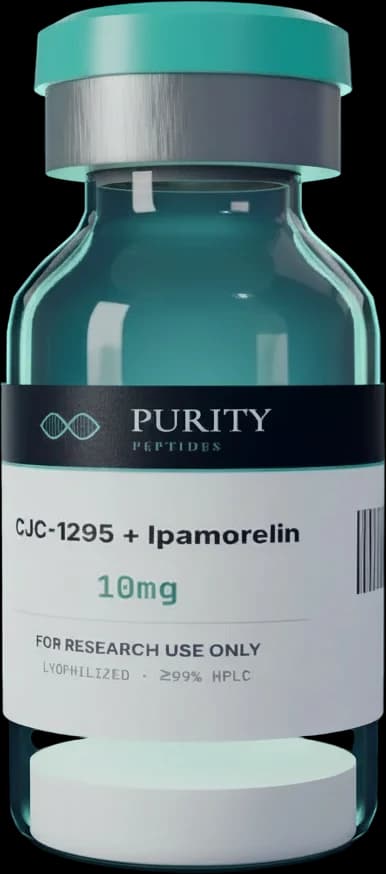
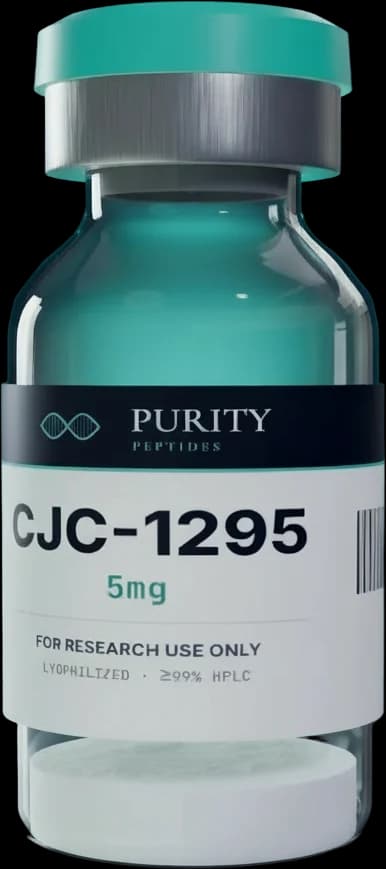
CJC-1295 without DAC, often called modified GRF (1-29), is a synthetic analogue of the first 29 amino acids of growth hormone-releasing hormone — the shortest fragment that retains full biological activity. Four amino-acid substitutions were introduced to resist cleavage by dipeptidyl peptidase-4 and to reduce oxidation and rearrangement, extending its activity compared with native GHRH(1-29).
Because it lacks the albumin-binding Drug Affinity Complex, this version has a short circulating half-life and produces brief, pulse-like rises in growth hormone in experimental settings rather than a sustained elevation. That property makes it a useful tool for researchers studying the physiology of pulsatile GH release and how GHRH analogues interact with ghrelin-receptor agonists. It has not been approved as a medicine by any regulator and appears on the WADA Prohibited List. We supply it as a research reference peptide only.
Mechanism studied
- CJC-1295
- GHRH receptor
- Pituitary GH pulse
- Hepatic IGF-1
CJC-1295 (no DAC) acts as an agonist at the GHRH receptor, a Gs-coupled receptor on pituitary somatotrophs. Receptor activation raises intracellular cAMP and activates protein kinase A, promoting GH gene transcription and the release of stored hormone. Because endogenous somatostatin tone still applies, GH output remains pulsatile. Circulating GH then stimulates hepatic IGF-1 production. The substitutions at positions 2, 8, 15 and 27 are designed to slow enzymatic degradation without altering receptor recognition.
Research highlights
- 01Tetrasubstituted analogue of GHRH(1-29) engineered for enzymatic stability
- 02Short half-life distinguishes it from the albumin-binding DAC version
- 03Frequently paired with ghrelin-receptor agonists in GH physiology research
- 04No completed clinical development programme for the non-DAC form
- 05GHRH analogues are prohibited in sport under WADA class S2
Research areas
- Pulsatile GH secretion studies
- GHRH receptor pharmacology
- Peptide stability engineering
- GH/IGF-1 axis research
Evidence & regulatory status
Overall status: Not approved — research
Key references
- [1]Teichman et al., 2006 — J Clin Endocrinol Metab 91(3):799–805
- [2]Ionescu & Frohman, 2006 — J Clin Endocrinol Metab
- [3]PubMed — reviews on GH secretagogues
- [4]WADA — Prohibited List of Substances and Methods
Latest published research
36 papers on PubMed →Detection of CJC-1295 in Equine Plasma by ELISA
Timms M et al. · Drug testing and analysis · 2026 Oct 14 · PMID 42876013
Peptides in urology and sexual medicine: clinical effectiveness, dosing, indications, and safety: a narrative review
Vasylieva V et al. · Sexual medicine reviews · 2026 Sep 30 · PMID 42862021
Peptide Supplements and Their Therapeutic Applications in Sports Medicine
Tewari K et al. · The American journal of sports medicine · 2026 Aug 11 · PMID 42578445
Safety and Efficacy of Approved and Unapproved Peptide Therapies for Musculoskeletal Injuries and Athletic Performance
Mendias CL et al. · Sports medicine (Auckland, N.Z.) · 2026 Aug · PMID 41966639
A new era of doping? Use of peptide and peptide-analog drugs in recreational and professional sport and bodybuilding: a critical review
Coutinho LFD et al. · The Journal of sports medicine and physical fitness · 2026 Jul · PMID 41880199
The emerging landscape of performance-enhancing peptides modulating GH-IGF1 axis: bridging the gap between clinical evidence and patient self-administration
Dominikowski A et al. · Frontiers in endocrinology · 2026 · PMID 42395176
Injectable Peptides in Sports Medicine: A Structured Narrative Review of Evidence, Safety, and Antidoping Implications
Villegas Meza AD et al. · JBJS reviews · 2026 May 1 · PMID 42160466
Therapeutic Peptides in Aesthetic, Metabolic and Endocrine Conditions: Effects, Safety, Clinical Applications, and Future Perspectives
Renke G et al. · International journal of molecular sciences · 2026 Apr 27 · PMID 42123471
Live feed from PubMed (NCBI) for “CJC-1295 (no DAC)”, updated 2026-10-30. Listing a paper is not an endorsement of its findings.
Registered studies
48 on ClinicalTrials.gov →- RecruitingPhase 2
MYELOMATCH: A Screening Study to Assign People With Myeloid Cancer to a Treatment Study or Standard of Care Treatment Within myeloMATCH (MyeloMATCH Screening Trial)
NCT05564390 · National Cancer Institute (NCI) · 2024-06-18
- RecruitingPhase 1Phase 2
Phase I/II Study of Engineered T Cell Receptor-Modified NK Cells Targeting PRAME in Conjunction With Lymphodepleting Chemotherapy for the Management of Relapse/Refractory Myeloid Malignancies
NCT06383572 · M.D. Anderson Cancer Center · 2024-06-26
- CompletedPhase 2
Venetoclax and Decitabin Based Conditioning Regimen Followed With Post-HSCT Decitabin Maintenance Therapy in TP53 Mutant AML/MDS Patients
NCT05528354 · Zhejiang University · 2022-06-02
- RecruitingPhase 1
A Study to Find the Highest Dose of Cedazuridine and Decitabine Combination With Filgrastim as a Treatment Option After Hematopoietic Stem Cell Transplant in Children With High-Risk Acute Myeloid Leukemia
NCT07012044 · National Cancer Institute (NCI) · 2026-06-09
- Active not recruitingPhase 1
Olaparib and ASTX727 in BRCA1/2- and Homologous Recombination Deficient (HRD)-Mutated Tumors
NCT06177171 · Varun Monga, MBBS · 2024-02-07
- Not yet recruitingPhase 1
Hydrochloroquinine & Decitabine With Venetoclax in AML
NCT07814339 · Rutgers, The State University of New Jersey · 2026-09
- Not yet recruitingPhase 3
Umbilical Cord Blood Consolidation for Older Adults With Intermediate- and High-Risk AML
NCT07761702 · Shanghai Jiao Tong University School of Medicine · 2026-10-01
- WithdrawnPhase 1
Decitabine and Nivolumab in Participants With Recurrent/Metastatic Squamous Cell Carcinoma of the Head and Neck
NCT07216833 · Case Comprehensive Cancer Center · 2026-01
From the public ClinicalTrials.gov registry for “CJC-1295 (no DAC)”, updated 2026-10-30. Shown for research context only; Purity Peptides products are not for human use.
FAQ
Both share the same modified GRF(1-29) backbone. The DAC version carries a lysine-linked maleimide group that binds serum albumin, extending its half-life to several days, while the non-DAC peptide is cleared within hours. Researchers choose between them depending on whether brief or sustained receptor activation is being modelled.
Lyophilized CJC-1295 is normally kept sealed at −20 °C, protected from light and moisture. Once reconstituted for laboratory work, aliquots are held at 2–8 °C for short-term use or frozen, avoiding repeated freeze–thaw. Follow the lot-specific guidance on the certificate of analysis.
Every lot of CJC-1295 ships with a certificate of analysis reporting HPLC purity, mass-spectrometry identity against the expected molecular weight, appearance and lot number. Match the COA lot to the vial label and keep it with your experimental records.
Last updated October 2026 · Reviewed by the Purity Peptides research team · Information is a summary of published literature and is not a recommendation for any use.