Science explained
Peptide Half-Life Engineering: Lipidation, PEG and DAC
How chemists extend peptide half-life: lipidation, albumin binding and DAC, PEGylation, Fc fusion, D-amino acids and cyclisation, with examples.
October 30, 2026 · 6 min read · Purity Peptides research team

Native peptide hormones are often cleared within minutes. Glucagon-like peptide-1 (GLP-1), for example, has a circulating half-life of only a couple of minutes because the enzyme dipeptidyl peptidase-4 (DPP-4) clips off its first two residues, and the kidneys filter small peptides rapidly. This article explains the main strategies for extending it, with catalogue examples.
Why peptides disappear so quickly
Three mechanisms dominate peptide clearance:
- Enzymatic degradation. Proteases and peptidases in blood and tissues cleave specific bonds. DPP-4, neprilysin and various aminopeptidases are common culprits.
- Renal filtration. The kidney's glomerular filter lets through molecules below roughly 60 kDa (the size of albumin) relatively freely. Most therapeutic peptides are 1–5 kDa.
- Receptor-mediated uptake. Binding to the target receptor can lead to internalisation and breakdown.
Each strategy below resists enzymes, increases apparent size, or binds a long-lived carrier.
Overview of strategies
| Strategy | Main mechanism | Catalogue examples |
|---|---|---|
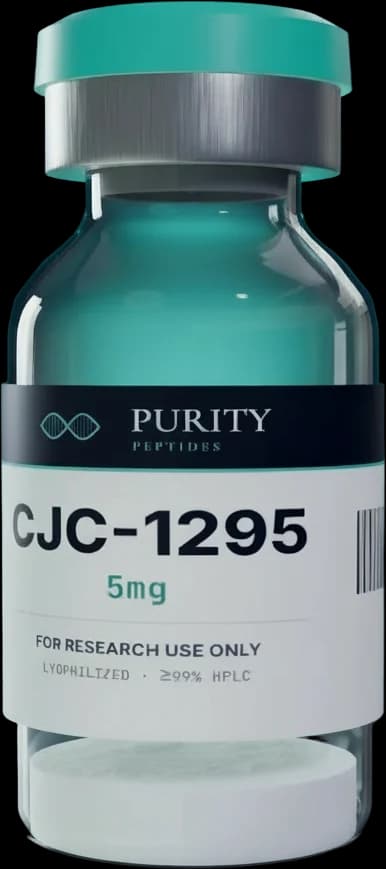
| Amino acid substitution | Blocks a protease cleavage site | Semaglutide (Aib8), CJC-1295 (no DAC) |
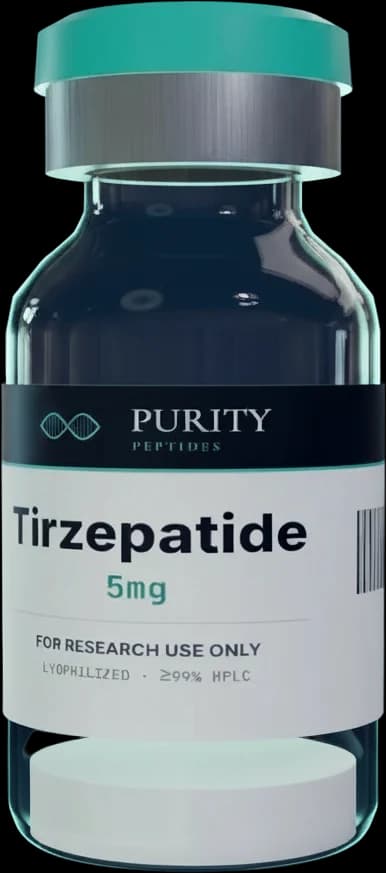
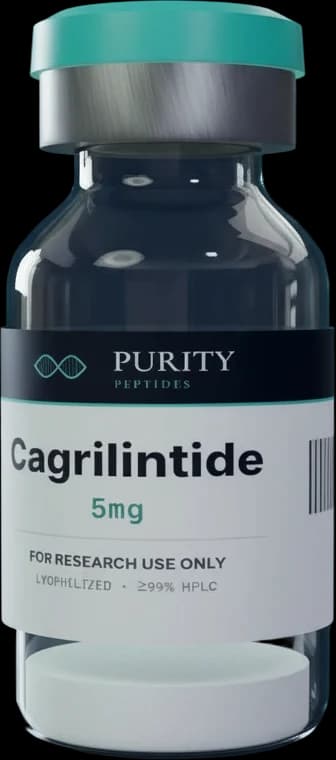
| Lipidation | Reversible binding to serum albumin | Liraglutide, semaglutide, tirzepatide, cagrilintide |
| Covalent albumin binding (DAC) | Permanent attachment to albumin | CJC-1295 DAC |
| PEGylation | Increases hydrodynamic size; shields from enzymes | Pegvisomant, PEG-MGF |
| Fc fusion or conjugation | Large size plus FcRn recycling | Dulaglutide, efpeglenatide |
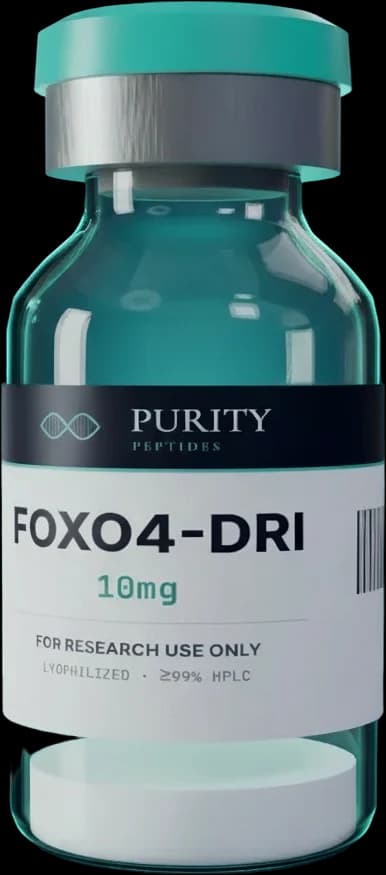
| D-amino acids | Proteases do not recognise D-residues | Leuprorelin, triptorelin, desmopressin, FOXO4-DRI |
| Cyclisation | Rigid structure resists proteolysis | Octreotide, linaclotide, setmelanotide |
Amino acid substitution
The simplest change is to replace the residue at a cleavage site. DPP-4 cuts after an alanine or proline in position 2. Exenatide naturally has glycine there and is far more resistant than GLP-1. Semaglutide replaces alanine 8 with α-aminoisobutyric acid (Aib), a non-natural residue with two methyl groups that DPP-4 cannot accommodate. Tirzepatide also contains Aib residues.
CJC-1295 without DAC, also called modified GRF (1-29), applies the same idea to growth hormone-releasing hormone. Four substitutions (D-alanine at position 2, glutamine at 8, alanine at 15 and leucine at 27) improve resistance to enzymatic cleavage and chemical degradation compared with native GHRH (1-29), which is cleared within minutes.
Lipidation: fatty-acid side chains
Serum albumin is the most abundant protein in plasma and has a half-life of about three weeks, protected by recycling through the neonatal Fc receptor (FcRn). Attaching a fatty acid to a peptide lets it bind albumin reversibly, which both shields it from kidney filtration and slows enzymatic access.
The development path from liraglutide to semaglutide, described by Knudsen and Lau, illustrates how the design is refined:
- Liraglutide carries a C16 (palmitic) fatty acid attached through a glutamic acid spacer to lysine 26. Its half-life in humans is about 13 hours.
- Semaglutide uses a C18 fatty diacid with a longer hydrophilic linker, which binds albumin more strongly, together with the Aib substitution. Its reported half-life is about 7 days (Lau et al., 2015).
- Tirzepatide, a dual GIP/GLP-1 receptor agonist, carries a C20 fatty diacid and has a reported half-life of about 5 days.
- Cagrilintide, a long-acting amylin analogue, is likewise lipidated with a fatty diacid.
Covalent albumin binding: DAC
Drug Affinity Complex (DAC) technology takes a different route. The peptide carries a reactive maleimide group that forms a covalent bond with the single free cysteine (Cys34) of circulating albumin.
CJC-1295 DAC is modified GRF (1-29) with a lysine-linked maleimidopropionyl group added at the C-terminus. Jetté and colleagues showed in 2005 that it conjugates to albumin and produces prolonged activity in rats. A study in healthy adults by Teichman and colleagues (2006) reported an estimated half-life of about 6–8 days, compared with minutes for native GHRH. The core sequence matches CJC-1295 without DAC; the pharmacokinetics do not.
PEGylation
Polyethylene glycol (PEG) is a flexible, highly hydrated polymer. Attaching PEG chains to a peptide or protein greatly increases its hydrodynamic size, pushing it above the renal filtration threshold, and creates a water shell that hinders protease access and immune recognition. Harris and Chess reviewed the approach in 2003.
- Pegvisomant, a growth hormone receptor antagonist, is a modified GH molecule carrying several 5 kDa PEG chains.
- PEG-MGF is a PEGylated form of mechano growth factor, the E-domain peptide of an IGF-1 splice variant, studied in research settings.
The trade-off is that PEG can reduce receptor binding affinity, so potency per molecule often falls even as exposure rises.
Fc fusion and conjugation
Fusing a peptide to the Fc portion of an antibody gives both large size and FcRn recycling. Dulaglutide consists of two GLP-1 analogue chains fused to a modified human IgG4 Fc. Efpeglenatide links an exendin-4 analogue to an Fc fragment through a short PEG linker.
D-amino acids
Proteases are chiral; they recognise L-amino acids. Replacing a key residue with its D-enantiomer can block cleavage while preserving activity if the D-residue also stabilises a favourable conformation.
- Leuprorelin and triptorelin are GnRH agonists with a D-amino acid at position 6 (D-leucine and D-tryptophan). This both resists cleavage and stabilises the bioactive turn, increasing potency many-fold over native gonadorelin.
- Desmopressin combines a D-arginine at position 8 with removal of the N-terminal amine, making it far more resistant to degradation than vasopressin.
- FOXO4-DRI takes the idea to its limit: it is a D-retro-inverso peptide, built entirely from D-amino acids in reversed order, so its side chains are presented similarly to the parent L-sequence while the backbone is not recognised by proteases (Baar et al., 2017).
Cyclisation
Linear peptides are flexible, and flexibility exposes cleavage sites. Linking parts of the chain together, through disulfide bonds, lactam bridges or head-to-tail cyclisation, locks the structure.
- Octreotide is a cyclic octapeptide (one disulfide) containing D-phenylalanine and D-tryptophan. Native somatostatin is cleared within minutes; octreotide's half-life is on the order of 1.5–2 hours (Bauer et al., 1982).
- Linaclotide has three disulfide bonds that make it highly resistant to digestion in the gut, where it acts locally.
- Setmelanotide is a cyclic MC4R agonist.
Combining strategies
Modern designs rarely rely on one technique: semaglutide pairs a substitution with lipidation, and octreotide pairs D-amino acids with a disulfide ring. For how such modifications are introduced, see solid-phase peptide synthesis explained.
References
- Deacon CF, Johnsen AH, Holst JJ. Degradation of glucagon-like peptide-1 by human plasma in vitro yields an N-terminally truncated peptide that is a major endogenous metabolite in vivo. J Clin Endocrinol Metab. 1995;80(3):952–957.
- Knudsen LB, Lau J. The discovery and development of liraglutide and semaglutide. Front Endocrinol. 2019;10:155.
- Lau J, Bloch P, Schäffer L, et al. Discovery of the once-weekly glucagon-like peptide-1 (GLP-1) analogue semaglutide. J Med Chem. 2015;58(18):7370–7380.
- Coskun T, Sloop KW, Loghin C, et al. LY3298176, a novel dual GIP and GLP-1 receptor agonist for the treatment of type 2 diabetes mellitus: from discovery to clinical proof of concept. Mol Metab. 2018;18:3–14.
- Jetté L, Léger R, Thibaudeau K, et al. Human growth hormone-releasing factor (hGRF)1-29-albumin bioconjugates activate the GRF receptor on the anterior pituitary in rats: identification of CJC-1295 as a long-lasting GRF analog. Endocrinology. 2005;146(7):3052–3058.
- Teichman SL, Neale A, Lawrence B, et al. Prolonged stimulation of growth hormone (GH) and insulin-like growth factor I secretion by CJC-1295, a long-acting analog of GH-releasing hormone, in healthy adults. J Clin Endocrinol Metab. 2006;91(3):799–805.
- Harris JM, Chess RB. Effect of pegylation on pharmaceuticals. Nat Rev Drug Discov. 2003;2(3):214–221.
- Bauer W, Briner U, Doepfner W, et al. SMS 201-995: a very potent and selective octapeptide analogue of somatostatin with prolonged action. Life Sci. 1982;31(11):1133–1140.
- Baar MP, Brandt RMC, Putavet DA, et al. Targeted apoptosis of senescent cells restores tissue homeostasis in response to chemotoxicity and aging. Cell. 2017;169(1):132–147.
FOR RESEARCH USE ONLY.Not for human or veterinary use. Not intended to diagnose, treat, cure, or prevent any disease.