Overview
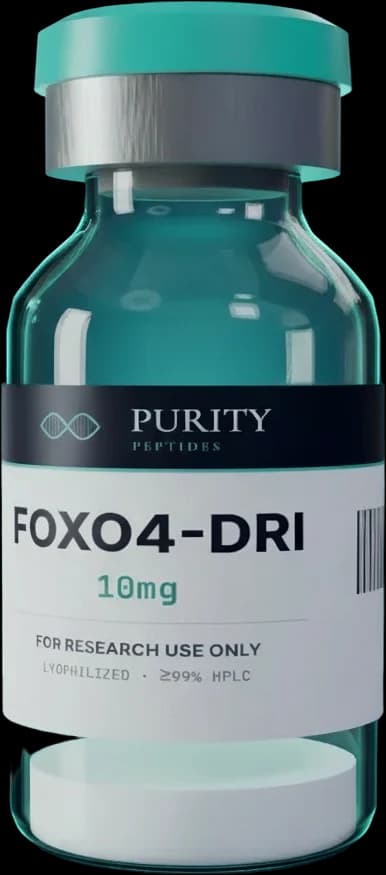
FOXO4-DRI is a synthetic peptide built from D-amino acids in reversed sequence order — a "retro-inverso" design that preserves the side-chain orientation of a natural peptide while making it resistant to proteases. It mimics a region of the transcription factor FOXO4 that binds the tumour suppressor p53.
The compound came to prominence in 2017, when a study in Cell reported that it selectively triggered apoptosis in senescent cells while sparing healthy ones. In fast-ageing and naturally aged mice, the treatment was associated with improved fur density, physical activity and kidney function. Follow-up work has applied it to senescent cells in other tissues, including testicular Leydig cells. Despite this attention, there are no published human trials, and the evidence base is limited to cell and rodent experiments. FOXO4-DRI is supplied here as a research tool for senescence biology only.
Mechanism studied
- FOXO4-DRI
- FOXO4–p53 disruption
- p53 nuclear exclusion
- Senescent cell apoptosis
In senescent cells, FOXO4 binds p53 and retains it in the nucleus, which helps those cells avoid apoptosis. FOXO4-DRI competes for this interaction. By displacing p53 from FOXO4, the peptide allows p53 to move to the mitochondria and initiate intrinsic apoptosis. Because healthy proliferating cells express little FOXO4 and do not depend on this interaction, the effect was reported to be selective for senescent cells. The retro-inverso backbone protects the peptide from proteolytic degradation, extending its activity in experimental systems.
Research highlights
- 01Retro-inverso D-peptide designed to disrupt the FOXO4–p53 interaction
- 02Landmark 2017 Cell study reported selective clearance of senescent cells
- 03Fast-ageing and naturally aged mice showed improvements in several fitness measures
- 04No human clinical trials have been published
- 05A reference compound in the broader senolytics research field
Research areas
- Senescent cell clearance models
- FOXO4–p53 interaction studies
- Ageing mouse models
- Senolytic drug discovery
Evidence & regulatory status
Overall status: Not approved — preclinical
Key references
- [1]Baar et al., 2017 — Cell 169(1):132–147
- [2]PubMed — reviews on senolytics and FOXO4
- [3]WADA — Prohibited List of Substances and Methods
Latest published research
19 papers on PubMed →Acylglycerol Kinase Sensitizes Glioblastoma to Temozolomide via Limiting Mitochondrial Damage Related Cellular Senescence
Ning N et al. · Molecular carcinogenesis · 2026 Sep · PMID 42391447
FOXO4 as a Redox-Sensitive Regulator of Antioxidant Defense and Cellular Senescence: Cysteine-Based Signaling, p53 Interaction, and Therapeutic Targeting
Mateescu DM et al. · Antioxidants (Basel, Switzerland) · 2026 Jul 3 · PMID 42510573
Targeting the FOXO4-p53 axis by retro-inverso peptide senolytic agents: a pharmacological strategy to mitigate brain aging and cognitive decline
Alameen AAM et al. · Naunyn-Schmiedeberg's archives of pharmacology · 2026 Jul · PMID 42024235
FOXO4-DRI regulates endothelial cell senescence via the P53 signaling pathway
Hu Z et al. · Frontiers in bioengineering and biotechnology · 2025 · PMID 41625068
The disordered p53 transactivation domain is the target of FOXO4 and the senolytic compound FOXO4-DRI
Bourgeois B et al. · Nature communications · 2025 Jul 1 · PMID 40593617
FOXO4-DRI induces keloid senescent fibroblast apoptosis by promoting nuclear exclusion of upregulated p53-serine 15 phosphorylation
Kong YX et al. · Communications biology · 2025 Feb 24 · PMID 39994346
FOXO4-DRI improves spermatogenesis in aged mice through reducing senescence-associated secretory phenotype secretion from Leydig cells
Li Y et al. · Experimental gerontology · 2024 Oct 1 · PMID 39025385
Cellular Senescence Contributes to the Progression of Hyperoxic Bronchopulmonary Dysplasia
Jing X et al. · American journal of respiratory cell and molecular biology · 2024 Feb · PMID 37874230
Live feed from PubMed (NCBI) for “FOXO4-DRI”, updated 2026-10-30. Listing a paper is not an endorsement of its findings.
FAQ
The peptide is synthesised from D-amino acids in reverse order. This keeps the side chains positioned much like the natural L-peptide, so it can still engage its target, while making the backbone resistant to proteases. The design is common in research peptides intended for longer activity in biological systems.
Lyophilized FOXO4-DRI is normally kept sealed at −20 °C, protected from light and moisture. Once reconstituted for laboratory work, aliquots are held at 2–8 °C for short-term use or frozen, avoiding repeated freeze–thaw. Follow the lot-specific guidance on the certificate of analysis.
Every lot of FOXO4-DRI ships with a certificate of analysis reporting HPLC purity, mass-spectrometry identity against the expected molecular weight, appearance and lot number. Match the COA lot to the vial label and keep it with your experimental records.
Last updated October 2026 · Reviewed by the Purity Peptides research team · Information is a summary of published literature and is not a recommendation for any use.