Research reviews
FOXO4-DRI and Senolytics: A Research Review
FOXO4-DRI reviewed alongside the wider senolytic field: senescence biology, the FOXO4–p53 interaction, retro-inverso design, mouse studies and open gaps.
October 30, 2026 · 6 min read · Purity Peptides research team

FOXO4-DRI is a synthetic peptide designed to eliminate senescent cells selectively. It was introduced in a single high-profile 2017 paper and has since become one of the best-known examples of a peptide senolytic. To understand what that paper showed, and what it did not, it helps to place it within the broader senolytic field, which includes small molecules that have advanced much further toward clinical testing.
Origin and discovery
Cellular senescence
Hayflick and Moorhead (1961) observed that normal human fibroblasts stop dividing after a finite number of population doublings. This state, later called replicative senescence, is now understood as one form of a broader response: a stable proliferative arrest triggered by telomere shortening, DNA damage, oncogene activation or other stresses. Senescent cells resist apoptosis and secrete a mix of cytokines, proteases and growth factors known as the senescence-associated secretory phenotype (SASP).
Senescence suppresses tumour formation and contributes to wound repair, but senescent cells accumulate with age. Baker et al. (2011) used the INK-ATTAC transgenic mouse, in which p16Ink4a-expressing cells can be selectively killed, to show that removing them delayed several age-related phenotypes in progeroid mice. That result launched the search for drugs that do the same thing, termed senolytics.
Small-molecule senolytics
Zhu et al. (2015) identified the combination of dasatinib and quercetin by targeting pro-survival pathways that senescent cells depend on. Chang et al. (2016) showed that navitoclax (ABT-263), a BCL-2 family inhibitor, cleared senescent haematopoietic stem cells in mice. These agents work by blocking anti-apoptotic networks, but they act on targets present in many normal cells too.
FOXO4-DRI
The laboratory of Peter de Keizer, then at Erasmus University Medical Center, investigated why senescent cells survive despite high p53 activity. Baar et al. (2017) found that the transcription factor FOXO4 was elevated in senescent cells and bound p53 in nuclear foci associated with DNA damage. Disrupting that interaction pushed senescent cells into apoptosis. The team designed FOXO4-DRI as a peptide to perform that disruption.
Structure and chemistry
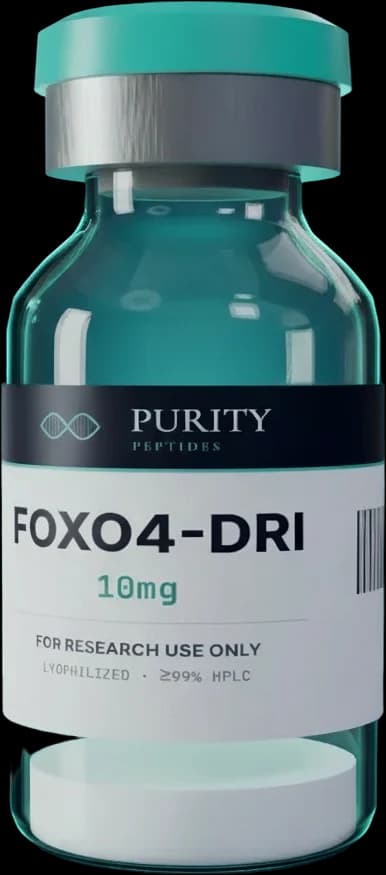
FOXO4-DRI is a D-retro-inverso (DRI) peptide. It is built from D-amino acids assembled in reverse order relative to a native FOXO4 sequence from the region involved in p53 binding, and it was reported to include a cell-penetrating sequence derived from HIV-TAT.
The retro-inverso design has two consequences:
- Protease resistance. Proteases generally do not recognise D-amino acid backbones, which extends the peptide's lifetime in biological systems.
- Side-chain mimicry. Reversing the sequence while inverting chirality places the side chains in a spatial arrangement that approximates the parent L-peptide, although backbone hydrogen-bonding patterns differ.
Combining the FOXO4-derived segment with a cell-penetrating sequence makes FOXO4-DRI much longer than most catalogue research peptides, and it is relatively expensive to synthesise at high purity. Identity confirmation by mass spectrometry is essential, because D- and L-forms have identical mass and standard HPLC does not distinguish them; chiral analysis or supplier documentation of D-amino acid sourcing is needed.
Mechanism studied
In senescent cells, FOXO4 binds p53 and retains it in the nucleus. Baar et al. reported that FOXO4-DRI competed with endogenous FOXO4 for p53 binding. Once released, p53 was excluded from the nucleus and engaged the intrinsic apoptotic pathway, leading to caspase-dependent cell death.
The proposed selectivity rests on two observations: proliferating cells express little FOXO4, and they do not rely on the FOXO4–p53 interaction for survival. In the original study, FOXO4-DRI reduced viability of senescent fibroblasts substantially more than of their non-senescent counterparts.
Research landscape by model system
In vitro
Baar et al. tested FOXO4-DRI in human IMR90 fibroblasts made senescent by ionising radiation, and compared it with non-senescent controls. Subsequent studies from other groups have applied it to senescent chondrocytes, Leydig cells, keloid fibroblasts and certain cancer cell lines with senescent features.
Animal models
The 2017 study examined three mouse settings:
- Chemotoxicity. In mice given doxorubicin, FOXO4-DRI reduced markers of senescence and liver toxicity.
- Accelerated ageing. In fast-ageing XpdTTD/TTD mice, it was associated with improved fur density, physical fitness and renal function.
- Natural ageing. In naturally aged mice, similar improvements in fitness, fur and kidney markers were reported.
Zhang et al. (2020) reported that FOXO4-DRI reduced senescent Leydig cells and improved testosterone secretion in aged mice. Other rodent studies have examined osteoarthritis and lung fibrosis models. Independent replication of the original systemic findings has been limited.
Human studies
No clinical trial of FOXO4-DRI has been published. In the wider field, small open-label pilot studies of dasatinib plus quercetin in idiopathic pulmonary fibrosis (Justice et al., 2019) and diabetic kidney disease (Hickson et al., 2019) assessed feasibility and senescence markers. A phase 2 trial of the senolytic UBX0101 in knee osteoarthritis did not meet its primary endpoint, which tempered expectations for local senolytic approaches.
Evidence quality and open questions
Evidence for FOXO4-DRI is very low: one landmark paper and a modest number of follow-up studies, almost all in cells and rodents. Key questions include:
- Replication. The systemic ageing findings in mice need independent confirmation with larger cohorts.
- Selectivity in vivo. Senescent cell populations are heterogeneous, and whether all depend on FOXO4–p53 is unknown.
- Beneficial senescence. Senescent cells contribute to wound repair and tumour suppression, so clearing them may carry costs.
- Biomarkers. The field lacks validated, specific measures of senescent cell burden in living organisms, which complicates trial design.
- Material identity. Confirming correct D-amino acid composition in commercial material is non-trivial.
Regulatory and anti-doping status
FOXO4-DRI is not approved by the FDA or EMA and has not entered registered clinical development. It is not named on the WADA Prohibited List at the time of writing, though the S0 provision for non-approved substances may apply; researchers should check the current list. Research suppliers provide it as a laboratory reagent only.
Summary table
| Attribute | FOXO4-DRI |
|---|---|
| Type | Synthetic D-retro-inverso peptide |
| Design basis | p53-interacting region of FOXO4, with a cell-penetrating sequence |
| Key study | Baar et al., 2017, Cell |
| Proposed mechanism | Disrupts FOXO4–p53 binding, releasing p53 to trigger apoptosis in senescent cells |
| Main model systems | Irradiated human fibroblasts; doxorubicin-exposed, fast-ageing and naturally aged mice |
| Human data | None published |
| Evidence level | Very low |
| FDA / EMA | Not approved |
| WADA | Not named (S0 may apply; check current list) |
References
- Hayflick L, Moorhead PS. The serial cultivation of human diploid cell strains. Exp Cell Res. 1961;25:585–621.
- Baker DJ, Wijshake T, Tchkonia T, et al. Clearance of p16Ink4a-positive senescent cells delays ageing-associated disorders. Nature. 2011;479:232–236.
- Zhu Y, Tchkonia T, Pirtskhalava T, et al. The Achilles' heel of senescent cells: from transcriptome to senolytic drugs. Aging Cell. 2015;14(4):644–658.
- Chang J, Wang Y, Shao L, et al. Clearance of senescent cells by ABT263 rejuvenates aged hematopoietic stem cells in mice. Nat Med. 2016;22(1):78–83.
- Baar MP, Brandt RMC, Putavet DA, et al. Targeted apoptosis of senescent cells restores tissue homeostasis in response to chemotoxicity and aging. Cell. 2017;169(1):132–147.
- Zhang C, Xie Y, Chen H, et al. FOXO4-DRI alleviates age-related testosterone secretion insufficiency by targeting senescent Leydig cells in aged mice. Aging (Albany NY). 2020;12(2):1272–1284.
- Justice JN, Nambiar AM, Tchkonia T, et al. Senolytics in idiopathic pulmonary fibrosis: results from a first-in-human, open-label, pilot study. EBioMedicine. 2019;40:554–563.
- Hickson LJ, Langhi Prata LGP, Bobart SA, et al. Senolytics decrease senescent cells in humans: preliminary report from a clinical trial of dasatinib plus quercetin in individuals with diabetic kidney disease. EBioMedicine. 2019;47:446–456.
FOR RESEARCH USE ONLY.Not for human or veterinary use. Not intended to diagnose, treat, cure, or prevent any disease.