Overview
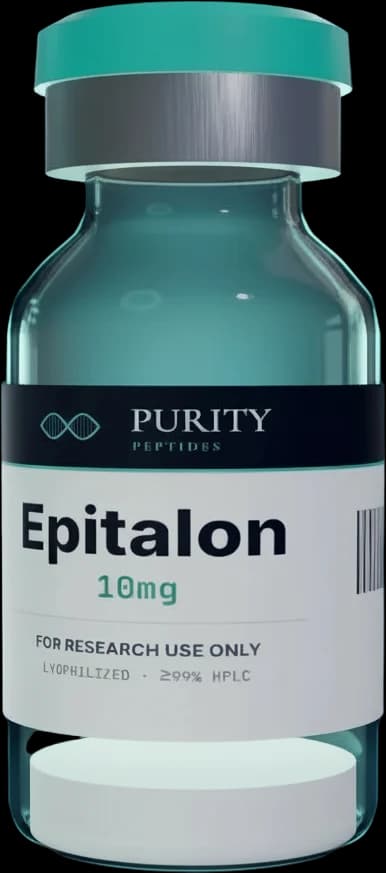
Epitalon is a synthetic tetrapeptide (Ala-Glu-Asp-Gly) developed at the St Petersburg Institute of Bioregulation and Gerontology. It was designed to reproduce the activity attributed to epithalamin, a polypeptide extract of bovine pineal gland that the same group had studied in ageing animals.
Published work has explored epitalon in human cell cultures, where telomerase activity and telomere length were reported to increase, and in rodents and primates, where researchers described changes in melatonin rhythms, tumour incidence and survival curves. The literature is intriguing but narrow: most studies come from one research network, sample sizes are small, and independent replication in Western laboratories has been limited. Epitalon is not an approved medicine anywhere. It is best viewed as an exploratory tool for chronobiology and cellular-ageing research, and it is supplied here strictly for that purpose.
Mechanism studied
- Epitalon
- Pineal gland
- Telomerase (hTERT)
- Cellular ageing markers
The proposed mechanism centres on gene regulation. Short peptides like epitalon have been reported to enter cells and interact with DNA or chromatin, influencing transcription. In cultured human fibroblasts, epitalon was associated with induction of the telomerase catalytic subunit and elongation of telomeres. In aged animals it was linked to restored nocturnal melatonin secretion and altered expression of genes involved in antioxidant defence. These mechanisms are largely inferred from correlative data, and direct molecular targets have not been firmly established.
Research highlights
- 01Synthetic analogue of the pineal extract epithalamin
- 02Telomerase induction reported in cultured human somatic cells
- 03Rodent and primate studies examined melatonin rhythms and survival
- 04Evidence comes mainly from a single research network
- 05Independent, controlled replication remains limited
Research areas
- Telomerase activity assays
- Pineal & melatonin rhythm studies
- Rodent lifespan models
- Cell senescence research
Evidence & regulatory status
Overall status: Not approved — research
Key references
- [1]Khavinson et al., 2003 — Neuro Endocrinol Lett
- [2]PubMed — reviews on epitalon and the pineal gland
- [3]WADA — Prohibited List of Substances and Methods
Latest published research
119 papers on PubMed →Epitalon and Epithalamin: A Narrative Review of Mechanistic, Preclinical, and Clinical Evidence
Jain A et al. · International journal of molecular sciences · 2026 Oct 8 · PMID 42884164
Synthetic Peptides in Pharmacy Compounding: Analysis of PCAC Recommendations and Industry Safety Standards
Willis J et al. · International journal of pharmaceutical compounding · 2026 Jul-Aug · PMID 42752426
LCP2 mediates SUV39H1-driven cellular senescence-related chemoresistance in natural killer/T-cell lymphoma
Zhang Y et al. · Cell death & disease · 2026 May 28 · PMID 42209466
Therapeutic peptides in gerontology: mechanisms and applications for healthy aging
Mavrych V et al. · Frontiers in aging · 2026 · PMID 42021992
Therapeutic Peptides in Orthopaedics: Applications, Challenges, and Future Directions
Rahman OF et al. · Journal of the American Academy of Orthopaedic Surgeons. Global research & reviews · 2026 Jan 1 · PMID 41490200
Correction: Epitalon increases telomere length in human cell lines through telomerase upregulation or ALT activity
Al-Dulaimi S et al. · Biogerontology · 2025 Nov 15 · PMID 41240216
Epitalon increases telomere length in human cell lines through telomerase upregulation or ALT activity
Al-Dulaimi S et al. · Biogerontology · 2025 Sep 4 · PMID 40908429
The Antioxidant Tetrapeptide Epitalon Enhances Delayed Wound Healing in an in Vitro Model of Diabetic Retinopathy
Gatta M et al. · Stem cell reviews and reports · 2025 Aug · PMID 40493162
Live feed from PubMed (NCBI) for “Epitalon”, updated 2026-10-30. Listing a paper is not an endorsement of its findings.
Registered studies
1 on ClinicalTrials.gov →From the public ClinicalTrials.gov registry for “Epitalon”, updated 2026-10-30. Shown for research context only; Purity Peptides products are not for human use.
FAQ
The evidence is classed as very low. Most publications originate from one Russian research group, sample sizes are small, and independent replication is limited. Epitalon is useful as an exploratory compound in telomere and chronobiology research but has no approved clinical use.
Lyophilized Epitalon is normally kept sealed at −20 °C, protected from light and moisture. Once reconstituted for laboratory work, aliquots are held at 2–8 °C for short-term use or frozen, avoiding repeated freeze–thaw. Follow the lot-specific guidance on the certificate of analysis.
Every lot of Epitalon ships with a certificate of analysis reporting HPLC purity, mass-spectrometry identity against the expected molecular weight, appearance and lot number. Match the COA lot to the vial label and keep it with your experimental records.
Last updated October 2026 · Reviewed by the Purity Peptides research team · Information is a summary of published literature and is not a recommendation for any use.