
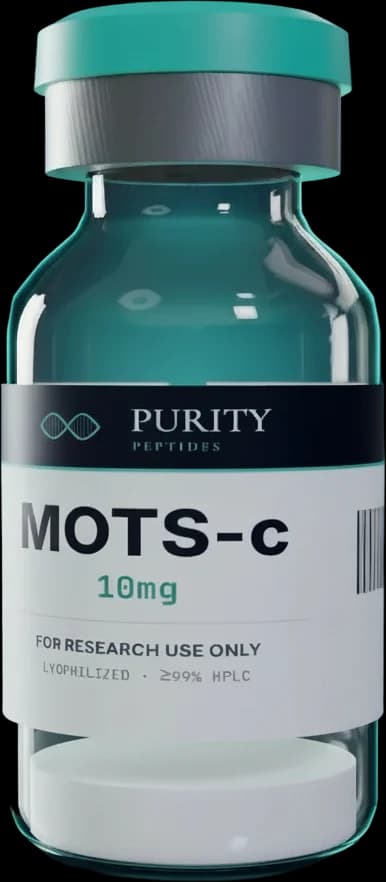
Overview
MOTS-c is a 16-amino-acid peptide encoded by a short open reading frame within the mitochondrial 12S ribosomal RNA gene. It was described in 2015 by researchers at the University of Southern California as a mitochondrial signal that regulates whole-body metabolism, joining humanin as a member of the mitochondrial-derived peptide family.
In the original study, MOTS-c improved insulin sensitivity and prevented diet-induced obesity in mice, with skeletal muscle identified as a primary target tissue. Later work showed that its levels rise in human muscle and plasma after exercise and that, in aged mice, it improved physical performance. Under metabolic stress, MOTS-c can move into the nucleus and influence gene expression. Human interventional data are not available, and MOTS-c is not an approved medicine. It is supplied here as a research peptide for metabolic and mitochondrial signalling studies.
Mechanism studied
- MOTS-c
- Folate–methionine pathway
- AICAR / AMPK
- Glucose uptake
The proposed mechanism begins with inhibition of the folate–methionine pathway, which leads to accumulation of the purine intermediate AICAR. AICAR in turn activates AMP-activated protein kinase (AMPK), a central energy sensor that promotes glucose uptake and fatty-acid oxidation in skeletal muscle. Under stress conditions, MOTS-c translocates to the nucleus in an AMPK-dependent manner and binds antioxidant-response elements, regulating transcription together with NRF2. This dual cytoplasmic and nuclear role is studied as a form of mitochondrial-to-nuclear communication.
Research highlights
- 01Encoded in mitochondrial 12S rRNA; described in Cell Metabolism in 2015
- 02Prevented diet-induced obesity and insulin resistance in mouse studies
- 03Activates AMPK via the folate–methionine pathway and AICAR accumulation
- 04Endogenous levels increase with exercise in human muscle and plasma
- 05No human interventional trials completed to date
Research areas
- AMPK activation studies
- Insulin resistance models
- Exercise physiology research
- Mitochondrial–nuclear signalling
Evidence & regulatory status
Overall status: Not approved — preclinical
Key references
- [1]Lee et al., 2015 — Cell Metab 21(3):443–454
- [2]PubMed — reviews on MOTS-c
- [3]WADA — Prohibited List of Substances and Methods
Latest published research
269 papers on PubMed →Mitochondria-derived peptide hydrogel augments mitochondrial transplantation for promoting cardiac repair via macrophage metabolic reprogramming
Li H et al. · Bioactive materials · 2027 Jan · PMID 42633281
MOTS-c is associated with oxidative stress and arterial stiffness in peritoneal dialysis patients: a pilot study
Musolino M et al. · International urology and nephrology · 2026 Nov · PMID 42126770
Mots-c attenuates diabetic nephropathy by downregulating LARS1 to promote lipophagy and suppress tubular senescence
Wang J et al. · Biochemical pharmacology · 2026 Oct 23 · PMID 42918312
Mitochondrial-derived peptides (MDPs) activated by physical exercise as therapeutic targets for metabolic disorders: A systematic review
Ayubi N et al. · Physiology international · 2026 Oct 16 · PMID 42640735
MOTS-c in sepsis-induced cardiomyopathy: Mechanisms and translational potential
Zhao Z et al. · European journal of pharmacology · 2026 Oct 15 · PMID 42633878
Integrative transcriptomic and computational analysis associates Ms4a6c+ macrophages with fibrosis in radiation proctitis and computationally nominates MOTS-c as a candidate modulator
Wang P et al. · Frontiers in immunology · 2026 · PMID 42952740
Mitochondrial-derived peptides in female reproduction: Emerging regulators of oocyte competence and novel therapeutic opportunities for infertility
Rostami Z et al. · Tissue & cell · 2026 Oct 11 · PMID 42880137
Associations of Serum MOTS-c with Exercise Capacity and Antioxidant Markers in Young Males: A Cross-Sectional Study
Zhang Z et al. · Antioxidants (Basel, Switzerland) · 2026 Oct 1 · PMID 42939841
Live feed from PubMed (NCBI) for “MOTS-c”, updated 2026-10-30. Listing a paper is not an endorsement of its findings.
Registered studies
5 on ClinicalTrials.gov →- Recruiting
Comparison of the Effects of General Anesthesia and Combined Spinal-Epidural Anesthesia on Ferroptosis, Humanin and MOTS-c Levels in Renal Transplantation
NCT07678073 · University of Gaziantep · 2026-03-01
- RecruitingPhase 2
MOTS-c for Improving Insulin Sensitivity in Adults With Prediabetes and Overweight/Obesity
NCT07505745 · Hudson Biotech · 2026-02-02
- Recruiting
The Cardiovascular Effect of GLP-1 Agonist, SGLT2 Inhibitor and Their Combination
NCT03878706 · University of Athens · 2017-11-03
- Active not recruiting
Cohort Of DEafness-gene Screening
NCT06133946 · Affiliated Hospital of Nantong University · 2016-01-01
- Unknown
Platelet Reactivity, B-amyloid, MOTS-c and Mortality of Type II Diabetics With CAD
NCT04027712 · University of Athens · 2014-01-01
From the public ClinicalTrials.gov registry for “MOTS-c”, updated 2026-10-30. Shown for research context only; Purity Peptides products are not for human use.
FAQ
Observational studies have measured endogenous MOTS-c in human blood and muscle, for example after exercise, but no controlled interventional trials have been completed. The functional evidence comes from cell and rodent experiments, so MOTS-c remains a preclinical research compound.
Lyophilized MOTS-c is normally kept sealed at −20 °C, protected from light and moisture. Once reconstituted for laboratory work, aliquots are held at 2–8 °C for short-term use or frozen, avoiding repeated freeze–thaw. Follow the lot-specific guidance on the certificate of analysis.
Every lot of MOTS-c ships with a certificate of analysis reporting HPLC purity, mass-spectrometry identity against the expected molecular weight, appearance and lot number. Match the COA lot to the vial label and keep it with your experimental records.
Last updated October 2026 · Reviewed by the Purity Peptides research team · Information is a summary of published literature and is not a recommendation for any use.