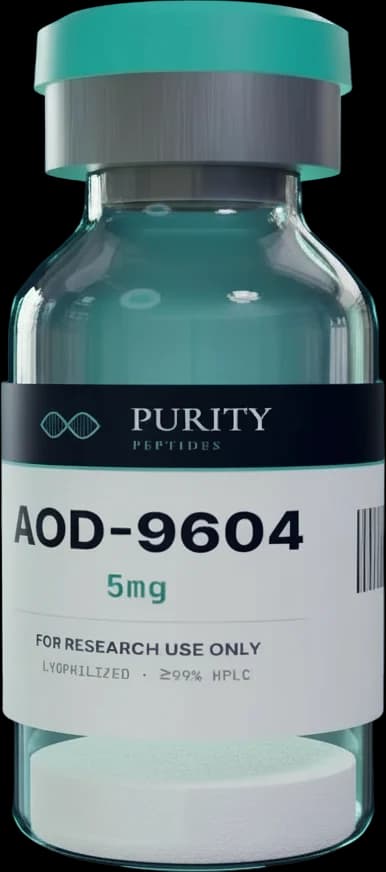
Overview
AOD-9604 is a 16-residue synthetic peptide modelled on the C-terminal region (residues 177–191) of human growth hormone, with an added N-terminal tyrosine. It was developed in Australia in the late 1990s to test whether the fat-metabolising activity attributed to this region of growth hormone could be separated from the hormone's growth-promoting and glycaemic effects.
Early work in obese rodents and isolated adipose tissue reported increased lipolysis and reduced lipogenesis without measurable changes in IGF-1. Human programmes later assessed tolerability and body-weight endpoints, but larger trials did not show a meaningful difference from placebo, and clinical development stopped. Today the peptide is mainly of interest to researchers studying growth hormone fragments, adipocyte signalling and anti-doping analytics. It is not an approved medicine in any major jurisdiction and is supplied here strictly as a research reference material.
Mechanism studied
- AOD-9604
- Adipocyte
- Lipolysis signalling
- Fat-mass endpoints
Studies suggest AOD-9604 does not bind the full growth hormone receptor in the way intact GH does, which is why it was investigated as a fragment lacking diabetogenic and IGF-1-raising activity. In rodent adipose tissue it was reported to stimulate lipolysis and inhibit lipogenic enzyme activity, with some work pointing to β3-adrenergic receptor involvement in the fat-oxidation response. The precise receptor target remains unresolved, and much of the mechanistic data comes from a small number of laboratories using animal and ex vivo models.
Research highlights
- 01Derived from the 177–191 region of human growth hormone with an added tyrosine residue
- 02Rodent studies reported increased lipolysis without changes in IGF-1 or glucose tolerance
- 03Human trials assessed tolerability, but weight-loss endpoints were not met versus placebo
- 04Named on the WADA Prohibited List under non-approved substances (S0)
- 05Validated LC-MS detection methods have been published for anti-doping laboratories
Research areas
- Adipocyte lipolysis models
- Obese rodent metabolism studies
- GH fragment structure–activity
- Anti-doping detection methods
Evidence & regulatory status
Overall status: Not approved — research
Key references
- [1]Ng et al., 2000 — PubMed 11146367
- [2]Stier et al., 2013 — J Clin Pharmacol 53(7):671–681
- [3]Moré et al., 2014 — Drug Test Anal 6(12):1083–1093
- [4]PubMed — reviews on AOD-9604 and lipolysis
- [5]WADA — Prohibited List of Substances and Methods
Latest published research
22 papers on PubMed →Safety and Efficacy of Approved and Unapproved Peptide Therapies for Musculoskeletal Injuries and Athletic Performance
Mendias CL et al. · Sports medicine (Auckland, N.Z.) · 2026 Aug · PMID 41966639
Rapid and harmonized analytical workflow for the determination of peptidic and non-peptidic doping agents in dried and liquid blood matrices
Mazzarino M et al. · The Analyst · 2026 Jul 27 · PMID 42328738
The emerging landscape of performance-enhancing peptides modulating GH-IGF1 axis: bridging the gap between clinical evidence and patient self-administration
Dominikowski A et al. · Frontiers in endocrinology · 2026 · PMID 42395176
Therapeutic Peptides in Orthopaedics: Applications, Challenges, and Future Directions
Rahman OF et al. · Journal of the American Academy of Orthopaedic Surgeons. Global research & reviews · 2026 Jan 1 · PMID 41490200
Simplifying and expanding the screening for peptides <2 kDa by direct urine injection, liquid chromatography, and ion mobility mass spectrometry
Thomas A et al. · Journal of separation science · 2016 Jan · PMID 26578461
Effect of Intra-articular Injection of AOD9604 with or without Hyaluronic Acid in Rabbit Osteoarthritis Model
Kwon DR et al. · Annals of clinical and laboratory science · 2015 Summer · PMID 26275694
Detection and in vitro metabolism of AOD9604
Cox HD et al. · Drug testing and analysis · 2015 Jan · PMID 25208511
Detecting peptidic drugs, drug candidates and analogs in sports doping: current status and future directions
Thevis M et al. · Expert review of proteomics · 2014 Dec · PMID 25382550
Live feed from PubMed (NCBI) for “AOD-9604”, updated 2026-10-30. Listing a paper is not an endorsement of its findings.
FAQ
No. AOD-9604 is not approved by the FDA, EMA or other major regulators as a therapeutic product. Clinical development was halted after efficacy endpoints were not met, and the material we supply is a research reference compound for laboratory and analytical use only.
Lyophilized AOD-9604 is normally kept sealed at −20 °C, protected from light and moisture. Once reconstituted for laboratory work, aliquots are held at 2–8 °C for short-term use or frozen, avoiding repeated freeze–thaw. Follow the lot-specific guidance on the certificate of analysis.
Every lot of AOD-9604 ships with a certificate of analysis reporting HPLC purity, mass-spectrometry identity against the expected molecular weight, appearance and lot number. Match the COA lot to the vial label and keep it with your experimental records.
Last updated October 2026 · Reviewed by the Purity Peptides research team · Information is a summary of published literature and is not a recommendation for any use.