Compound comparisons
CJC-1295 vs Ipamorelin: GH Secretagogues Compared
GHRH analogues vs ghrelin-receptor agonists: CJC-1295 with and without DAC, Ipamorelin, GHRP-2, GHRP-6, Hexarelin, Sermorelin and Tesamorelin compared.
October 29, 2026 · 5 min read · Purity Peptides research team

Growth hormone (GH) secretagogues stimulate the pituitary to release GH. Research peptides in this group fall into two classes acting on two different receptors: GHRH analogues and ghrelin-receptor agonists (GHRPs). CJC-1295 and Ipamorelin are the best-known representatives of each.
Two receptors, two signals
GH release from pituitary somatotroph cells is governed by three hypothalamic signals:
- GHRH (growth hormone-releasing hormone) acts on the GHRH receptor, a class B G protein-coupled receptor that signals mainly through cAMP.
- Ghrelin acts on the growth hormone secretagogue receptor type 1a (GHS-R1a), which signals mainly through phospholipase C and intracellular calcium.
- Somatostatin inhibits GH release and acts as the brake on both.
Synthetic GH-releasing peptides were developed by Cyril Bowers and colleagues before their receptor was known. GHS-R1a was cloned in 1996 (Howard et al.) and its natural ligand, ghrelin, identified in 1999 (Kojima et al.). Because the two receptors signal differently, combined stimulation has been reported to produce greater GH release than either alone.
GHRH analogues
Sermorelin
Sermorelin is GHRH(1–29)-NH2, the shortest fragment of native 44-residue GHRH that retains full activity. It was approved in the US as Geref, and the manufacturer withdrew it from the market in 2008 for commercial reasons. Its half-life in circulation is on the order of minutes.
Tesamorelin
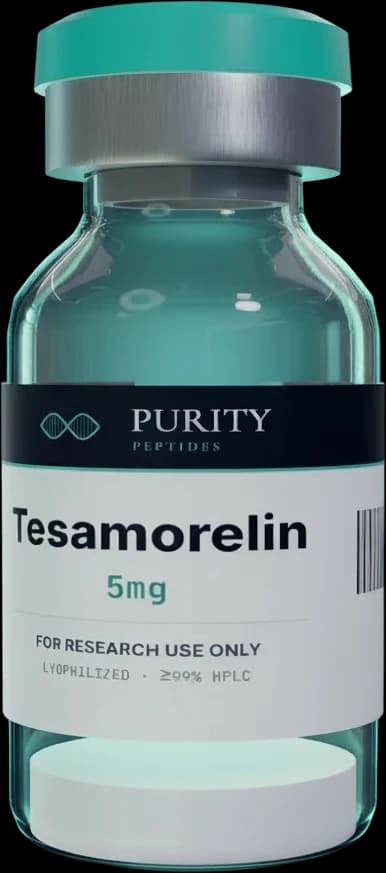
Tesamorelin is full-length GHRH(1–44) with a trans-3-hexenoyl group on the N-terminus, which protects it from DPP-4 cleavage. It was evaluated in phase 3 trials in HIV-associated abdominal fat accumulation (Falutz et al., 2007) and is an approved prescription medicine (Egrifta) for that indication.
CJC-1295 without DAC (Mod GRF 1–29)
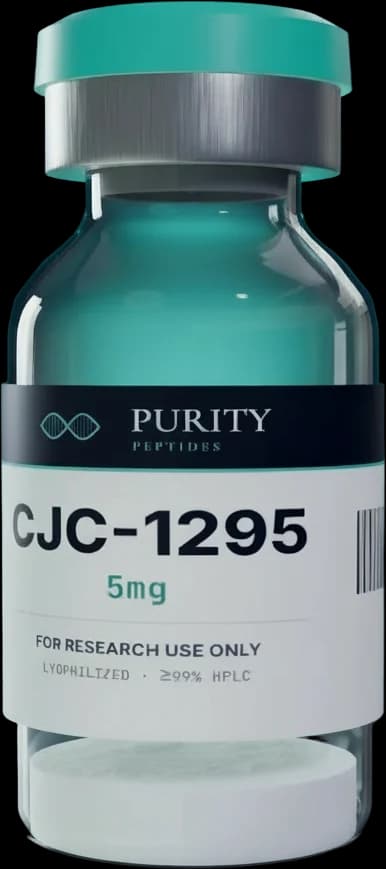
GRF(1–29) with four substitutions (D-Ala2, Gln8, Ala15, Leu27) that improve resistance to enzymatic degradation. In commerce, "CJC-1295" often means this version. Its half-life is commonly cited as around 30 minutes, though primary data are sparse.
CJC-1295 with DAC
The same modified backbone, with a Drug Affinity Complex (DAC): a maleimidopropionyl group on a C-terminal lysine that binds covalently to serum albumin. Teichman et al. (2006) studied it in healthy adults and reported an estimated half-life of 5.8–8.1 days, with sustained elevations of GH and IGF-1. Ionescu and Frohman (2006) found that pulsatile GH secretion persisted during this continuous stimulation. Clinical development was discontinued; it is not approved.
Ghrelin-receptor agonists (GHRPs)
GHRP-6
A hexapeptide (His-D-Trp-Ala-Trp-D-Phe-Lys-NH2) described by Bowers et al. (1984). It is a potent GH releaser and, in animal studies, a strong stimulus of food intake, consistent with ghrelin-receptor activation. It also raises cortisol and prolactin.
GHRP-2 (pralmorelin)
A hexapeptide (D-Ala-D-2Nal-Ala-Trp-D-Phe-Lys-NH2) with greater GH-releasing potency than GHRP-6 in published comparisons. It has been used as a diagnostic agent for GH secretory capacity in Japan. Like GHRP-6, it raises cortisol and prolactin.
Hexarelin
A hexapeptide closely related to GHRP-6, with a 2-methyl-tryptophan substitution. It is among the most potent GHRPs studied; attenuation of the GH response with repeated exposure has been reported. It also binds CD36, investigated in cardiac models independently of GH release.
Ipamorelin
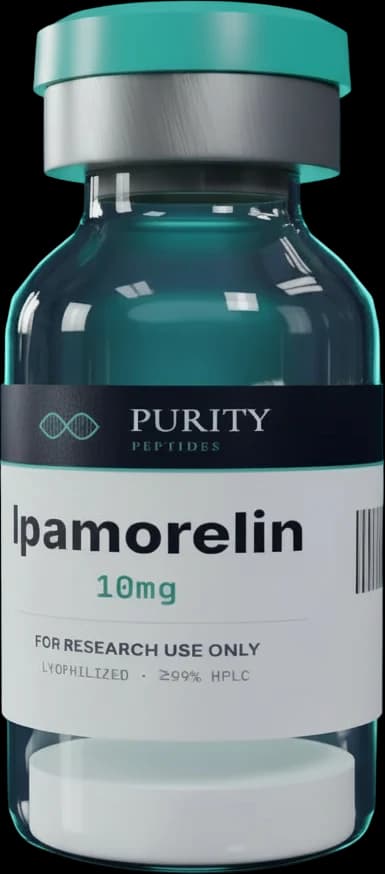
A pentapeptide (Aib-His-D-2Nal-D-Phe-Lys-NH2). Raun et al. (1998) described it as "the first selective growth hormone secretagogue": in swine, it released GH without significant increases in ACTH or cortisol, even at exposures far above those needed for GH release. That selectivity is the main reason it is studied in preference to older GHRPs.
Comparison table
| Compound | Class | Receptor | Length | Key modification | Reported half-life | Selectivity notes | Status |
|---|---|---|---|---|---|---|---|
| Sermorelin | GHRH analogue | GHRH-R | 29 aa | C-terminal amide | Minutes | GH-specific | Previously approved (US); withdrawn 2008 |
| Tesamorelin | GHRH analogue | GHRH-R | 44 aa | N-terminal hexenoyl | Short | GH-specific | Approved prescription medicine |
| CJC-1295 (no DAC) | GHRH analogue | GHRH-R | 29 aa | 4 substitutions | ~30 min (limited data) | GH-specific | Not approved |
| CJC-1295 DAC | GHRH analogue | GHRH-R | 29 aa + DAC | Albumin binding | 5.8–8.1 days | GH-specific | Not approved |
| GHRP-6 | GHRP | GHS-R1a | 6 aa | D-amino acids | Short | Raises cortisol, prolactin; strong appetite signal | Not approved |
| GHRP-2 | GHRP | GHS-R1a | 6 aa | D-2Nal | Short | Raises cortisol, prolactin | Diagnostic use in Japan |
| Hexarelin | GHRP | GHS-R1a, CD36 | 6 aa | 2-methyl-Trp | Short | Raises cortisol, prolactin; attenuation reported | Not approved |
| Ipamorelin | GHRP | GHS-R1a | 5 aa | Aib, D-2Nal | Short | Selective for GH in swine data | Not approved |
The research landscape
Human data for this group are mostly endocrine pharmacology: short studies measuring GH, IGF-1 and other pituitary hormones. Long-term outcome data exist mainly for tesamorelin. The ghrelin-receptor field has produced two approved small molecules outside this peptide set: macimorelin, an oral diagnostic for adult GH deficiency, and anamorelin, approved in Japan for cancer cachexia.
The CJC-1295 + Ipamorelin pairing, supplied as a blend, rests on the complementary-receptor rationale above. Published data on that specific combination are limited.
Regulatory and WADA status
All compounds in this article appear on the WADA Prohibited List under S2: GHRH and its analogues, and GH secretagogues and GHRPs. Outside the approved medicines named above, none has marketing authorisation from the FDA or EMA.
References
- Bowers CY, Momany FA, Reynolds GA, Hong A. On the in vitro and in vivo activity of a new synthetic hexapeptide that acts on the pituitary to specifically release growth hormone. Endocrinology. 1984;114(5):1537–1545.
- Howard AD, Feighner SD, Cully DF, et al. A receptor in pituitary and hypothalamus that functions in growth hormone release. Science. 1996;273(5277):974–977.
- Kojima M, Hosoda H, Date Y, et al. Ghrelin is a growth-hormone-releasing acylated peptide from stomach. Nature. 1999;402:656–660.
- Raun K, Hansen BS, Johansen NL, et al. Ipamorelin, the first selective growth hormone secretagogue. Eur J Endocrinol. 1998;139(5):552–561.
- Teichman SL, Neale A, Lawrence B, et al. Prolonged stimulation of growth hormone (GH) and insulin-like growth factor I secretion by CJC-1295, a long-acting analog of GH-releasing hormone, in healthy adults. J Clin Endocrinol Metab. 2006;91(3):799–805.
- Ionescu M, Frohman LA. Pulsatile secretion of growth hormone (GH) persists during continuous stimulation by CJC-1295, a long-acting GH-releasing hormone analog. J Clin Endocrinol Metab. 2006;91(12):4792–4797.
- Falutz J, Allas S, Blot K, et al. Metabolic effects of a growth hormone-releasing factor in patients with HIV. N Engl J Med. 2007;357:2359–2370.
FOR RESEARCH USE ONLY.Not for human or veterinary use. Not intended to diagnose, treat, cure, or prevent any disease.