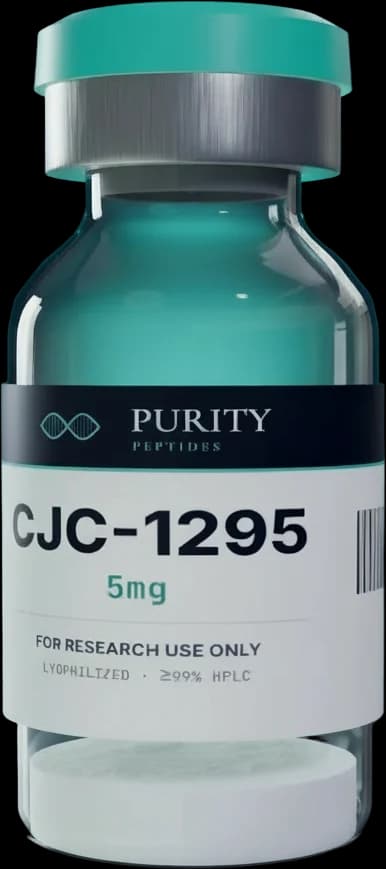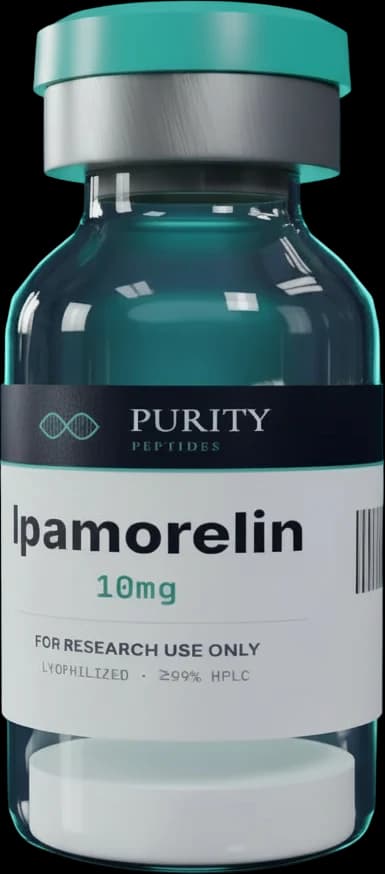
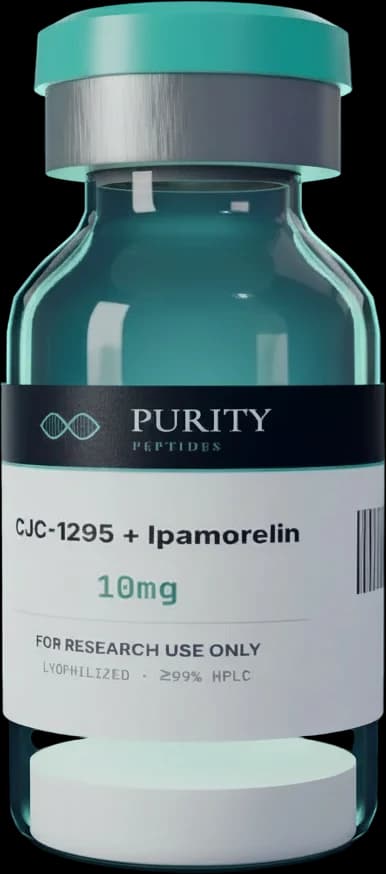
Overview
This research blend combines CJC-1295 (modified GRF 1-29), a stabilised analogue of growth hormone-releasing hormone, with ipamorelin, a selective agonist of the ghrelin receptor (GHS-R1a). The two peptides act on different receptors on the same pituitary cells, and pairing them reflects a long-standing observation in endocrine physiology: co-stimulation of the GHRH and ghrelin pathways produces a larger growth hormone response than either signal alone.
No clinical trials have evaluated this specific combination, and neither component is an approved medicine. The blend is therefore of interest primarily for laboratory and animal studies of receptor cross-talk, somatotroph signalling and the regulation of GH pulse amplitude. Supplying both peptides in a single lyophilized vial simplifies experimental preparation where a fixed ratio is required. Each component is verified individually before blending, and the product is intended strictly for research use.
Mechanism studied
- CJC-1295 + Ipamorelin
- GHRH-R & GHS-R1a
- Amplified GH pulse
- IGF-1
CJC-1295 activates the Gs-coupled GHRH receptor, raising cAMP in somatotrophs, while ipamorelin activates GHS-R1a, which signals mainly through Gq, phospholipase C and intracellular calcium. Experimental work on GHRH and GH-releasing peptides has shown that engaging both pathways together amplifies GH release more than additively, partly because ghrelin-receptor agonists also oppose somatostatin's inhibitory tone. Ipamorelin is notable for producing little change in cortisol or prolactin, which keeps the combined signal comparatively specific to GH.
Blend components
Research highlights
- 01Combines GHRH-receptor and ghrelin-receptor agonism in a single research preparation
- 02GHRH plus GHS synergy is well described in endocrine physiology literature
- 03No dedicated clinical trials of this exact combination have been published
- 04Ipamorelin's selectivity limits off-target cortisol and prolactin signalling
- 05Both components are prohibited in sport under WADA class S2
Research areas
- GHRH + GHS synergy studies
- Pulsatile GH release models
- Receptor co-activation pharmacology
- GH/IGF-1 axis research
Evidence & regulatory status
Overall status: Not approved — research
Key references
- [1]Sinha et al., 2018 — Transl Androl Urol (review)
- [2]PubMed — reviews on GH secretagogues in combination
- [3]WADA — Prohibited List of Substances and Methods
FAQ
They stimulate growth hormone release through two distinct receptors. Endocrine studies have shown that combining a GHRH analogue with a ghrelin-receptor agonist produces a synergistic GH response, so a pre-blended vial is convenient for experiments that model this receptor co-activation at a fixed ratio.
Lyophilized the CJC-1295 + Ipamorelin blend is normally kept sealed at −20 °C, protected from light and moisture. Once reconstituted for laboratory work, aliquots are held at 2–8 °C for short-term use or frozen, avoiding repeated freeze–thaw. Follow the lot-specific guidance on the certificate of analysis.
Every lot of the CJC-1295 + Ipamorelin blend ships with a certificate of analysis reporting HPLC purity, mass-spectrometry identity against the expected molecular weight, appearance and lot number. Match the COA lot to the vial label and keep it with your experimental records. Identity is confirmed for each component peptide.
Last updated October 2026 · Reviewed by the Purity Peptides research team · Information is a summary of published literature and is not a recommendation for any use.