
Research reviews
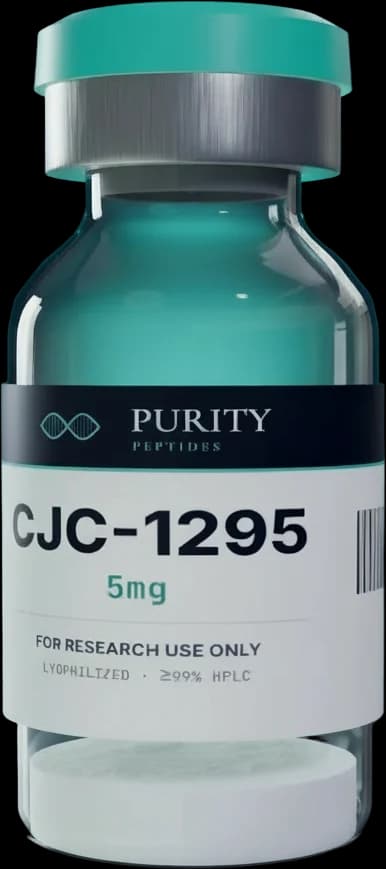
GHRH Analogues: Tesamorelin, Sermorelin and CJC-1295
Tesamorelin, sermorelin and CJC-1295 reviewed: GHRH discovery, analogue chemistry, GHRH receptor pharmacology, clinical research and WADA S2 status.
October 30, 2026 · 6 min read · Purity Peptides research team

Growth hormone-releasing hormone (GHRH) analogues are among the oldest and best-documented peptides in endocrine research. Unlike growth hormone itself, they act one step upstream, on the pituitary, preserving the feedback loops that shape the pulsatile pattern of endogenous growth hormone (GH) secretion. This review covers the discovery of GHRH and three analogues that illustrate different design strategies: sermorelin, tesamorelin and CJC-1295.
Origin and discovery
The existence of a hypothalamic factor stimulating GH release was proposed long before it was isolated. The breakthrough came from an unusual source: pancreatic tumours in patients with acromegaly that secreted a GH-releasing substance. In 1982 two groups isolated and sequenced the peptide from such tumours (Guillemin et al., 1982; Rivier et al., 1982). The native hormone is 44 amino acids long with an amidated C-terminus, and a 40-residue form also circulates.
Structure–activity work quickly showed that the first 29 residues, GHRH(1–29), retain the full biological activity of the native sequence. That fragment became the template for most later analogues.
Structure and chemistry
Sermorelin is GHRH(1–29) amide, an exact copy of the N-terminal active region. Like native GHRH, it is rapidly inactivated by dipeptidyl peptidase-4 (DPP-4), which removes the first two residues, and by other proteases, giving it a very short half-life.
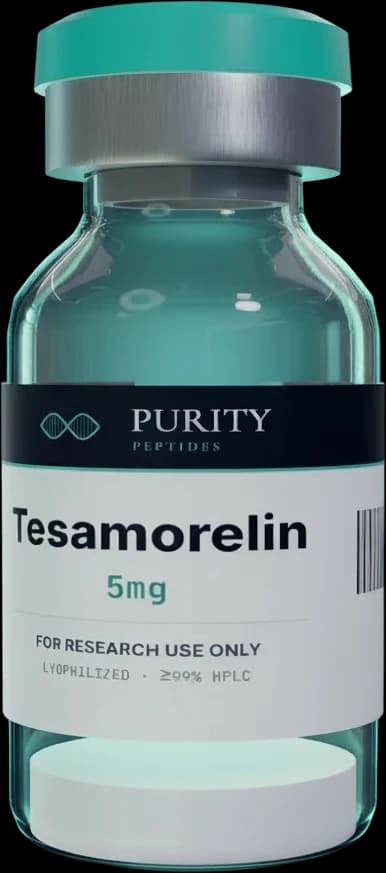
Tesamorelin is the full 44-residue human GHRH sequence with a trans-3-hexenoyl group attached to the N-terminal tyrosine. This modification protects the peptide from DPP-4 cleavage while preserving GHRH receptor activation. It was developed by Theratechnologies.
CJC-1295 refers to two related research peptides, which are frequently confused:
- CJC-1295 without DAC, also called modified GRF(1–29) or tetrasubstituted GRF(1–29), carries four substitutions in the GHRH(1–29) sequence (D-Ala2, Gln8, Ala15 and Leu27). These improve resistance to DPP-4 cleavage, reduce oxidation and rearrangement-prone residues, and stabilise the helix.
- CJC-1295 with DAC adds a Drug Affinity Complex: a lysine bearing a maleimidopropionyl group at the C-terminus that forms a covalent bond with cysteine-34 of serum albumin. This conjugation extends circulating half-life to several days in published human pharmacokinetic studies (Teichman et al., 2006).
The analytical implications differ. Sermorelin and modified GRF(1–29) are relatively small and straightforward to characterise. Tesamorelin is larger, and DAC-bearing peptides contain a reactive maleimide whose integrity should be confirmed.
Receptor pharmacology and mechanism studied
The GHRH receptor (GHRHR) is a class B G protein-coupled receptor expressed on somatotroph cells of the anterior pituitary. Activation couples to Gαs, raising cAMP and activating protein kinase A. This increases transcription of the GH gene, promotes somatotroph proliferation in development and triggers release of stored GH.
Several features distinguish GHRH analogues from direct exposure to GH in research settings:
- Feedback is preserved. Somatostatin from the hypothalamus continues to inhibit GH release, and IGF-1 continues to exert negative feedback. GH output therefore remains pulsatile rather than constant.
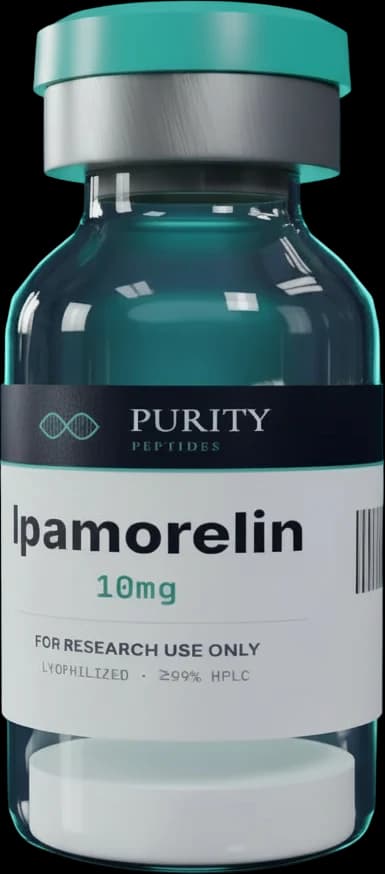
- Synergy with ghrelin-receptor agonists. GHRH analogues and growth hormone secretagogue receptor agonists such as ipamorelin act through different receptors and second-messenger pathways. Co-stimulation produces a larger GH response than either alone in experimental studies, which is why combinations are a frequent research topic.
- Duration shapes the signal. Short-acting analogues produce brief GH pulses. CJC-1295 with DAC produced sustained elevations in GH and IGF-1 over days in its pharmacokinetic studies, while the pulsatile pattern was partly preserved (Ionescu and Frohman, 2006).
- Downstream effects. GH increases hepatic IGF-1 production and has lipolytic actions. Visceral adipose tissue has appeared particularly responsive in tesamorelin imaging studies.
Research and clinical-trial landscape
Sermorelin was evaluated clinically in the 1980s and 1990s, including diagnostic testing of pituitary GH reserve and studies in children with GH deficiency (reviewed by Prakash and Goa, 1999). It was marketed by Serono as Geref, and the product was discontinued in the United States in 2008 for commercial reasons.
Tesamorelin was evaluated in randomised, placebo-controlled phase 3 trials in people living with HIV who had excess abdominal fat. These trials evaluated visceral adipose tissue measured by CT imaging as the primary endpoint (Falutz et al., 2007; Falutz et al., 2010). Later randomised trials in the same population evaluated liver-fat and liver-histology endpoints (Stanley et al., 2014; Stanley et al., 2019).
CJC-1295 with DAC was evaluated in small phase 1/2 pharmacokinetic and pharmacodynamic studies in healthy adults (Teichman et al., 2006; Ionescu and Frohman, 2006). Its clinical development did not lead to an approved product. CJC-1295 without DAC has no comparable published clinical programme and is used mainly as a research reagent.
Evidence quality and open questions
- Tesamorelin has the strongest evidence base of the three, from randomised, controlled trials in a defined population.
- Sermorelin's evidence is older and largely from small studies conducted before modern trial standards.
- CJC-1295 evidence is limited to small, short-duration studies; much of what circulates about it outside the literature is unsupported.
- Long-term questions for any GH-axis stimulation include effects on glucose metabolism, IGF-1-related cell-growth signalling and the clinical relevance of sustained versus pulsatile exposure.
- Product confusion. Because "CJC-1295" is used loosely for two different molecules, researchers should confirm by mass spectrometry which compound they hold.
Regulatory and anti-doping status
Tesamorelin is an approved prescription medicine in the United States (Egrifta) for reduction of excess abdominal fat in adults with HIV-associated lipodystrophy; a European application was withdrawn. Sermorelin was previously approved as Geref and is discontinued. CJC-1295 is not approved anywhere. Research-grade versions are intended only for in vitro and animal research.
All three are prohibited in sport. The WADA Prohibited List places GHRH and its analogues, explicitly naming CJC-1295, sermorelin and tesamorelin, under S2 (peptide hormones, growth factors, related substances and mimetics), prohibited at all times.
Summary table
| Sermorelin | Tesamorelin | CJC-1295 (no DAC) | CJC-1295 (DAC) | |
|---|---|---|---|---|
| Basis | GHRH(1–29) amide | GHRH(1–44) amide | Modified GHRH(1–29) | Modified GHRH(1–29) + DAC |
| Key modification | None | N-terminal trans-3-hexenoyl | D-Ala2, Gln8, Ala15, Leu27 | Same, plus albumin-reactive lysine |
| DPP-4 resistance | Low | High | Improved | Improved |
| Half-life | Minutes | Short | Short | Several days |
| Clinical evidence | Older small studies | Phase 3 RCTs | Minimal | Small phase 1/2 |
| Status | Discontinued Rx | Approved Rx (US) | Not approved | Not approved |
| WADA | S2 prohibited | S2 prohibited | S2 prohibited | S2 prohibited |
References
- Guillemin R, Brazeau P, Böhlen P, et al. Growth hormone-releasing factor from a human pancreatic tumor that caused acromegaly. Science. 1982;218(4572):585–587.
- Rivier J, Spiess J, Thorner M, Vale W. Characterization of a growth hormone-releasing factor from a human pancreatic islet tumour. Nature. 1982;300:276–278.
- Prakash A, Goa KL. Sermorelin: a review of its use in the diagnosis and treatment of children with idiopathic growth hormone deficiency. BioDrugs. 1999;12(2):139–157.
- Falutz J, Allas S, Blot K, et al. Metabolic effects of a growth hormone-releasing factor in patients with HIV. N Engl J Med. 2007;357:2359–2370.
- Falutz J, Mamputu JC, Potvin D, et al. Effects of tesamorelin (TH9507), a growth hormone-releasing factor analog, in human immunodeficiency virus-infected patients with excess abdominal fat: a pooled analysis of two multicenter, double-blind placebo-controlled phase 3 trials with safety extension data. J Clin Endocrinol Metab. 2010;95(9):4291–4304.
- Stanley TL, Feldpausch MN, Oh J, et al. Effect of tesamorelin on visceral fat and liver fat in HIV-infected patients with abdominal fat accumulation: a randomized clinical trial. JAMA. 2014;312(4):380–389.
- Stanley TL, Fourman LT, Feldpausch MN, et al. Effects of tesamorelin on non-alcoholic fatty liver disease in HIV: a randomised, double-blind, multicentre trial. Lancet HIV. 2019;6(12):e821–e830.
- Teichman SL, Neale A, Lawrence B, et al. Prolonged stimulation of growth hormone (GH) and insulin-like growth factor I secretion by CJC-1295, a long-acting analog of GH-releasing hormone, in healthy adults. J Clin Endocrinol Metab. 2006;91(3):799–805.
- Ionescu M, Frohman LA. Pulsatile secretion of growth hormone (GH) persists during continuous stimulation by CJC-1295, a long-acting GH-releasing hormone analog. J Clin Endocrinol Metab. 2006;91(12):4792–4797.
- World Anti-Doping Agency. The Prohibited List (current edition), section S2.
FOR RESEARCH USE ONLY.Not for human or veterinary use. Not intended to diagnose, treat, cure, or prevent any disease.