Overview
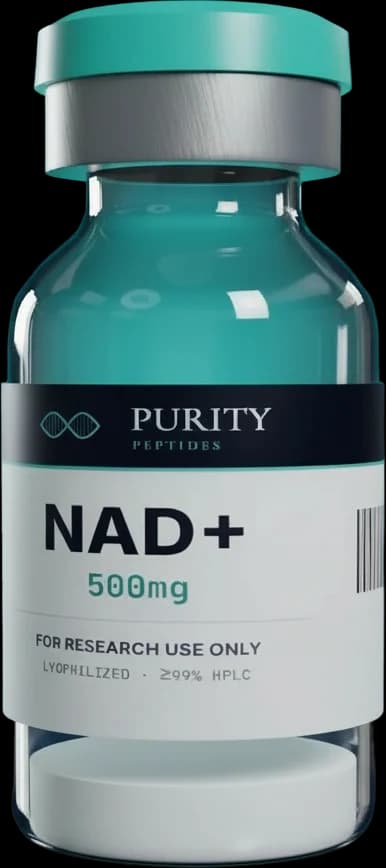
Nicotinamide adenine dinucleotide (NAD+) is a coenzyme found in every living cell. Composed of two nucleotides joined through their phosphate groups, it shuttles electrons in hundreds of redox reactions, including glycolysis, the citric acid pathway and oxidative phosphorylation. Strictly speaking it is not a peptide, but it is a staple reagent in metabolic and longevity research.
Beyond its redox role, NAD+ is consumed as a substrate by sirtuin deacylases, PARP DNA-repair enzymes and the ectoenzyme CD38. Studies in rodents and humans have reported that tissue NAD+ levels decline with age, prompting intensive research into precursors such as nicotinamide riboside and nicotinamide mononucleotide. Human trials so far have mostly examined safety and biomarkers, with functional outcomes still being defined. Our NAD+ is supplied as a high-purity research reagent for enzyme assays, in vitro research method.">cell culture and metabolic studies.
Mechanism studied
- NAD+
- Redox & glycolysis
- Sirtuins / PARPs / CD38
- Metabolic & DNA-repair signalling
In energy metabolism, NAD+ accepts a hydride to form NADH, which feeds electrons into mitochondrial complex I to drive ATP synthesis. Separately, sirtuins use NAD+ to remove acetyl and other acyl groups from histones and metabolic enzymes, linking nutrient status to gene expression. PARP enzymes consume NAD+ to build poly(ADP-ribose) chains at sites of DNA damage, and CD38 hydrolyses it during immune signalling. Cells maintain NAD+ pools mainly via the salvage pathway, in which NAMPT recycles nicotinamide.
Research highlights
- 01Central electron carrier linking glycolysis and mitochondrial respiration
- 02Consumed by sirtuins, PARPs and CD38, connecting metabolism to signalling
- 03Tissue NAD+ levels reported to decline with age in rodent and human studies
- 04Precursors NR and NMN under active clinical investigation
- 05Not a peptide, but a core reagent in longevity and metabolism research
Research areas
- Sirtuin & PARP activity
- Mitochondrial metabolism
- NAD+ decline in ageing models
- Enzyme assay cofactor
Evidence & regulatory status
Overall status: Not approved as a drug — research reagent
Key references
- [1]Verdin, 2015 — Science 350(6265):1208–1213
- [2]Rajman, Chwalek & Sinclair, 2018 — Cell Metab 27(3):529–547
- [3]Covarrubias et al., 2021 — Nat Rev Mol Cell Biol 22(2):119–141
Latest published research
58,556 papers on PubMed →Systems metabolic engineering of a plasmid-free Escherichia coli cell factory for high-level cytidine production
Zhao R et al. · Synthetic and systems biotechnology · 2027 May · PMID 42861367
Self-assembled ruthenium(II) nanostructures disrupt electron transport and energy metabolism in MRSA via bacterial interfacial interactions
Tang Z et al. · Journal of colloid and interface science · 2027 Feb · PMID 42790117
Oligosaccharide adjuvant-deferred antigen endocytosis promotes cross-presentation
Li Y et al. · Bioactive materials · 2027 Feb · PMID 42751513
Control-referenced bacterial bioluminescence reveals a two-axis salivary response phenotype in benign and malignant breast disease
Martyschuk PA et al. · Talanta · 2027 Feb 1 · PMID 42691711
Electric stimulation coupled with activated carbon enhances lactic acid production from food waste
Wang N et al. · Bioelectrochemistry (Amsterdam, Netherlands) · 2027 Feb · PMID 42673740
AIE-pharmacology-enabled organelle therapeutics for microplastic-induced asthenozoospermia
Wen F et al. · Biomaterials · 2027 Feb · PMID 42648265
A proton-gated gold nanocluster platform for disrupting biofilm bioenergetics and suppressing virulence in bacterial infections
Liu J et al. · Biomaterials · 2027 Feb · PMID 42603427
Qinghuang powder ameliorates cellular senescence and energy metabolism abnormalities in bone marrow mesenchymal stem cells of myelodysplastic syndromes
Jiang P et al. · Journal of ethnopharmacology · 2027 Jan 30 · PMID 42637061
Live feed from PubMed (NCBI) for “NAD+”, updated 2026-10-30. Listing a paper is not an endorsement of its findings.
Registered studies
269 on ClinicalTrials.gov →- Recruiting
Nicotinamide Riboside, Vit B3 Analogue, and Brain Energy Metabolism
NCT07649161 · Massachusetts General Hospital · 2026-12
- Not yet recruitingPhase 2
FEAST and HOPE: Redox PSC Pilot Study
NCT07898839 · Brigham and Women's Hospital · 2027-01
- CompletedPhase 2
NAD+ Augmentation in Cardiac Surgery Associated Myocardial Injury Trial
NCT04750616 · Kaiser Permanente · 2021-09-13
- Active not recruiting
A Study of Tumor Imaging With Multispectral Optoacoustic Tomography
NCT05488483 · Memorial Sloan Kettering Cancer Center · 2022-07-27
- Not yet recruitingPhase 1
Effects of Trigonelline Monohydrate on NAD+ Metabolism, Pharmacokinetics, Safety, and Tolerability in Healthy Adults
NCT07880925 · dsm-firmenich Switzerland AG · 2026-10
- Not yet recruitingPhase 2
Nicotinamide for Retinal Protection in Primary Open-Angle Glaucoma (NADIR Trial)
NCT07808333 · University of Chicago · 2027-06-01
- RecruitingPhase 1
A Phase 1 Study to Evaluate the Safety, Pharmacokinetics, and Preliminary Efficacy of MK-6204 (SKB535) for Injection in Participants With Advanced Solid Tumors
NCT06726369 · Sichuan Kelun-Biotech Biopharmaceutical Co., Ltd. · 2024-12-12
- Recruiting
Nicotinamide Mononucleotide Supplementation for Exercise Tolerance Improvement in Healthy Older Adults
NCT07144527 · Scott Silveira · 2026-02-21
From the public ClinicalTrials.gov registry for “NAD+”, updated 2026-10-30. Shown for research context only; Purity Peptides products are not for human use.
FAQ
NAD+ is relatively stable in mildly acidic to neutral solutions kept cold, but it degrades in alkaline conditions and with repeated warming. Prepare working solutions fresh where possible, keep them on ice during assays, and store aliquots frozen and protected from light.
Lyophilized NAD+ is normally kept sealed at −20 °C, protected from light and moisture. Once reconstituted for laboratory work, aliquots are held at 2–8 °C for short-term use or frozen, avoiding repeated freeze–thaw. Follow the lot-specific guidance on the certificate of analysis.
Every lot of NAD+ ships with a certificate of analysis reporting HPLC purity, mass-spectrometry identity against the expected molecular weight, appearance and lot number. Match the COA lot to the vial label and keep it with your experimental records. UV absorbance ratio may also be reported for purity.
Last updated October 2026 · Reviewed by the Purity Peptides research team · Information is a summary of published literature and is not a recommendation for any use.