Research reviews
Selank and Semax: A Research Review
Selank and Semax reviewed: Russian origins, tuftsin and ACTH(4-7) designs, BDNF and GABA findings in rodents, clinical literature and evidence limits.
October 30, 2026 · 6 min read · Purity Peptides research team

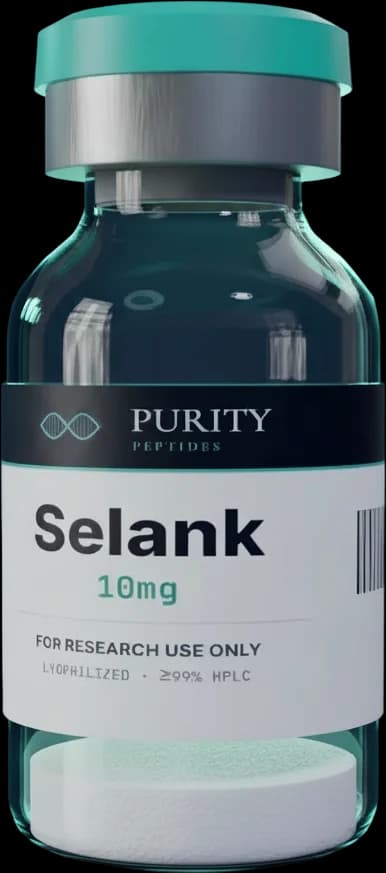
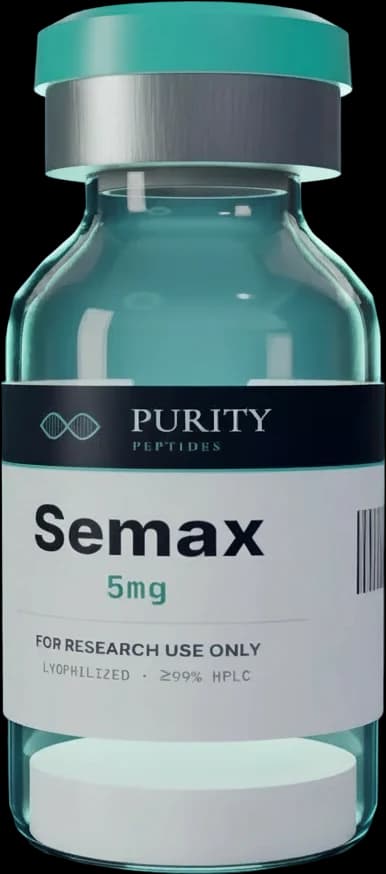
Selank and Semax are short synthetic peptides developed in Moscow and registered as medicines in the Russian Federation. Both were built by attaching the tripeptide Pro-Gly-Pro to a fragment of a naturally occurring peptide, and both are studied for effects on the central nervous system. Outside Russia and a few neighbouring states they are unapproved research compounds, and much of their literature is published in Russian. This review summarises their origins, chemistry and the model systems in which they have been examined.
Origin and discovery
Both peptides came out of a collaboration between the Institute of Molecular Genetics of the Russian Academy of Sciences, associated with Nikolai Myasoedov, and Moscow State University, associated with Igor Ashmarin, with pharmacological work at the Zakusov Institute of Pharmacology.
Semax was developed first, in the 1980s. It builds on decades of work, notably by David de Wied in the Netherlands, showing that fragments of adrenocorticotropic hormone (ACTH) lacking hormonal activity could influence learning and memory in rodents. The ACTH(4-10) fragment was active but short-lived. Semax uses the shorter ACTH(4-7) sequence, Met-Glu-His-Phe, extended with Pro-Gly-Pro to slow enzymatic degradation (Ashmarin et al., 1997).
Selank was developed in the 1990s from tuftsin, a tetrapeptide (Thr-Lys-Pro-Arg) released from the Fc region of immunoglobulin G and first described by Najjar and Nishioka (1970) as a stimulator of phagocytosis. Tuftsin also has central nervous system effects in rodents, and Selank extends it with the same Pro-Gly-Pro motif.
Structure and chemistry
| Selank | Semax | |
|---|---|---|
| Sequence | Thr-Lys-Pro-Arg-Pro-Gly-Pro (TKPRPGP) | Met-Glu-His-Phe-Pro-Gly-Pro (MEHFPGP) |
| Parent peptide | Tuftsin (TKPR) | ACTH(4-7) (MEHF) |
| Molecular formula | C33H57N11O9 | C37H51N9O10S |
| Approx. molecular weight | ~751.9 Da | ~813.9 Da |
| Net charge at neutral pH | Basic (Lys, Arg) | Near neutral to slightly acidic |
The C-terminal Pro-Gly-Pro motif is itself biologically studied: PGP is a collagen-derived fragment with reported activity on neutrophils, and proline-rich termini resist many exopeptidases. Semax contains methionine, which is susceptible to oxidation, so stability testing and storage conditions matter for research material. Both peptides are small enough for reliable identity confirmation by mass spectrometry.
Mechanism studied
Semax
Semax lacks the corticotropic activity of full-length ACTH and does not stimulate adrenal steroid release at concentrations studied. Its effects are therefore attributed to central actions:
- Neurotrophins. Dolotov et al. (2006) reported rapid increases in brain-derived neurotrophic factor (BDNF) and its receptor TrkB in the rat hippocampus.
- Monoamines. Rodent studies describe modulation of dopaminergic and serotonergic activity in striatum and other regions.
- Gene expression after ischaemia. Medvedeva et al. (2014) found that Semax shifted expression of genes related to immune and vascular systems in a rat focal ischaemia model.
Interactions with melanocortin receptors have been proposed, given the ACTH origin, but a primary molecular target has not been established.
Selank
- GABAergic signalling. Volkova et al. (2016) reported that Selank altered expression of genes involved in GABAergic neurotransmission in rodent brain, and other studies suggest allosteric effects on GABA-A receptors.
- Enkephalin metabolism. Selank has been reported to inhibit enkephalin-degrading enzymes in vitro, which could prolong endogenous opioid peptide activity.
- Monoamines and BDNF. Changes in serotonin metabolism and hippocampal BDNF expression have been described in rats.
- Immune signalling. Reflecting its tuftsin origin, Selank has been studied for effects on cytokine expression, including IL-6, which researchers examine as a neuroimmune link.
Research landscape by model system
In vitro
Cell and enzyme studies include enkephalinase inhibition assays for Selank, cytokine expression in immune cells, and gene-expression analyses in neuronal cultures. In vitro work is comparatively limited; most mechanistic data come from rodent brain tissue.
Animal models
- Semax: rat models of focal and global cerebral ischaemia, learning and memory tasks, and attention-related behaviours.
- Selank: rodent anxiety paradigms such as the elevated plus maze and open field, stress-induced behavioural changes, learning tasks, and comparisons with benzodiazepines.
Many studies come from the originating institutes, use small group sizes, and were published in Russian-language journals with limited methodological detail available in English.
Human studies
Clinical studies of Semax in ischaemic stroke and cognitive disorders, and of Selank in anxiety-related conditions, have been conducted in Russia, often as part of national registration. Most were small, open-label or inadequately blinded, and published in Russian. Zozulya et al. (2008) is among the more frequently cited Selank reports. These studies have not been replicated in large, multicentre, pre-registered trials meeting international standards.
Evidence quality and open questions
Evidence for both peptides is low. Principal limitations:
- Geographic and linguistic concentration. Most primary research comes from a small number of Russian institutions, and much is not indexed in full in Western databases.
- Trial design. Human studies predate or fall short of modern standards for randomisation, blinding and outcome reporting.
- Targets. Neither peptide has a confirmed primary receptor, and reported effects span multiple neurotransmitter systems.
- Pharmacokinetics. Detailed peer-reviewed data on brain exposure and metabolism of the intact peptides are sparse; both are rapidly degraded, and active metabolites may contribute.
- Independent replication. Few laboratories outside Russia have tested key behavioural or neurotrophic findings.
Regulatory and anti-doping status
Semax and Selank are registered medicines in the Russian Federation. Neither is approved by the FDA or EMA. Neither is named on the WADA Prohibited List at the time of writing, but researchers working with athletes should check the current list, including the S0 provision for substances without approval by any government regulatory health authority. Research suppliers provide both as laboratory reference materials only.
Summary table
| Attribute | Selank | Semax |
|---|---|---|
| Type | Synthetic heptapeptide | Synthetic heptapeptide |
| Design basis | Tuftsin + Pro-Gly-Pro | ACTH(4-7) + Pro-Gly-Pro |
| Approx. molecular weight | ~751.9 Da | ~813.9 Da |
| Proposed mechanisms | GABAergic modulation, enkephalinase inhibition, serotonin and BDNF changes, cytokine effects | BDNF/TrkB induction, monoamine modulation, gene-expression shifts after ischaemia |
| Main model systems | Rodent anxiety and stress paradigms | Rodent cerebral ischaemia and cognition models |
| Human data | Small Russian clinical studies | Small Russian clinical studies |
| Evidence level | Low | Low |
| Approval | Registered in Russia; not FDA/EMA approved | Registered in Russia; not FDA/EMA approved |
| WADA | Not named (check current list) | Not named (check current list) |
References
- Najjar VA, Nishioka K. "Tuftsin": a natural phagocytosis stimulating peptide. Nature. 1970;228:672–673.
- Ashmarin IP, Nezavibat'ko VN, Myasoedov NF, et al. A nootropic adrenocorticotropin analog 4-10 — semax (15 years experience in the design and study). Zh Vyssh Nerv Deiat Im I P Pavlova. 1997;47(2):420–430.
- Dolotov OV, Karpenko EA, Inozemtseva LS, et al. Semax, an analog of ACTH(4-10) with cognitive effects, regulates BDNF and trkB expression in the rat hippocampus. Brain Res. 2006;1117(1):54–60.
- Medvedeva EV, Dmitrieva VG, Povarova OV, et al. The peptide semax affects the expression of genes related to the immune and vascular systems in rat brain focal ischemia: genome-wide transcriptional analysis. BMC Genomics. 2014;15:228.
- Volkova A, Shadrina M, Kolomin T, et al. Selank administration affects the expression of some genes involved in GABAergic neurotransmission. Front Pharmacol. 2016;7:31.
- Zozulya AA, Neznamov GG, Syunyakov TS, et al. Efficacy and possible mechanisms of action of a new peptide anxiolytic selank in the therapy of generalized anxiety disorders and neurasthenia. Zh Nevrol Psikhiatr Im S S Korsakova. 2008;108(4):38–48.
- World Anti-Doping Agency. Prohibited List (current edition). wada-ama.org.
FOR RESEARCH USE ONLY.Not for human or veterinary use. Not intended to diagnose, treat, cure, or prevent any disease.