Overview
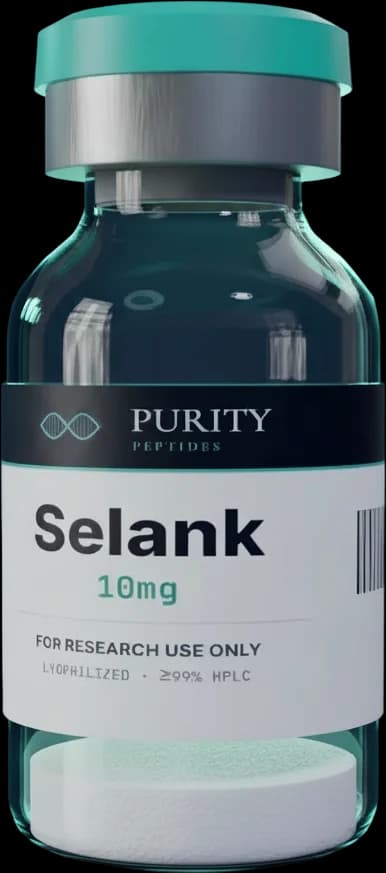
Selank is a synthetic seven-residue peptide developed at the Institute of Molecular Genetics of the Russian Academy of Sciences. It combines tuftsin — an immunomodulatory tetrapeptide (Thr-Lys-Pro-Arg) derived from immunoglobulin G — with a Pro-Gly-Pro extension that improves its metabolic stability.
Russian research groups have studied selank in animal behaviour models of anxiety and stress, and in small clinical studies of generalised anxiety, reporting anxiolytic-like effects without the sedation associated with benzodiazepines. It has been registered as a nasal preparation in Russia. Outside that setting, independent replication is limited, trial sizes have been small, and no Western regulator has evaluated the compound. Additional work has examined its effects on immune gene expression and neurotrophic factors. Selank is supplied here as a research peptide for neuroscience and neuroimmunology studies.
Mechanism studied
- Selank
- CNS (intranasal models)
- GABA / serotonin modulation
- Behavioural endpoints
Research suggests selank modulates GABAergic transmission, possibly by allosteric effects on GABA-A receptors, and influences serotonin metabolism in brain regions linked to emotional behaviour. It has also been reported to inhibit enkephalin-degrading enzymes, prolonging endogenous opioid peptide activity. In rodent studies, selank altered expression of genes involved in GABAergic signalling and increased hippocampal BDNF. Its tuftsin component contributes immunomodulatory activity, including changes in cytokine expression such as IL-6, which researchers study as a neuroimmune link.
Research highlights
- 01Tuftsin analogue stabilised with a C-terminal Pro-Gly-Pro sequence
- 02Registered in Russia; not evaluated by FDA or EMA
- 03Anxiolytic-like effects reported without sedation in animal models
- 04Linked to GABA-A modulation, enkephalinase inhibition and BDNF expression
- 05Clinical studies are small and mostly from a single country
Research areas
- Anxiety behaviour models
- GABAergic modulation studies
- Neuroimmune signalling
- BDNF expression research
Evidence & regulatory status
Overall status: Not approved — research (registered in Russia only)
Key references
- [1]Zozulya et al., 2008 — Zh Nevrol Psikhiatr Im S S Korsakova
- [2]PubMed — reviews on selank and anxiety
Latest published research
134 papers on PubMed →Trends and research clusters in artificial intelligence-assisted ultrasound-guided regional anesthesia: A bibliometric analysis
Lu X et al. · Digital health · 2026 Jan-Dec · PMID 42662121
Using nutrient limitation experiments to inform nutrient management thresholds in wadeable streams
Shupryt M et al. · Environmental monitoring and assessment · 2026 Apr 13 · PMID 41975048
Short-term nitrogen addition mediates nutrient allocation and resorption trade-offs in Populus koreana: insights for vegetation restoration on volcanic lava platform
Yin H et al. · BMC plant biology · 2026 Feb 16 · PMID 41699470
Therapeutic Peptides in Orthopaedics: Applications, Challenges, and Future Directions
Rahman OF et al. · Journal of the American Academy of Orthopaedic Surgeons. Global research & reviews · 2026 Jan 1 · PMID 41490200
Cinnamophilin ameliorates testosterone-induced prostatic hyperplasia and fibrosis by regulating 5α-reductase and TGF-β/Smad signaling pathway
Han D et al. · Iranian journal of basic medical sciences · 2026 · PMID 41641137
Efficiency in packed red blood management for brain tumor resection: multicenter prospective cohort study (TScoreBTR)
Contreras-Lopez L et al. · Blood transfusion = Trasfusione del sangue · 2026 Jan-Feb · PMID 40901795
A study of the correlation between urinary perchlorate, nitrate, thiocyanate, and serum liver function indices
Zhang W et al. · Scientific reports · 2025 Aug 18 · PMID 40825826
The effect of different carbon materials' addition on the biomethane production from food waste
Kozłowski M et al. · Scientific reports · 2025 May 28 · PMID 40436890
Live feed from PubMed (NCBI) for “Selank”, updated 2026-10-30. Listing a paper is not an endorsement of its findings.
Registered studies
2 on ClinicalTrials.gov →- Unknown
Comparing the Efficacy of tDCS and tRNS to Improve Reading Skills in Children and Adolescents With Dyslexia
NCT05832060 · Bambino Gesù Hospital and Research Institute · 2023-05-01
- Completed
Effects of Transcranial Magnetic Stimulation on Object Recognition
NCT01747200 · National Institute of Neurological Disorders and Stroke (NINDS) · 2012-11-16
From the public ClinicalTrials.gov registry for “Selank”, updated 2026-10-30. Shown for research context only; Purity Peptides products are not for human use.
FAQ
No. Selank has been registered in Russia, but it has not been approved by the FDA, EMA or other Western regulators, and independent controlled trials are lacking. The material we supply is a research reference peptide intended solely for laboratory and animal studies.
Lyophilized Selank is normally kept sealed at −20 °C, protected from light and moisture. Once reconstituted for laboratory work, aliquots are held at 2–8 °C for short-term use or frozen, avoiding repeated freeze–thaw. Follow the lot-specific guidance on the certificate of analysis.
Every lot of Selank ships with a certificate of analysis reporting HPLC purity, mass-spectrometry identity against the expected molecular weight, appearance and lot number. Match the COA lot to the vial label and keep it with your experimental records.
Last updated October 2026 · Reviewed by the Purity Peptides research team · Information is a summary of published literature and is not a recommendation for any use.