Overview
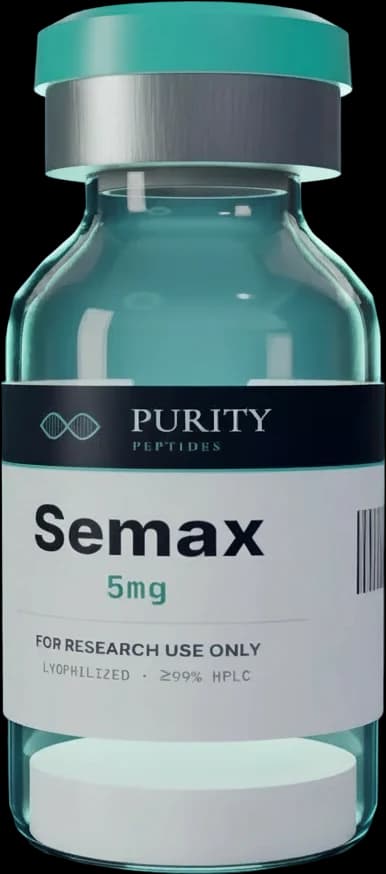
Semax is a synthetic heptapeptide composed of the ACTH(4-7) fragment (Met-Glu-His-Phe) joined to a Pro-Gly-Pro tail. It was developed in Russia in the 1980s from research showing that short ACTH fragments affect learning and attention in animals without stimulating the adrenal glands. The added tripeptide protects it from rapid enzymatic degradation.
Semax has been studied in rodent models of cerebral ischaemia, learning and memory, and in Russian clinical studies of stroke and cognitive disorders, leading to its national registration as a nasal preparation. Molecular studies have reported increased expression of brain-derived neurotrophic factor and changes in genes related to inflammation and vascular function after ischaemic injury. Western regulators have not evaluated it, and large independent trials are lacking. Semax is supplied here as a research peptide for neurotrophic and neuroprotection studies.
Mechanism studied
- Semax
- CNS (intranasal models)
- BDNF / TrkB
- Neuroprotection models
Semax lacks the corticotropic activity of full-length ACTH, so its effects are attributed to central actions rather than adrenal stimulation. In rat studies it rapidly increased BDNF and its receptor TrkB in the hippocampus and cortex, and modulated dopaminergic and serotonergic activity. Transcriptomic work in ischaemia models showed shifts in genes associated with immune response, vascular tone and neurotransmission. Melanocortin receptor interactions have been proposed, but the primary molecular target has not been conclusively identified.
Research highlights
- 01ACTH(4-7) fragment stabilised with a Pro-Gly-Pro extension
- 02No corticotropic (adrenal-stimulating) activity
- 03Increased hippocampal BDNF and TrkB reported in rat studies
- 04Registered in Russia; not evaluated by Western regulators
- 05Transcriptomic studies in rodent ischaemia models
Research areas
- Cerebral ischaemia models
- BDNF / TrkB signalling
- Learning & memory models
- Neurotrophic gene expression
Evidence & regulatory status
Overall status: Not approved — research (registered in Russia only)
Key references
- [1]Ashmarin et al., 1997 — Neurosci Behav Physiol
- [2]PubMed — reviews on semax and neuroprotection
Latest published research
217 papers on PubMed →Quantitative MRI Pharmacokinetic Modeling and MALDI Mass Spectrometry Imaging Biodistribution of a pH Mapping MRI Contrast Agent
Mohanta Z et al. · Theranostics · 2026 · PMID 42559144
Synthetic Peptides in Pharmacy Compounding: Analysis of PCAC Recommendations and Industry Safety Standards
Willis J et al. · International journal of pharmaceutical compounding · 2026 Jul-Aug · PMID 42752426
Multi-Layer Magnetic Shields Based on Fe-Based Nanocrystalline and Co-Based Amorphous Ribbons
Liang Y et al. · Materials (Basel, Switzerland) · 2026 May 11 · PMID 42195624
Digitally Guided Hybrid Maxillary Expansion with Supragingival Mandibular Miniplates for Class III Correction in Late Adolescents: A Pilot Clinical Study
Arcos I et al. · Journal of clinical medicine · 2026 Apr 17 · PMID 42074872
Therapeutic peptides in gerontology: mechanisms and applications for healthy aging
Mavrych V et al. · Frontiers in aging · 2026 · PMID 42021992
Therapeutic Peptides in Orthopaedics: Applications, Challenges, and Future Directions
Rahman OF et al. · Journal of the American Academy of Orthopaedic Surgeons. Global research & reviews · 2026 Jan 1 · PMID 41490200
[Expert Council resolution: adjunctive pharmacotherapy for hyperkinetic disorders (attention deficit hyperactivity disorder) in children and adolescents]
Lapochkin OL et al. · Zhurnal nevrologii i psikhiatrii imeni S.S. Korsakova · 2026 · PMID 42910684
[Changes in retinal light sensitivity and morphometry during surgical treatment of primary glaucoma with physiotherapeutic stimulation]
Yusef Y et al. · Vestnik oftalmologii · 2026 · PMID 42885627
Live feed from PubMed (NCBI) for “Semax”, updated 2026-10-30. Listing a paper is not an endorsement of its findings.
FAQ
No. Semax contains only the ACTH(4-7) fragment plus a stabilising tripeptide, and it does not stimulate cortisol release. Its effects in research models are attributed to central neurotrophic and neurotransmitter modulation, which is why it is studied as a neuropeptide rather than as a hormone analogue.
Lyophilized Semax is normally kept sealed at −20 °C, protected from light and moisture. Once reconstituted for laboratory work, aliquots are held at 2–8 °C for short-term use or frozen, avoiding repeated freeze–thaw. Follow the lot-specific guidance on the certificate of analysis.
Every lot of Semax ships with a certificate of analysis reporting HPLC purity, mass-spectrometry identity against the expected molecular weight, appearance and lot number. Match the COA lot to the vial label and keep it with your experimental records.
Last updated October 2026 · Reviewed by the Purity Peptides research team · Information is a summary of published literature and is not a recommendation for any use.