Overview
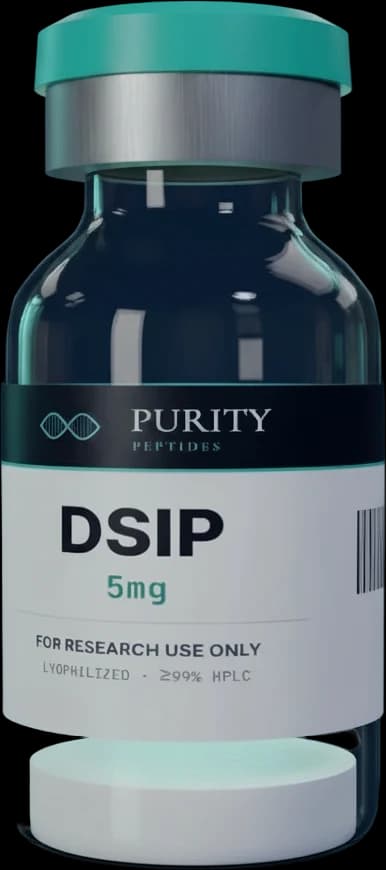
Delta sleep-inducing peptide is a nine-residue neuropeptide first isolated in 1977 from the cerebral venous blood of rabbits kept in a state of electrically induced sleep. When transferred to recipient animals, the fraction appeared to increase slow-wave (delta) EEG activity, which gave the peptide its name.
In the decades since, DSIP has been examined in a wide range of experimental settings, including sleep regulation, stress-hormone responses, pain perception, body temperature and withdrawal models. Findings have been inconsistent: some studies reproduced sleep-promoting effects, while others did not, and no dedicated receptor or gene encoding DSIP has been conclusively identified. Small human studies were conducted in the 1980s, but none led to approval. DSIP therefore remains an open research question in neuroendocrinology and is supplied here as a reference peptide for laboratory investigation only.
Mechanism studied
- DSIP
- CNS penetration
- Neuromodulation
- Slow-wave EEG
How DSIP acts is still unclear. Proposed mechanisms include modulation of GABAergic and glutamatergic transmission, interaction with adrenergic signalling, and effects on hypothalamic–pituitary hormones such as reduced corticotropin and altered LH release in animal models. The peptide appears able to cross the blood–brain barrier to a limited degree and is rapidly degraded in plasma. Without a confirmed receptor or endogenous precursor gene, researchers continue to debate whether DSIP is a true physiological sleep factor or a fragment of a larger protein.
Research highlights
- 01Isolated in 1977 from rabbits in induced slow-wave sleep
- 02Sleep-promoting effects have been reported but not consistently replicated
- 03No specific receptor or encoding gene has been conclusively identified
- 04Investigated in stress, nociception and withdrawal models
- 05Small human studies in the 1980s did not lead to clinical approval
Research areas
- Sleep architecture studies
- Stress-response neuroendocrinology
- Nociception models
- Neuropeptide pharmacology
Evidence & regulatory status
Overall status: Not approved — research
Key references
- [1]Graf & Kastin, 1986 — Neurosci Biobehav Rev
- [2]PubMed — reviews on delta sleep-inducing peptide
- [3]WADA — Prohibited List of Substances and Methods
Latest published research
463 papers on PubMed →Therapeutic Peptides in Orthopaedics: Applications, Challenges, and Future Directions
Rahman OF et al. · Journal of the American Academy of Orthopaedic Surgeons. Global research & reviews · 2026 Jan 1 · PMID 41490200
Domain-specific information preservation for Alzheimer's disease diagnosis with incomplete multi-modality neuroimages
Xu H et al. · Medical image analysis · 2025 Apr · PMID 39798527
Pichia pastoris secreted peptides crossing the blood-brain barrier and DSIP fusion peptide efficacy in PCPA-induced insomnia mouse models
Mu X et al. · Frontiers in pharmacology · 2024 · PMID 39444618
Sensing the Bactericidal and Bacteriostatic Antimicrobial Mode of Action Using Raman Deuterium Stable Isotope Probing (DSIP) in Escherichia coli
Karlo J et al. · ACS omega · 2024 Jun 4 · PMID 38854576
Practical N-to-C peptide synthesis with minimal protecting groups
Tatsumi T et al. · Communications chemistry · 2023 Oct 26 · PMID 37884638
Single-surface Intensive Phototherapy or Double-Surface Intensive Phototherapy in Neonatal Non-Hemolytic Hyperbilirubinemia: A Comparison of Effectiveness and Complications
Sabzehei MK et al. · Medical journal of the Islamic Republic of Iran · 2021 · PMID 36042828
Delta Sleep-Inducing Peptide Recovers Motor Function in SD Rats after Focal Stroke
Tukhovskaya EA et al. · Molecules (Basel, Switzerland) · 2021 Aug 26 · PMID 34500605
DSIP-Like KND Peptide Reduces Brain Infarction in C57Bl/6 and Reduces Myocardial Infarction in SD Rats When Administered during Reperfusion
Tukhovskaya EA et al. · Biomedicines · 2021 Apr 9 · PMID 33918965
Live feed from PubMed (NCBI) for “DSIP (Delta Sleep-Inducing Peptide)”, updated 2026-10-30. Listing a paper is not an endorsement of its findings.
Registered studies
1 on ClinicalTrials.gov →From the public ClinicalTrials.gov registry for “DSIP (Delta Sleep-Inducing Peptide)”, updated 2026-10-30. Shown for research context only; Purity Peptides products are not for human use.
FAQ
No dedicated receptor has been confirmed. Researchers have proposed interactions with GABA, glutamate and adrenergic signalling, but the molecular target remains unresolved. This uncertainty is one reason DSIP continues to be studied as a basic neuroscience tool rather than a characterised pharmacological agent.
Lyophilized DSIP is normally kept sealed at −20 °C, protected from light and moisture. Once reconstituted for laboratory work, aliquots are held at 2–8 °C for short-term use or frozen, avoiding repeated freeze–thaw. Follow the lot-specific guidance on the certificate of analysis.
Every lot of DSIP ships with a certificate of analysis reporting HPLC purity, mass-spectrometry identity against the expected molecular weight, appearance and lot number. Match the COA lot to the vial label and keep it with your experimental records.
Last updated October 2026 · Reviewed by the Purity Peptides research team · Information is a summary of published literature and is not a recommendation for any use.