

Research reviews
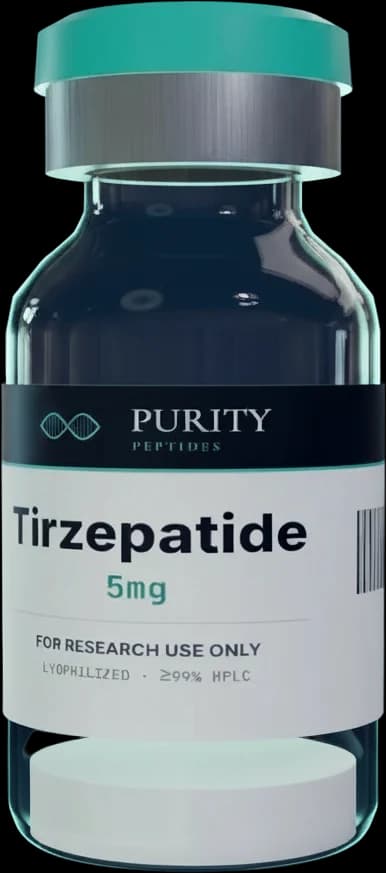
Tirzepatide Research Review: GIP/GLP-1 Dual Agonism
Tirzepatide reviewed: discovery of the GIP/GLP-1 dual agonist, its structure, biased GLP-1R signalling, the SURPASS and SURMOUNT trials and open questions.
October 30, 2026 · 6 min read · Purity Peptides research team

Tirzepatide was the first dual agonist of the glucose-dependent insulinotropic polypeptide receptor (GIPR) and the glucagon-like peptide-1 receptor (GLP-1R) to reach approval. Its development reopened a long-running question in incretin biology: what does GIP agonism actually add? This review summarises tirzepatide's discovery, its chemistry, the receptor pharmacology described in the literature, the scope of its clinical programmes and the evidence gaps that remain for researchers.
Origin and discovery
GIP was identified in the early 1970s and GLP-1 in the 1980s; together they account for the incretin effect, the larger insulin response to nutrients in the gut compared with an equivalent glucose challenge that bypasses the gut. For years GIP was considered a poor drug target because its insulinotropic action appeared blunted in type 2 diabetes. Preclinical work by several groups, including the GIP/GLP-1 co-agonist peptides described by Finan et al. (2013), suggested that combining the two signals in one molecule could outperform either alone in rodents.
Eli Lilly developed tirzepatide under the code LY3298176. Its discovery and early clinical characterisation were reported by Coskun and colleagues in Molecular Metabolism in 2018, combining receptor assays, rodent studies and phase 1 data.
Structure and chemistry
Tirzepatide is a linear peptide of 39 amino acids. Its sequence is based on native GIP but incorporates residues that confer GLP-1R activity. Two α-aminoisobutyric acid (Aib) residues, at positions 2 and 13, resist cleavage by dipeptidyl peptidase-4 (DPP-4). The C-terminus is amidated.
A C20 fatty diacid is attached to the lysine at position 20 through a linker of γ-glutamic acid and two 8-amino-3,6-dioxaoctanoic acid (OEG) groups. The diacid binds serum albumin with high affinity, which slows clearance; the reported half-life is approximately five days. The theoretical molecular weight is about 4,813.5 Da.
Because tirzepatide is long, lipidated and amphipathic, synthesis and purification are demanding. Research laboratories should verify identity by mass spectrometry and purity by HPLC with a suitable gradient, and be aware that truncated and deletion sequences can co-elute with the full-length peptide.
Receptor pharmacology and mechanism studied
Coskun et al. (2018) described tirzepatide as an "imbalanced" agonist. At the GIP receptor its affinity is comparable to native GIP; at the GLP-1 receptor its affinity is several-fold weaker than native GLP-1.
A second layer of pharmacology was described by Willard and colleagues (2020) in JCI Insight. At the GLP-1 receptor, tirzepatide favours cAMP generation over β-arrestin recruitment, a profile called biased agonism. In cell systems this was associated with reduced receptor internalisation compared with native GLP-1. Whether this bias contributes to the clinical profile is plausible but not proven.
The GIP component remains the subject of active debate:
- Central effects. GIPR is expressed in hypothalamic and hindbrain regions. Mouse studies indicate that central GIPR signalling can reduce food intake and may attenuate nausea-related pathways engaged by GLP-1R agonism (reviewed by Samms et al., 2020).
- Adipose tissue. GIPR in adipocytes is linked to lipid buffering and adipose blood flow, which may influence where lipid is stored.
- The agonist/antagonist paradox. Both GIPR agonism (tirzepatide) and GIPR antagonism combined with GLP-1R agonism (for example maridebart cafraglutide) have been associated with body-weight effects in clinical studies. One hypothesis is that prolonged agonism desensitises the receptor, functionally resembling antagonism; this remains unresolved.
Research and clinical-trial landscape
Tirzepatide has been evaluated in several large phase 3 programmes:
- SURPASS in type 2 diabetes, including SURPASS-2, which compared tirzepatide with semaglutide on HbA1c endpoints (Frías et al., 2021).
- SURMOUNT in obesity and overweight, beginning with SURMOUNT-1 (Jastreboff et al., 2022), which evaluated body-weight endpoints over 72 weeks, and including SURMOUNT-5, a head-to-head comparison with semaglutide (Aronne et al., 2025).
- SURMOUNT-OSA in obstructive sleep apnoea with obesity, which evaluated the apnoea-hypopnoea index (Malhotra et al., 2024).
- SUMMIT in heart failure with preserved ejection fraction and obesity (Packer et al., 2025).
- SYNERGY-NASH, a phase 2 trial in metabolic dysfunction-associated steatohepatitis with fibrosis (Loomba et al., 2024).
- SURPASS-CVOT, a cardiovascular outcomes trial comparing tirzepatide with dulaglutide in type 2 diabetes.
Reported adverse events across programmes were mainly gastrointestinal, consistent with the incretin class.
Evidence quality and open questions
- Strength of the evidence base. Tirzepatide is supported by multiple large, randomised, double-blind trials published in major journals, which places its evidence base well above most peptides discussed on research sites.
- Head-to-head data are limited. SURPASS-2 and SURMOUNT-5 are the main direct comparisons with semaglutide. Other comparisons across trials are confounded by design differences.
- Mechanism attribution. Separating GIP-dependent from GLP-1-dependent effects in humans is difficult. Comparisons with selective GLP-1R agonists at matched GLP-1R occupancy are not straightforward.
- Body composition. The ratio of fat to lean mass loss, and its functional significance, continues to be studied.
- Species differences. Rodent and human GIP receptors differ in their pharmacology toward some ligands, so preclinical findings in mice must be interpreted with care when extrapolating to the human receptor.
- Tolerability mechanisms. Whether GIPR agonism reduces nausea-related signalling in humans, as suggested in animal models, has not been directly established.
- Durability. Withdrawal studies such as SURMOUNT-4 examined what happens to body-weight endpoints after discontinuation; long-term maintenance remains an open research area.
Regulatory and anti-doping status
Tirzepatide is an approved prescription medicine. In the United States it is marketed as Mounjaro for type 2 diabetes and as Zepbound for chronic weight management and, more recently, for moderate-to-severe obstructive sleep apnoea in adults with obesity. It is also approved in the EU and other jurisdictions. Regulators including the FDA have issued warnings about unapproved and compounded versions, and research-grade tirzepatide is a different product intended only for in vitro and animal work.
Tirzepatide has not been named on the WADA Prohibited List at the time of writing. The list is updated annually, so researchers working with sport organisations should check the current edition.
Summary table
| Property | Tirzepatide |
|---|---|
| Code name | LY3298176 |
| Developer | Eli Lilly |
| Receptor targets | GIPR and GLP-1R |
| Pharmacology | GIP-like at GIPR; weaker than GLP-1 at GLP-1R, cAMP-biased |
| Length | 39 residues |
| Key modifications | Aib at positions 2 and 13; C20 diacid on Lys20 via γGlu-2xOEG linker |
| Molecular weight | About 4,813.5 Da |
| Reported half-life | About five days |
| Key programmes | SURPASS, SURMOUNT, SUMMIT, SURMOUNT-OSA |
| Regulatory status | Approved prescription medicine (Mounjaro, Zepbound) |
| Anti-doping | Not named on WADA list; check current edition |
References
- Coskun T, Sloop KW, Loghin C, et al. LY3298176, a novel dual GIP and GLP-1 receptor agonist for the treatment of type 2 diabetes mellitus: from discovery to clinical proof of concept. Mol Metab. 2018;18:3–14.
- Willard FS, Douros JD, Gabe MB, et al. Tirzepatide is an imbalanced and biased dual GIP and GLP-1 receptor agonist. JCI Insight. 2020;5(17):e140532.
- Finan B, Ma T, Ottaway N, et al. Unimolecular dual incretins maximize metabolic benefits in rodents, monkeys, and humans. Sci Transl Med. 2013;5(209):209ra151.
- Samms RJ, Coghlan MP, Sloop KW. How may GIP enhance the therapeutic efficacy of GLP-1? Trends Endocrinol Metab. 2020;31(6):410–421.
- Frías JP, Davies MJ, Rosenstock J, et al. Tirzepatide versus semaglutide once weekly in patients with type 2 diabetes. N Engl J Med. 2021;385:503–515.
- Jastreboff AM, Aronne LJ, Ahmad NN, et al. Tirzepatide once weekly for the treatment of obesity. N Engl J Med. 2022;387:205–216.
- Aronne LJ, Sattar N, Horn DB, et al. Continued treatment with tirzepatide for maintenance of weight reduction in adults with obesity: the SURMOUNT-4 randomized clinical trial. JAMA. 2024;331(1):38–48.
- Aronne LJ, et al. Tirzepatide as compared with semaglutide for the treatment of obesity. N Engl J Med. 2025.
- Malhotra A, Grunstein RR, Fietze I, et al. Tirzepatide for the treatment of obstructive sleep apnea and obesity. N Engl J Med. 2024;391:1193–1205.
- Packer M, Zile MR, Kramer CM, et al. Tirzepatide for heart failure with preserved ejection fraction and obesity. N Engl J Med. 2025;392:427–437.
- Loomba R, Hartman ML, Lawitz EJ, et al. Tirzepatide for metabolic dysfunction-associated steatohepatitis with liver fibrosis. N Engl J Med. 2024;391:299–310.
FOR RESEARCH USE ONLY.Not for human or veterinary use. Not intended to diagnose, treat, cure, or prevent any disease.