


Guides
Reconstitution and Storage of Lyophilized Peptides
Lab guide to lyophilized peptides: choosing a diluent, mg/mL and µL concentration math, aseptic technique, storage temperatures, freeze–thaw and light.
October 29, 2026 · 5 min read · Purity Peptides research team
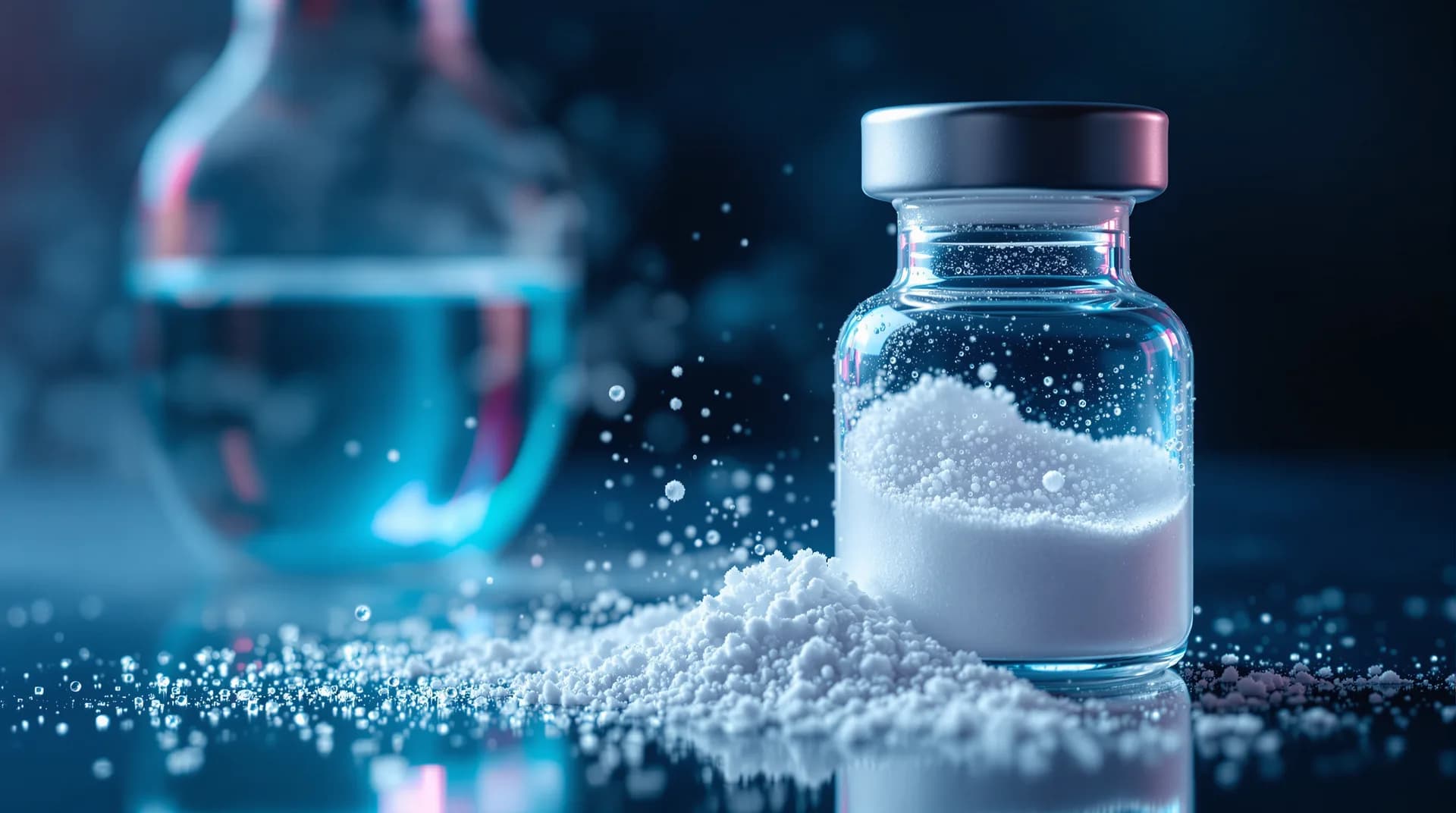
Most research peptides are supplied as a lyophilised (freeze-dried) powder. Handled correctly, they remain stable for long periods. Handled carelessly, they aggregate, oxidise or hydrolyse, and experimental results drift. This guide covers the laboratory steps from unopened vial to stored solution.
Why peptides are lyophilised
Lyophilisation removes water by freezing the solution and then sublimating the ice under vacuum. With water removed, the reactions that degrade peptides in solution (hydrolysis, deamidation of asparagine and glutamine, and oxidation) slow sharply. The result is a dry cake or film. A few milligrams can look like very little material, or may coat the vial wall rather than sit at the bottom; this is normal.
Before opening the vial
- Equilibrate to room temperature for 15–30 minutes, ideally in a desiccator. Opening a cold vial draws in moisture, which condenses on the hygroscopic powder.
- Collect the powder at the bottom with a gentle tap or a brief low-speed spin.
- Check the COA for net peptide content, counter-ion and any recommended solvent.
Choosing a diluent
| Diluent | Composition | When it is used | Considerations |
|---|---|---|---|
| Sterile water | Sterile ultrapure or WFI-grade water, no preservative | Single-use preparations; preservative-sensitive cell assays | No antimicrobial protection once the septum is pierced |
| Bacteriostatic water | Sterile water with 0.9% benzyl alcohol | Vials accessed repeatedly over several days | Benzyl alcohol can be cytotoxic in some cell culture systems |
| Dilute acetic acid | 0.1–1% acetic acid in sterile water | Basic or hydrophobic peptides that dissolve poorly at neutral pH | Dilute into buffer after dissolution if neutral pH is needed |
| DMSO, then aqueous buffer | Small volume of DMSO, diluted afterwards | Very hydrophobic sequences | Can oxidise methionine and cysteine; check assay tolerance |
A useful rule: calculate the peptide's net charge at pH 7. Net-positive (basic) peptides usually dissolve in dilute acid; net-negative (acidic) peptides in a slightly basic buffer such as dilute ammonium bicarbonate. Test solubility on a small portion first when material is limited.
Concentration math
Concentration is the peptide mass divided by the diluent volume:
Concentration (mg/mL) = peptide mass (mg) ÷ diluent volume (mL)
Because 1 mg/mL equals 1 µg/µL, the volume needed for a given mass is:
Volume (µL) = required mass (µg) ÷ concentration (µg/µL)
Worked example
A vial contains 10 mg of peptide. Adding 2.0 mL of diluent gives 10 ÷ 2 = 5 mg/mL, which is 5 µg/µL. An assay requiring 250 µg of peptide therefore needs 250 ÷ 5 = 50 µL of solution.
| Peptide mass | Diluent volume | Concentration | Volume containing 250 µg |
|---|---|---|---|
| 5 mg | 2.0 mL | 2.5 mg/mL | 100 µL |
| 10 mg | 1.0 mL | 10 mg/mL | 25 µL |
| 10 mg | 2.0 mL | 5 mg/mL | 50 µL |
| 10 mg | 3.0 mL | 3.33 mg/mL | 75 µL |
| 10 mg | 5.0 mL | 2 mg/mL | 125 µL |
Two refinements matter for quantitative work. First, the label mass is usually gross powder mass; correct for net peptide content from the COA if molar accuracy matters. Second, larger volumes reduce pipetting error for small aliquots. Our reconstitution calculator performs these conversions and shows the working.
Aseptic technique
- Work in a biosafety cabinet or laminar-flow hood.
- Wipe the vial septum with 70% isopropyl alcohol and let it dry completely.
- Use sterile, single-use transfer devices and pipette tips.
- Add diluent slowly down the inside wall of the vial, not directly onto the powder.
- Swirl or roll gently. Do not shake or vortex. Agitation creates foam and air–liquid interfaces that promote aggregation.
- Allow 5–15 minutes to dissolve fully, then inspect against a dark background. A clear, particle-free solution is expected; cloudiness suggests the solvent needs adjusting.
- Where sterility is required, filter through a 0.22 µm low-protein-binding membrane (PES or PVDF).
- Label the vial with peptide, batch, diluent, concentration and date.
Storage temperatures
| State | Recommended condition | Typical stability window |
|---|---|---|
| Lyophilised, long term | −20 °C or below, desiccated, dark | Months to years; −80 °C for extended archiving |
| Lyophilised, short term | 2–8 °C | Weeks |
| Lyophilised, in transit | Ambient | Days, for most sequences |
| Reconstituted, working solution | 2–8 °C | Days to a few weeks; sequence-dependent |
| Reconstituted, longer term | Single-use aliquots at −20 °C or −80 °C | Weeks to months |
Stability is sequence-specific. Peptides containing cysteine, methionine, tryptophan, asparagine or glutamine are generally less stable in solution.
Freeze–thaw
Each freeze–thaw event exposes the peptide to ice–liquid interfaces and local concentration changes that drive aggregation. Divide stock solutions into single-use aliquots before freezing, and thaw each aliquot once. Avoid frost-free freezers, which warm periodically to clear ice.
Light and oxidation
Tryptophan and tyrosine are susceptible to photo-oxidation; methionine and cysteine to oxidation by air. Store vials in the original carton or wrap them in foil, and use amber tubes for aliquots. For oxidation-prone sequences, minimise headspace or overlay with nitrogen or argon.
Checklist
- Warm the vial to room temperature before opening.
- Choose the diluent from the sequence and the assay.
- Calculate concentration in mg/mL and aliquot volumes in µL.
- Dissolve gently, inspect and label.
- Store cold, dark and dry; aliquot before freezing.
References
- Wang W. Lyophilization and development of solid protein pharmaceuticals. Int J Pharm. 2000;203(1–2):1–60.
- Manning MC, Chou DK, Murphy BM, Payne RW, Katayama DS. Stability of protein pharmaceuticals: an update. Pharm Res. 2010;27(4):544–575.
- Frokjaer S, Otzen DE. Protein drug stability: a formulation challenge. Nat Rev Drug Discov. 2005;4(4):298–306.
FOR RESEARCH USE ONLY.Not for human or veterinary use. Not intended to diagnose, treat, cure, or prevent any disease.