



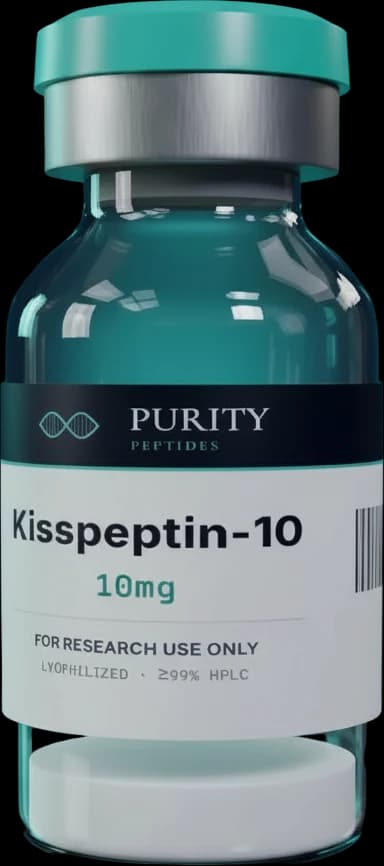
Overview
Kisspeptin-10 is the C-terminal decapeptide of kisspeptin, a family of peptides encoded by the KISS1 gene. Originally studied as a metastasis suppressor (hence the alternative name metastin), kisspeptin moved to the centre of reproductive biology in 2003, when loss-of-function mutations in its receptor were found to cause failure of puberty in humans.
Kisspeptin-10 is the shortest fragment that retains full receptor activity and has been studied extensively in both animals and humans. Clinical research studies have shown that it rapidly stimulates LH secretion in healthy volunteers and in people with certain forms of hypogonadism, providing insight into how the brain controls the reproductive axis. Longer forms, such as kisspeptin-54, have been investigated for triggering egg maturation in IVF. Kisspeptin-10 is not an approved medicine and is supplied here as a research peptide for neuroendocrine studies.
Mechanism studied
- Kisspeptin-10
- KISS1R (GPR54)
- GnRH neurons
- LH & FSH
Kisspeptin-10 binds KISS1R (formerly GPR54), a Gq-coupled receptor expressed on hypothalamic GnRH neurons. Receptor activation depolarises these neurons and stimulates GnRH release into the pituitary portal circulation, which in turn drives secretion of LH and, to a lesser extent, FSH. Kisspeptin neurons in the arcuate nucleus are thought to form part of the GnRH pulse generator, integrating signals from sex steroids, metabolism and stress. Prolonged exposure can desensitise the receptor, an effect studied in its own right.
Research highlights
- 01Shortest kisspeptin fragment with full KISS1R agonist activity
- 02KISS1R mutations identified in 2003 as a cause of absent puberty
- 03Human research studies show rapid stimulation of LH secretion
- 04Studied as a probe of the hypothalamic GnRH pulse generator
- 05Related kisspeptin-54 investigated for oocyte maturation in IVF research
Research areas
- GnRH pulse generator research
- LH secretion studies
- Puberty onset models
- Hypothalamic amenorrhoea research
Evidence & regulatory status
Overall status: Not approved — research
Key references
- [1]Jayasena et al., 2014 — J Clin Invest
- [2]PubMed — reviews on kisspeptin and reproduction
Latest published research
418 papers on PubMed →Kisspeptin-10/basal LH ratio improves differentiation of central precocious puberty and premature thelarche
Banerjee AA et al. · Clinica chimica acta; international journal of clinical chemistry · 2027 Jan 1 · PMID 42364891
Regulation of PACAP gene expression by ovarian sex steroids and kisspeptin: Study using hypothalamic cell lines and an in vivo female rat model
Tumurbaatar T et al. · Biochemistry and biophysics reports · 2026 Dec · PMID 42936012
Kisspeptin-10 alleviates OGD/R-induced H9c2 cardiomyocyte injury by triggering autophagy via regulating the YY1/TFEB axis
Li Q et al. · Cytotechnology · 2026 Dec · PMID 42871171
The kisspeptin analog C6 elicits greater tachyphylaxis and transcriptional activation than kisspeptin-10 and -54
Robert V et al. · Molecular and cellular endocrinology · 2026 Oct · PMID 42379494
Kisspeptin-10 Alleviates Obesity-induced Testicular Oxidative Stress and Mitochondrial Dysfunction via Modulation of Mitophagy and Autophagy Signaling
Arkalı G et al. · Reproductive sciences (Thousand Oaks, Calif.) · 2026 Sep 28 · PMID 42806235
Enzymatic Stability and Comparative Effects of Kisspeptin-14, Kisspeptin-13 and Kisspeptin-10 on Beta-Cell Function, Glucose Homeostasis and Appetite Regulation
Spratt JA et al. · Metabolites · 2026 Sep 17 · PMID 42783811
Maternal Kisspeptin-10 Treatment Partially Rescues Fetal and Postnatal Cardiac Programming Disrupted by Maternal Hypothyroidism
Barbosa EM et al. · Cardiovascular toxicology · 2026 Sep 11 · PMID 42726152
Structural basis for Kisspeptin-10 selectivity toward KISS1R: computational insights
Netesa MA et al. · In silico pharmacology · 2026 · PMID 42707558
Live feed from PubMed (NCBI) for “Kisspeptin-10”, updated 2026-10-30. Listing a paper is not an endorsement of its findings.
Registered studies
5 on ClinicalTrials.gov →- WithdrawnPhase 1
Evaluation of Kisspeptin Stimulated Insulin Secretion With Hyperglycemic Clamp
NCT05456854 · Massachusetts General Hospital · 2022-06-03
- WithdrawnPhase 1
Evaluation of Kisspeptin Glucose-Stimulated Insulin Secretion With Physiologic Mixed Meal Tolerance
NCT04532801 · Stephanie B. Seminara, MD · 2019-09-01
- CompletedPhase 3
KP-10 and Insulin Secretion in Men
NCT03771326 · Quaid-e-Azam University · 2013-10-29
- CompletedPhase 3
Age-dependent Changes in the Responsiveness of Hypothalamic Pituitary Gonadal Axis in Men
NCT03315325 · Quaid-e-Azam University · 2014-08-08
- CompletedPhase 3
Link Between the Sensitivity of Kisspeptin Signalling and Pubertal Onset in Boys.
NCT03286517 · Ghulam Nabi · 2014-06-26
From the public ClinicalTrials.gov registry for “Kisspeptin-10”, updated 2026-10-30. Shown for research context only; Purity Peptides products are not for human use.
FAQ
Both are cleaved from the same KISS1 precursor and activate the same receptor. Kisspeptin-10 is the minimal active C-terminal fragment and is cleared quickly, while the 54-residue form circulates longer. Researchers select the fragment based on how long receptor activation needs to persist in a given model.
Lyophilized Kisspeptin-10 is normally kept sealed at −20 °C, protected from light and moisture. Once reconstituted for laboratory work, aliquots are held at 2–8 °C for short-term use or frozen, avoiding repeated freeze–thaw. Follow the lot-specific guidance on the certificate of analysis.
Every lot of Kisspeptin-10 ships with a certificate of analysis reporting HPLC purity, mass-spectrometry identity against the expected molecular weight, appearance and lot number. Match the COA lot to the vial label and keep it with your experimental records.
Last updated October 2026 · Reviewed by the Purity Peptides research team · Information is a summary of published literature and is not a recommendation for any use.