


Overview
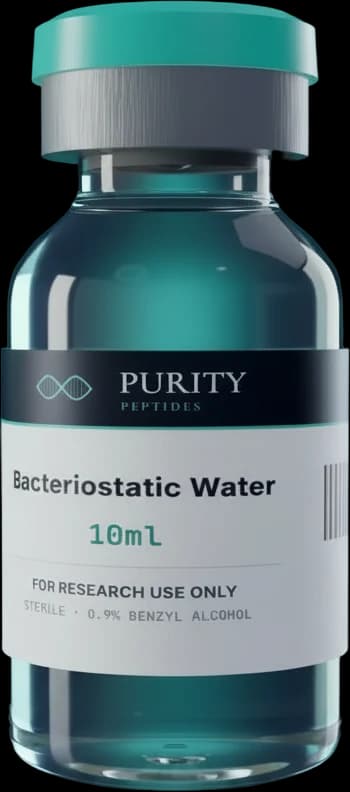
Sterile water containing 0.9% benzyl alcohol, which inhibits bacterial growth in vials that are accessed repeatedly.">Bacteriostatic water is sterile water containing 0.9% (9 mg/mL) benzyl alcohol as a preservative. The benzyl alcohol inhibits the growth of most bacteria introduced during repeated needle entry, allowing a sealed vial to be accessed multiple times over a limited period, unlike single-use sterile water.
In peptide research, it is the most commonly used diluent for reconstituting lyophilized material into stock solutions. Most peptides dissolve readily in it, although some hydrophobic or aggregation-prone sequences may require dilute acetic acid or another solvent, and benzyl alcohol can interfere with certain cell-based or enzymatic assays. Researchers should therefore confirm compatibility with their experimental system. Our bacteriostatic water is supplied in sealed, sterile vials as a laboratory supply. It is a diluent only, not a research compound, and is not intended for human or veterinary use.
Mechanism studied
- Lyophilized peptide
- Add diluent
- Gentle dissolution
- Research-ready solution
Sterile water containing 0.9% benzyl alcohol, which inhibits bacterial growth in vials that are accessed repeatedly.">Bacteriostatic water does not act on biological targets; its function is physical and antimicrobial. Water serves as the solvent that rehydrates lyophilized peptide powder into solution. The 0.9% benzyl alcohol disrupts microbial cell membranes and inhibits bacterial growth, preventing proliferation of organisms that may be introduced when a vial stopper is punctured repeatedly. It is bacteriostatic rather than sterilising, so aseptic technique remains essential. Benzyl alcohol is a small aromatic alcohol that is compatible with most peptides but can affect sensitive biological assays.
Research highlights
- 01Sterile water with 0.9% benzyl alcohol as a bacteriostatic preservative
- 02Allows multiple withdrawals from one vial over a limited period
- 03Standard diluent for reconstituting lyophilized research peptides
- 04Benzyl alcohol may be incompatible with some cell or enzyme assays
- 05Supplied sealed and sterile; laboratory use only
Research areas
- Reconstitution of lyophilized peptides
- Multi-withdrawal vial preparation
- Stock solution preparation
- Laboratory dilution
Evidence & regulatory status
Overall status: Laboratory supply — not a research compound
Key references
- [1]USP–NF monograph — Bacteriostatic Water for Injection
- [2]Benzyl alcohol as an antimicrobial preservative — USP <51> Antimicrobial Effectiveness Testing
FAQ
Store unopened vials at controlled room temperature, about 20–25 °C, away from direct light. Once the stopper has been punctured, common laboratory practice is to discard the vial after 28 days or sooner if the solution becomes cloudy or the seal is compromised.
Use preservative-free sterile water or another solvent when benzyl alcohol could interfere with the experiment, for example in sensitive cell cultures or enzyme assays, or when a peptide's data sheet specifies a different solvent. Check the compound's certificate of analysis for reconstitution guidance.
Allow the peptide vial to reach room temperature, then add the diluent slowly down the inside wall of the vial rather than directly onto the powder. Swirl gently until dissolved; avoid vigorous shaking, which can cause foaming and aggregation. Label the vial with the date and concentration.
Last updated October 2026 · Reviewed by the Purity Peptides research team · Information is a summary of published literature and is not a recommendation for any use.